

Local SEO for Real Estate Agents: The Complete 2025 Authority Guide
Last Updated: October 2025
Real estate is local. Buyers search for homes in specific neighborhoods. Sellers want an agent who knows their street. Yet most agents compete on impossible national keywords while local SEO—the discipline that captures high-intent, geographically-constrained searches—remains underutilized.
The reality is clear: 76% of people who perform a local search on a smartphone visit a place within a day, and 28% make a purchase. Industry roundups estimate ~42% of local search clicks go to the Google Map Pack—the battleground where many local deals are won.
This guide equips you with actionable local SEO strategies proven to rank agents in the Local Pack, generate qualified leads, and build sustainable market dominance. Whether you’re a solo agent or managing a brokerage, these tactics work at every scale.
What Is Local SEO for Real Estate Agents?
Local SEO is the discipline of optimizing your online presence to rank prominently in location-specific search results. For real estate, this means appearing when someone searches “homes for sale in [neighborhood],” “real estate agent near me,” or “[city] market trends.”
Unlike traditional SEO—which targets national keywords and builds broad authority—local SEO focuses on geographic constraint and transactional intent. According to surveyed local marketing professionals, the most impactful ranking factors on Google’s local pack include the primary Google Business Profile category, keywords in the Google Business Profile title, and the proximity of address to the point of search.
The difference is critical: a buyer searching “real estate tips” might be researching from anywhere. A buyer searching “homes for sale in Oakwood Heights” is ready to transact. Local SEO captures the latter.
Key Takeaway: Focus on hyper-local, long-tail keywords where you can realistically rank and where buyer intent is highest.
Why Local SEO Matters Now
The Digital Home Search Reality
Nearly 90% of home buyers rely on professional agents during the purchase process, yet the path to finding that agent starts online. According to research from Google and Ipsos, customers are 2.7x more likely to view a business as reputable if it has a complete Google Business Profile, and businesses with a complete GBP are 50% more likely to be considered by customers for potential purchases.
60% of mobile users have reached out to a business directly using the search results, and these interactions happen in seconds. If you’re not visible in local results when a buyer or seller searches, a competitor is capturing that lead.
Competing Against National Portals
Zillow, Realtor.com, and Redfin dominate broad keywords like “homes for sale” and “real estate.” Direct competition is unwinnable for individual agents.
The solution: dominate neighborhood-specific searches where local expertise is essential. Instead of competing for “homes for sale,” own “homes for sale in Oakwood Heights.” Instead of “real estate agent,” own “real estate agent specializing in first-time buyers in Downtown [City].”
Key Takeaway: You can’t beat the portals at their game. Win by playing a different game—hyper-local authority.
Google Business Profile (GBP): Your Foundation
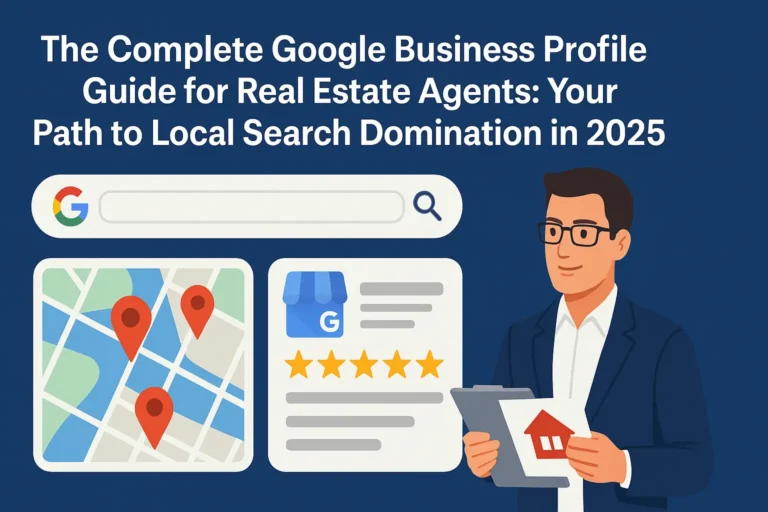
Google Business Profile is the single most influential asset in your local SEO toolkit. According to surveyed marketers, the most impactful ranking factors on Google’s local pack include the primary Google Business Profile category, keywords in the Google Business Profile title, and the proximity of address to the point of search.
💡 Watch: Step-by-step Google Business Profile setup that helps realtors rank faster and attract ready-to-act buyers.
Setup & Compliance (Critical for Avoiding Suspension)
Address Eligibility
- Physical Offices: Must have a fixed, permanent location with visible signage and staff during stated hours.
- Service-Area Businesses (SABs): Agents working from home must hide their residential address and clearly define service areas.
- NOT Eligible: P.O. boxes, virtual offices, or shared mailboxes.
Business Naming Use format: “[Your Name] – Real Estate Agent” or “[Your Name] – Realtor.” Never include keywords like “Best Realtor in [City]”—this violates Google’s policy and risks suspension.
One Profile Per Location Individual practitioners (including real estate agents) may have their own Business Profile if they meet GBP practitioner guidelines. Brokerages with multiple physical offices can have separate profiles per location (each with independent staffing).
Verification Claim your profile in the Google Business Profile dashboard and complete verification (phone, video, or postcard). Ensure your NAP (Name, Address, Phone) is identical across all platforms.
Optimization for Lead Generation
High-Quality Visuals Upload professional photos: headshot, 5–10 property photos, office/team photos, and 1–2 short video tours (30–60 seconds). For your website, use descriptive filenames and alt text with hyper-local keywords (e.g., “homes-for-sale-oakwood-heights.jpg”). For GBP, prioritize quality, recency, and relevance—keywords in filenames and alt text don’t affect GBP rankings.
Business Description Lead with your unique value proposition in 750 characters. Example: “10+ years helping [City] families buy and sell homes. Specializing in [neighborhood]-area properties and first-time buyer guidance. Free consultation available.”
Service Area Definition If you work from home, set up as a Service-Area Business, hide your address, and add cities or ZIP codes you serve (Google will display a polygon of your coverage).
Interactive Features
- Google Posts: Post 2–3 times per week (new listings, market updates, local events). Each post should include images and link back to your website.
- Q&A Section: Pre-populate 10+ questions (e.g., “What’s the average home price in [Neighborhood]?”). Answer with hyper-local keywords and links to your website.
- Messaging: Enable and set auto-reply for after-hours inquiries.
Key Takeaway Box
✓ Address eligible and verified
✓ Correct business naming (no keyword-stuffing)
✓ One profile per business/location
✓ GBP fully optimized with visuals and active engagement
Hyper-Local Content Strategy: Your Competitive Moat
National portals excel at volume. They can’t compete on neighborhood-specific expertise. This is your advantage.
💡 Watch: 8 Local SEO hacks realtors are using right now to dominate local map rankings.
Pillar Content: Neighborhood Guides
Create comprehensive neighborhood guides targeting “[City] Real Estate” and “[Neighborhood] Homes for Sale.”
Structure:
- Neighborhood overview (community vibe, history)
- Housing market data (average price, days on market, trends)
- Schools & education (link to district websites, ratings)
- Amenities & recreation (parks, shopping, dining)
- Transportation (public transit, nearby employers)
- Featured listings (IDX grid, active inventory)
- Client testimonials (case studies with photos)
Fair Housing Compliance: Never make subjective claims about neighborhood quality, safety, or demographics. Instead, link to objective third-party sources: school rating websites, public crime statistics, walkability tools (Walkscore.com), and tax information.
Update Cadence: Quarterly market updates, monthly neighborhood highlights, annual content refreshes.
Local Keyword Strategy
High-Intent Keywords to Target:
- “Homes for sale in [neighborhood]”
- “Luxury homes in [neighborhood]”
- “[Property type] for sale in [neighborhood]”
- “Best schools in [neighborhood]”
- “Real estate agent in [neighborhood]”
- “[Neighborhood] market trends 2025”
Low-Competition Niches:
- “[Neighborhood] [specific property type]” (e.g., “Oakwood Heights co-ops”)
- “First-time home buyer [city]”
- “[Property type] for sale near [specific school/landmark]”
Focus Strategy: Allocate 70% of content efforts to long-tail, neighborhood-specific keywords where you can realistically rank. Use the remaining 30% for broader city-level terms.
Key Takeaway: Hyper-local content ranks faster, converts better, and compounds over time. This is where agents beat national portals.
Technical Foundation: Schema Markup & Speed
Schema Markup (Structured Data)
Schema tells Google exactly what content is on your page, enabling rich snippets and featured snippet placement.
Critical Schema Types for Real Estate:
LocalBusiness Schema (Homepage, contact page) Validates local authority and NAP consistency. Use on all core pages.
RealEstateAgent Schema (Agent bio/team pages) Enhances SERP display and builds personal brand authority.
Residence/SingleFamilyResidence Schema (Property listing pages) Enables rich snippets (price, beds/baths) in search results—pre-qualifies leads and increases click-through rate.
FAQPage Schema (Neighborhood guides, blog posts) Captures “People Also Ask” features; improves featured snippet chances.
BreadcrumbList Schema (All pages) Improves crawlability and SERP display.
Implementation Note: For property listing markup, confirm current rich-result support in Google’s Search Central documentation. Not all schema types generate special results, and support evolves regularly.
Implementation Checklist:
- Install schema for all core content types
- Use Google Rich Results Test to validate
- Connect entities via @id tags (RealEstateAgent → Service Area)
- Monitor Core Web Vitals for performance impact
Mobile Optimization & Page Speed
60% of mobile users have reached out to a business directly using the search results. Mobile optimization is non-negotiable.
Essential Checklist:
- Responsive design (adapts to all screen sizes)
- Fast loading (target: under 2 seconds)
- Touch-friendly buttons and navigation
- Compressed images (WebP format preferred)
- Lazy-loading for images
- No intrusive pop-ups on initial load
Test Tools: Google PageSpeed Insights, GTmetrix, WebPageTest.
Common Real Estate Issues: Heavy IDX feeds, unoptimized property photos, slow third-party integrations.
Citations, Reviews & Local Trust Signals
NAP Consistency: The Foundation
NAP = Name, Address, Phone number. Inconsistent NAP confuses search engines and splits your authority.
NAP Audit Checklist:
- List all platforms where your NAP appears
- Standardize format across all platforms
- Use citation management services (Moz Local, BrightLocal) for monitoring
Top Priority Directories: Google Business Profile, Zillow, Realtor.com, Yelp, Facebook, LinkedIn, Yellow Pages, Chamber of Commerce.
Audit quarterly. This is ongoing maintenance, not a one-time fix.
Review Generation & Management
75% of consumers say they “always” or “regularly” read online reviews when researching local businesses.
Compliant Review Strategy: After closing, send clients an email with a direct link to your GBP review page. Example template:
“Thanks for working with me on your recent [purchase/sale]. I’d be grateful if you’d take 2 minutes to share your experience on Google: [GBP review link]. Positive reviews help me grow my business.”
Never pay for reviews or offer incentives—this violates platform policies.
Multi-Platform Approach: Primary: Google Business Profile (most important for local SEO)
Secondary: Zillow, Realtor.com (industry-specific)
Tertiary: Yelp, Facebook (credibility signals)
Response Protocol: Respond to all reviews within 24–48 hours. Thank positive reviewers and address negative reviews professionally, offering to discuss offline.
Keyword Injection (Ethical): Gently encourage clients to mention specifics naturally in reviews. Example: “We loved working with Jane on our condo sale in Downtown!” This reinforces hyper-local relevance.
Measurement & ROI Tracking
Defining Success
Revenue Metrics (What Matters):
- GBP phone calls (high intent)
- Website clicks from GBP
- Conversion rate (clicks → qualified leads)
- Cost per closing from local SEO
- Closed deals attributed to local SEO
Vanity Metrics (Ignore These):
- Website traffic volume
- Rankings for specific keywords
- GBP views (views without actions are worthless)
Tracking Setup
Google Search Console: Monitor queries, track keyword positions, identify CTR opportunities.
Google Analytics 4: Track organic traffic from search, conversion paths, lead form submissions.
GBP Insights: Review monthly: views, calls, clicks, directions, Q&A interactions.
CRM Tracking: Tag all leads by source (GBP, organic search, etc.). Track conversion rate by source. Calculate cost per closing by source.
Rank Tracking Tools: Local Falcon (GBP-specific), Semrush/Ahrefs (organic keywords), BrightLocal (citations + rank tracking).
Example Dashboard: Track these metrics monthly: GBP phone calls/month, GBP website clicks/month, organic traffic, conversion rate (GBP → lead), cost per closing, closed deals from local SEO.
Common Mistakes & How to Avoid Them
Mistake 1: Competing on Broad Keywords Many agents waste time competing with Zillow on generic terms. Instead, own neighborhood-specific keywords where you have genuine expertise.
Mistake 2: Neglecting Mobile Optimization 60% of home buyers search on mobile. A slow, non-responsive site = lost leads. Prioritize mobile speed and design.
Mistake 3: Inconsistent NAP Information Inconsistent business names, phone formats, or addresses split your authority across multiple listings. Audit and standardize everything.
Mistake 4: Ignoring GBP Interactive Features GBP is a content platform, not just a listing. Regular posts, Q&A answers, and messaging signal relevance and keep your profile visible.
Mistake 5: Focusing on Quantity Over Quality One high-quality, hyper-local neighborhood guide outperforms five generic city pages. Depth beats breadth.
90-Day Action Plan
Weeks 1–2:
- Claim and verify your GBP profile
- Audit NAP consistency across all platforms
- Complete GBP optimization (description, photos, categories)
- Set up Google Search Console and Analytics
Weeks 3–6:
- Conduct keyword research for target neighborhoods
- Create outline for 3–5 pillar neighborhood guides
- Begin citation cleanup and consolidation
- Implement LocalBusiness schema on homepage
Weeks 7–12:
- Publish first pillar neighborhood guide
- Begin bi-weekly GBP posts (2–3 posts/week)
- Generate first batch of client reviews (post-closing emails)
- Start local link building outreach (1–2 local sources per week)
Expected Outcomes:
- GBP visibility increase within 2–4 weeks
- First neighborhood guide ranking within 6–8 weeks
- Measurable lead increase by week 12 (2–5 qualified leads/month from local SEO)
Frequently Asked Questions
Q: How long does local SEO take to work? A: Initial ranking improvements within 3–6 months. Meaningful lead volume typically by 6–12 months. This varies by market competitiveness. Quick wins (GBP optimization, citations cleanup) generate leads within weeks.
Q: Can I really compete with Zillow as an individual agent? A: Yes, but only on neighborhood-specific searches. Focus on hyper-local, long-tail keywords (e.g., “homes for sale in Oakwood Heights near top-rated schools”) where local expertise matters and competition is lower.
Q: What happens if my GBP gets suspended? A: Most common causes: using a virtual office/P.O. box, keyword-stuffing in business name, duplicate profiles, or violating review policies. Check Google’s guidelines for your business type. If suspended, submit an appeal with supporting documentation.
Q: How do I set up a GBP as a solo agent working from home? A: Set up as a Service-Area Business (SAB), hide your home address from public view, clearly define your service area, verify via phone/video, and use your phone number for contact.
Q: Should I hire an SEO professional or do it myself? A: Do-it-yourself if you have 10+ hours/week and budget under $3,000/month. Hire a professional if your time is better spent on sales, you work in a competitive market, or your budget allows $3,000–$8,000/month.
Q: What metrics should I track? A: Monthly: GBP calls/clicks, organic traffic, keyword rankings, new reviews. Quarterly: conversion rates, cost per lead, cost per closing. Annual: ROI comparison vs. other marketing channels.
Conclusion
Local SEO is the foundational digital strategy for real estate agents because home buyers search locally with high transactional intent. Agents who dominate local search results dominate their markets.
Success requires three integrated strategies:
- Compliance & Foundation: Optimize your GBP fully and maintain strict compliance with Google’s policies to avoid suspension.
- Hyper-Local Content: Create neighborhood-specific guides and content that national portals can’t replicate—this is your competitive moat.
- Consistent Execution: Maintain consistent NAP information, generate reviews systematically, optimize for mobile, and track revenue-generating metrics.
The data confirms this investment yields substantial returns. Agents who implement local SEO see measurable business growth within 6–12 months, with compounding returns over time.
Start this week. Claim your GBP, audit your NAP consistency, and outline your first neighborhood guide. Your future self will thank you for starting today.
Sources Cited:
- Google Business & Google/Ipsos Research – 76% of smartphone local searches lead to a place visit within a day; 28% make a purchase; 60% of smartphone users contact a business directly from search results
- National Association of REALTORS (NAR), 2024 Profile of Home Buyers & Sellers – 88% of buyers purchased their home through a real estate agent or broker
- Backlinko, “24 Must-Know Local SEO Statistics for 2025” – Local Pack click-share estimates and local search ranking factors (primary category, keywords in GBP title, proximity)
- Google Business Profile Official Guidelines – Compliance, setup requirements, service-area business rules, practitioner guidelines
- Google for Developers – Technical implementation, mobile optimization, image best practices
- Google Search Central – Schema markup support and rich result documentation
- Industry best practices from real estate marketing professionals and SEO experts

One Comment