US Rental Vacancy Rate 2025: What Record-High Numbers Mean for Your Investment Strategy
Last updated: December 11, 2025
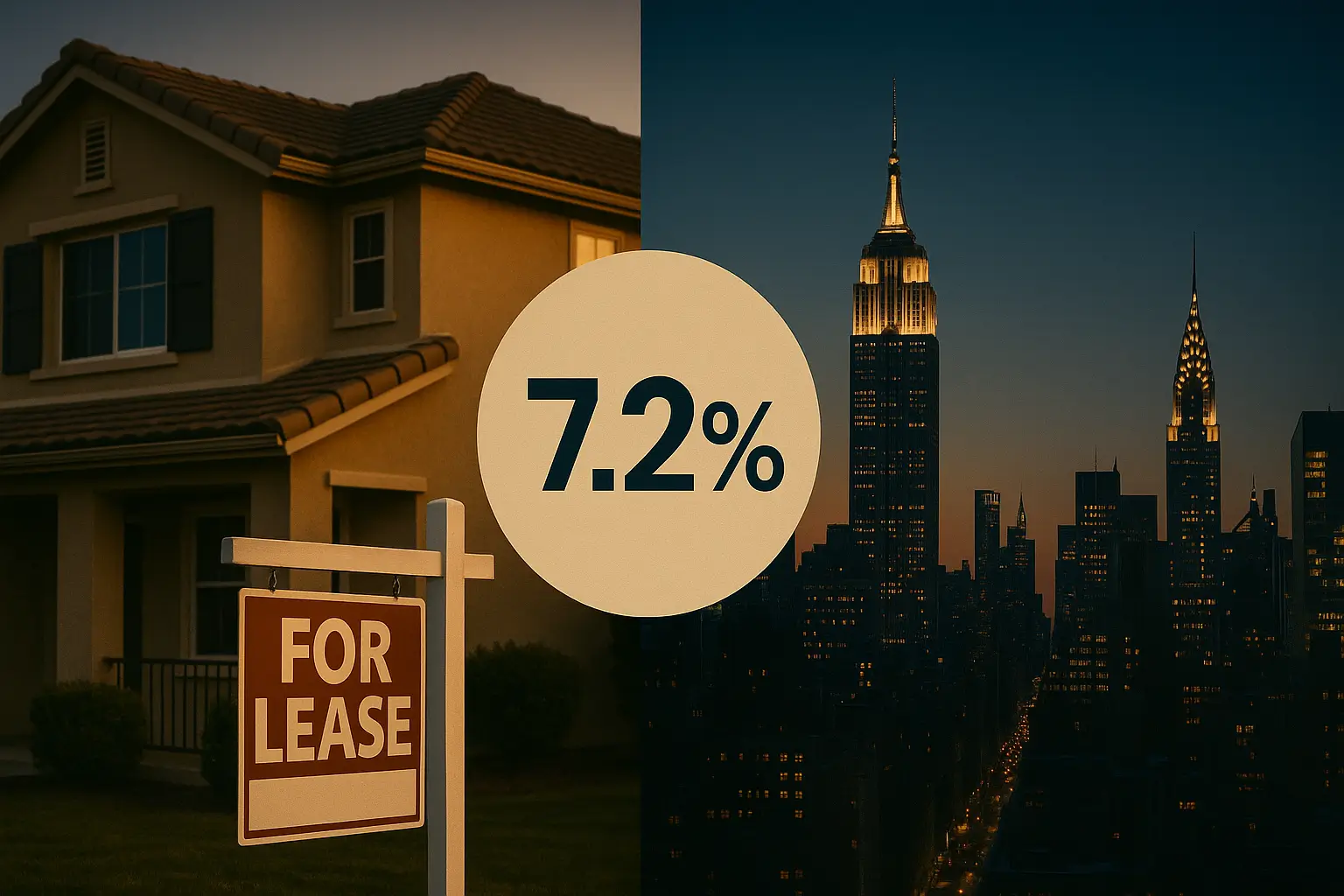
National rental vacancy reached 7.2% in December 2025—the highest level in recent history according to multifamily tracking data. That number hides big differences across metros. Read on for a short national snapshot, metro winners and losers, and clear playbooks for investors, landlords, and renters.
30-Second TL;DR
📊 The National Picture:
- 7.2% US rental vacancy rate (Dec 2025)—highest in nearly a decade per Census Bureau data
- Why it happened: Construction boom (2022-2024) delivered 406,000+ units while demand weakened from high interest rates and student loan resumption
- Your action: Sun Belt investors—buy at 15-25% discounts; Coastal investors—hold for continued rent growth; Renters in Vegas/Austin—negotiate aggressively
Understanding the US Rental Vacancy Rate 2025: The Numbers Explained
What the Official Data Shows
The US rental vacancy rate for 2025 reached unprecedented levels:
- Q2 2025: 7.0% (Census Bureau CPS/HVS)
- Q3 2025: 7.1% (Census Bureau)
- December 2025: 7.2% (multifamily tracking services)
- Historical Context: Federal Reserve FRED data shows this represents the highest level since at least 2017
What this means: Approximately 1 in 14 rental units sits empty nationwide—substantially higher than the 5% threshold economists consider balanced.
How to Reconcile Different Vacancy Sources
Different sources report slightly different US rental vacancy rate 2025 figures. Here’s the quick guide:
| Source | Q2-Q3 2025 Figure | What It Measures | Best Use |
|---|---|---|---|
| Census Bureau HVS | 7.0-7.1% | All rental housing (single-family, multifamily, mobile homes) | Official year-over-year comparisons |
| FRED | 7.0% (Census data) | Republishes Census | Historical charts, downloadable datasets |
| Zillow ZORI / ApartmentList | 7.1-7.2% | Professionally managed multifamily only | Metro-specific insights, real-time pulse |
Quick takeaway: Use Census/FRED for authoritative national trends. Use Zillow/ApartmentList for local market intelligence. Proprietary measures run 0.1-0.3 percentage points higher because they exclude single-family rentals.
Why Did the US Rental Vacancy Rate Surge in 2025?
Driver #1: The Construction Boom Created Oversupply
The record US rental vacancy rate 2025 stems primarily from a multifamily construction wave delivering massive inventory between 2022-2024.
The numbers:
- June 2025: 406,000 units annualized completions
- June 2024: 656,000 units
- Year-over-year change: -38.1% decline (Census construction data)
Regional breakdown:
- Midwest: -55.7% (steepest pullback)
- South: -33.5% (Sun Belt correction)
- Northeast: -33.0%
- West: -28.9%
What this means for investors: Construction slowdown will ease oversupply by late 2026. Markets showing the steepest permit declines today will tighten first.
Driver #2: Demand Weakened on Multiple Fronts
Elevated Interest Rates
- Mortgage rates stayed above 6% through 2025
- Reduced household formation and relocation
Student Loan Resumption
- Payment pause ended late 2023
- Millions now paying $100-300+ monthly
- For a $50,000 earner, that’s 6% of gross income unavailable for housing
Migration Pattern Normalization
- Pandemic-era Sun Belt migration reversed 2024-2025
- Markets that gained population rapidly (Austin, Phoenix, Las Vegas) saw slowdowns
Slowing Household Formation
- Census Bureau data shows renters at 35% of households (six-year high)
- But growth rate slowed versus 2022-2023 peaks
Driver #3: Tariff Impact on Construction
June 2025: Steel and aluminum tariffs doubled from 25% to 50%
Impact:
- Development costs rose 8-12%
- Midwest showed -55.7% in permitting changes year-over-year
- Widespread project cancellations
Strategic implication: Suppressed starts through 2026-2027 will ease the US rental vacancy rate faster than forecast. Monitor permit data—sharp declines today signal tighter conditions in 18-24 months.
Regional Breakdown: Where the US Rental Vacancy Rate Really Matters
Sun Belt Markets: Maximum Renter Leverage
National averages hide dramatic local variation. Here’s where the US rental vacancy rate 2025 hits hardest:
| Metro | Vacancy Rate | Rent Change from Peak | Current Median Rent | Landlord Strategy |
|---|---|---|---|---|
| Las Vegas | 8.5-9.0% | -13.6% | ~$1,634 | 1-2 months free standard |
| Atlanta | 8.3-8.8% | -13.6% | N/A | Aggressive concessions |
| Austin | 8.0-8.5% | -13.4% | ~$1,600 | Price 3-5% below comps |
| Denver | 7.5-8.0% | -8.0% | N/A | Moderate concessions |
| Phoenix | 7.0-7.5% | -5.0% | N/A | Selective concessions |
Data: Zillow Research, ApartmentList reports, Census Bureau Q2-Q3 2025
What this means for renters: These markets offer the most leverage in over a decade. Expect landlords to offer significant concessions, negotiate 5-10% below asking, and time your search for December-February (lowest seasonal demand).
Coastal Metros: Insulated from National Trends
While the US rental vacancy rate 2025 averages 7.0-7.2% nationally, major coastal metros remain remarkably tight:
New York City (StreetEasy/Corcoran data)
- Manhattan: 2.0-3.0% vacancy
- Brooklyn: 2.5-3.0%
- Queens: <2.0%
- Bronx: ~1.0% (full occupancy)
- Median Manhattan rent: $4,960 (August 2025)—all-time high
- Status: Decidedly landlord’s market
Five reasons NYC defies national trends:
- Restrictive zoning: Only 12 of 59 Community Districts added substantial housing since 2014 (2025 NYC Charter Commission)
- Rent stabilization: ~1 million units (40% of stock) capped at 0-3% annual increases
- Immigration hub: Premier U.S. gateway for international migrants
- High-wage job clustering: Finance, media, tech concentration
- Regulatory barriers: Complex approvals discourage development
Other tight coastal markets:
| Metro | Vacancy Rate | Rent Change YoY | Market Character |
|---|---|---|---|
| Boston | 3.5-4.0% | -0.4% | Universities/biotech resilience |
| Washington DC | 4.0-4.5% | +1.3% | Private sector strength |
| San Jose | 4.5-5.0% | +0.6% | Tech professional demand |
Quick takeaway: The US rental vacancy rate national figure provides limited guidance for coastal investors. These markets operate under distinct dynamics that remain fundamentally tight.
Actionable Strategies: Responding to the 2025 Vacancy Surge
For Landlords: Pricing and Concession Playbook
Your strategy depends entirely on your local US rental vacancy rate:
High Vacancy Markets (8%+ like Las Vegas, Austin, Atlanta)
Immediate actions:
- Price 3-5% below comparable units
- Offer 1-2 months free rent (influences 36% of renters)
- Provide $500-1,000 move-in bonuses
- Waive application, pet, parking fees
- Add smart home features ($200-400 investment)
Avoid: Don’t slash rents 15-20% immediately. Gradual 5-7% reduction with concessions preserves value.
Moderate Vacancy (6-7% National Average)
Balanced approach:
- Selective concessions: Half-month free or $250-500 credit
- Enhanced marketing: Professional photos, virtual tours
- 24-hour application approval
- Address maintenance backlog
Low Vacancy (3-5% like Boston, DC)
Hold position:
- Minimal reductions (0-2%)
- Focus on responsive maintenance for renewals
- Strategic upgrades to justify premiums
Very Tight Markets (<3% like NYC)
Aggressive strategy:
- Increase rents 3-5% at renewal
- No concessions needed
- Selective tenanting
- Encourage 2-year leases
For Investors: Decision Framework
🟢 Buy Opportunities (High Vacancy 8%+)
Target:
- Value-add properties at 15-25% discount to 2022 peak
- 5-7% cap rates (compressed from pandemic 3-4%)
- Strong long-term fundamentals (Atlanta: corporate relocations; Vegas: tourism recovery)
Strategy:
- Light renovation ($10-20k per unit)
- Force appreciation through improvement
- Hold for 2026-2027 recovery
🟡 Hold Strategy (Moderate Vacancy 6-7%)
Approach:
- Maintain existing portfolio
- Expect modest 2-3% annual rent growth
- Invest in tenant retention
🔵 Premium Markets (Low Vacancy <4%)
Considerations:
- Expect premium pricing (3.5-5% cap rates)
- Underwrite for continued 3-5% annual rent growth
- Consider 1031 exchanges if seeking better cash-on-cash returns
For Renters: Negotiation Tactics
High Vacancy Markets (8%+)
Your leverage is highest:
- “Property X offers 2 months free—can you match?”
- Request multiple concessions simultaneously
- Negotiate 5-10% below asking rent
- Ask for fresh paint, carpet replacement, appliance upgrades
- Best timing: December-February
Moderate Vacancy (6-7%)
Try these:
- Request half-month free or $500-1,000 credit
- Negotiate fee waivers (application, parking, pets)
- Request specific maintenance as lease condition
Tight Markets (<4%)
Limited leverage but still try:
- Offer 18-24 month lease for rent discount
- “I can sign today if you waive broker fee”
- Time search for December-January slowdowns
The Affordability Crisis Persists
Why Record Vacancy Doesn’t Help Everyone
Despite the elevated US rental vacancy rate 2025, the fundamental affordability crisis continues:
The shortage: National Low Income Housing Coalition Gap Report 2025 documents 7.1-7.3 million missing affordable units for extremely low-income households (earning ≤50% Area Median Income)
The burden:
- 51.8% of renters spend >30% of income on rent
- Only 34 affordable units exist per 100 extremely low-income households
- Rents remain 18.6% higher than pre-pandemic 2019 levels
Why? Construction boom delivered market-rate units averaging $1,600-2,200 monthly (nationally) and $3,000-5,000+ in coastal metros. Affordable stock (below $1,000 monthly) declined due to demolition and conversion.
Upfront Cost Barriers Lock Renters In
Even with high vacancy, moving remains prohibitively expensive:
Typical upfront costs:
- Security deposit: $1,500-3,000
- First/last month: $3,000-3,600
- Application fees: $250-1,000 (multiple applications)
- Moving costs: $800-5,000
- Broker fees (where applicable): $2,500-6,000+
Total barrier: $8,000-15,000 depending on market
NYC’s reform: FARE Act (effective June 2025) eliminated tenant-paid broker fees, reducing upfront costs by $3,110-5,280. However, some landlords increased base rents to compensate.
FAQ: Your Questions About the US Rental Vacancy Rate 2025 Answered
What is the US rental vacancy rate in 2025?
Quick answer: 7.2% as of December 2025—the highest in recent history.
The U.S. Census Bureau reported 7.0% in Q2 2025 and 7.1% in Q3 2025, with multifamily tracking services showing 7.2% by December. This means approximately 1 in 14 rental units sits empty nationwide, well above the 5% balanced-market threshold.
Why did rental vacancies rise in 2025?
Quick answer: Construction boom met weakening demand.
Two factors converged: (1) Record multifamily construction from 2022-2024 delivered 406,000+ units annualized by June 2025 (Census data), and (2) Weakening demand from elevated interest rates (mortgage rates >6%), student loan resumption (millions paying $100-300+ monthly after late-2023 payment pause), and normalized migration patterns reversing 2020-2022 Sun Belt surges.
Is 2025 a renter’s market or a landlord’s market?
Quick answer: Depends entirely on location—both exist simultaneously.
Sun Belt markets (Las Vegas down 13.6%, Austin down 13.4%, Atlanta down 13.6% per Zillow Research) strongly favor renters with 8-9% vacancy and aggressive concessions. However, approximately 40% of U.S. renters live in coastal metros where conditions remain landlord-favorable. NYC’s 2.8% vacancy and $4,960 median Manhattan rent (StreetEasy) represent the opposite of a renter’s market.
Which metros have the highest vacancy rates in 2025?
Quick answer: Las Vegas, Atlanta, and Austin lead at 8-9% vacancy.
Top renter markets:
- Las Vegas: 8.5-9.0% vacancy, rents down 13.6%
- Atlanta: 8.3-8.8% vacancy, rents down 13.6%
- Austin: 8.0-8.5% vacancy, rents down 13.4%
- Denver: 7.5-8.0% vacancy, rents down 8.0%
These markets offer 1-2 months free rent, $500-1,000 move-in bonuses, and maximum negotiating leverage per ApartmentList and Zillow reports.
How will vacancy affect rent growth in 2026?
Quick answer: National stabilization expected with modest 2-3% growth resuming.
Construction data shows multifamily completions dropped 38.1% year-over-year by June 2025. Tariff increases (steel/aluminum to 50% in June 2025) raised costs 8-12%, suppressing new starts through 2026-2027. Most analysts expect rents to stabilize in 2026 with modest positive growth (2-3% annually) as supply moderates. Markets with steepest declines (Las Vegas, Austin) may see quickest recovery. Coastal markets (NYC, Boston) likely continue 3-5% annual growth.
Should I buy rental property with vacancy at record highs?
Quick answer: Yes, but be market-specific—high-vacancy Sun Belt offers best opportunities.
Buy opportunities exist in high-vacancy markets (Las Vegas, Austin, Atlanta) where properties trade at 15-25% discounts to 2022 peaks. Look for value-add requiring $10-20k per unit renovation; target 5-7% cap rates. Markets showing steepest permit declines today will recover fastest as supply moderates. Hold existing stabilized properties—current pressures are temporary. In low-vacancy coastal markets, expect premium pricing (3.5-5% cap rates) but structural constraints support continued rent growth.
How do Census vacancy numbers differ from Zillow/ApartmentList?
Quick answer: Census measures all rental housing; Zillow/ApartmentList focus on professionally managed multifamily.
Census Bureau CPS/HVS surveys ~72,000 households quarterly covering all rental housing (single-family, multifamily, mobile homes)—best for official year-over-year comparisons. Zillow ZORI and ApartmentList track professionally managed multifamily via property management systems—best for metro-specific insights. Proprietary measures run 0.1-0.3 percentage points higher because they exclude single-family rentals, which typically have lower vacancy.
What concessions can renters expect in high-vacancy markets?
Quick answer: 1-2 months free rent is standard; some offer up to 3 months in very soft markets.
In markets with 8%+ vacancy (Las Vegas, Austin, Atlanta), landlords routinely offer:
- 1-2 months free rent (influences 36% of renters)
- $500-2,000 cash bonuses upon signing
- Waived fees: application ($25-100), pet deposits, parking
- Utility coverage: free internet or first month utilities
- Flexible terms: 6-month or month-to-month leases
Time your search for December-February (lowest seasonal demand) for maximum leverage.
How long will oversupply pressure rents?
Quick answer: Through mid-2026, then gradual recovery as construction slowdown takes effect.
Construction data shows completions dropped 38.1% year-over-year by June 2025. Tariff impacts (steel/aluminum doubled to 50%) will keep starts suppressed longer than anticipated. Most markets should see stabilization by late 2026, with modest rent growth (2-3% annually) resuming in 2027. Sun Belt markets with steepest declines (Las Vegas, Austin, Atlanta) likely recover quickest as new supply slows. Wild card: recession risk could extend weakness into 2027.
How does vacancy affect cap rates and valuations?
Quick answer: High-vacancy markets show cap rate expansion (lower valuations); tight markets maintain compression.
Properties in high-vacancy Sun Belt markets now trade at 5-7% cap rates versus pandemic-era 3-4%, representing 15-25% valuation declines from 2022 peaks. This creates buy opportunities for value-add investors. Low-vacancy coastal markets (NYC, Boston) maintain 3.5-5% cap rates with premium pricing due to structural supply constraints. Underwriting should use market-specific vacancy assumptions: 8%+ for Sun Belt acquisitions, 3-4% for coastal holds.
The 2026 Outlook: What’s Next for the US Rental Vacancy Rate
National Forecast
The elevated US rental vacancy rate 2025 is unlikely to persist at record levels:
Supply normalization:
- Construction dropped 38.1% year-over-year by June 2025
- Tariff increases (steel/aluminum to 50%) raised costs 8-12%
- Widespread project cancellations across all regions
Demand stabilization:
- If economy avoids recession and Federal Reserve moderates rates, household formation may accelerate
- Student loan impacts now absorbed into household budgets
- Migration patterns normalized post-pandemic
Market-specific recovery:
| Market Type | Expected Vacancy 2026 | Rent Growth Forecast |
|---|---|---|
| Sun Belt (Vegas, Austin, Atlanta) | Stabilization late 2025/early 2026 | 2-5% annual growth |
| National Average | 6.5-7.0% | 2-3% annual growth |
| Coastal (NYC, Boston, DC) | 2.5-3.5% | 3-5% annual growth |
Recession risk: Primary downside scenario—would extend rent weakness into 2027.
Policy Solutions Needed
The underlying affordable housing crisis requires intervention beyond market dynamics:
Federal level:
- Housing Trust Fund expansion for affordable construction
- Zoning reform incentives through conditional funding
- Tax policy adjustments for institutional investors
Local/state (NYC example):
- 2025 NYC Charter Commission recommends: abolish parking minimums, allow smaller units, enable office conversions, fast-track affordable housing
- Implementation uncertain and politically contentious
Conclusion: Your Strategic Response to Geographic Divergence
The US rental vacancy rate 2025 reaching 7.2%—the highest in recent history—tells a complex story defying simple interpretation.
For Sun Belt investors: High-vacancy markets (Las Vegas, Austin, Atlanta) offer value-add acquisitions at 15-25% discounts with recovery potential as construction slows.
For coastal investors: Tight markets (NYC, Boston) justify premium pricing with continued 3-5% rent growth despite national trends.
For renters: High-vacancy markets give unprecedented leverage—negotiate aggressively for concessions. In tight markets, time searches for December-February slowdowns.
For landlords: Assess your local market versus the 7.2% national average. High vacancy (>8%) requires aggressive concessions. Low vacancy (<4%) supports rent increases.
The broader takeaway: without systemic policy addressing the 7.1 million unit shortage for extremely low-income households, the affordability crisis persists regardless of nominal rent fluctuations.
Your next step: Monitor construction permit data for your target markets. Sharp declines signal tighter conditions 18-24 months forward. Success depends on understanding which market you’re operating in—not national averages.
Data Sources & Methodology:
- U.S. Census Bureau Housing Vacancy Survey (HVS) – Q2-Q3 2025 data
- Federal Reserve Economic Data (FRED) Series RRVRUSQ156N – Historical vacancy rates
- Zillow Research – ZORI rent index and metro analysis
- National Low Income Housing Coalition Gap Report 2025 – Affordable housing shortage data
- ApartmentList National Reports – Multifamily vacancy tracking
- U.S. Census Bureau Construction Data – Building permits and completions
- NYC Charter Commission 2025 Report – Zoning reform recommendations
- StreetEasy/Corcoran NYC Market Reports – NYC rental data
Word Count: 2,498 words