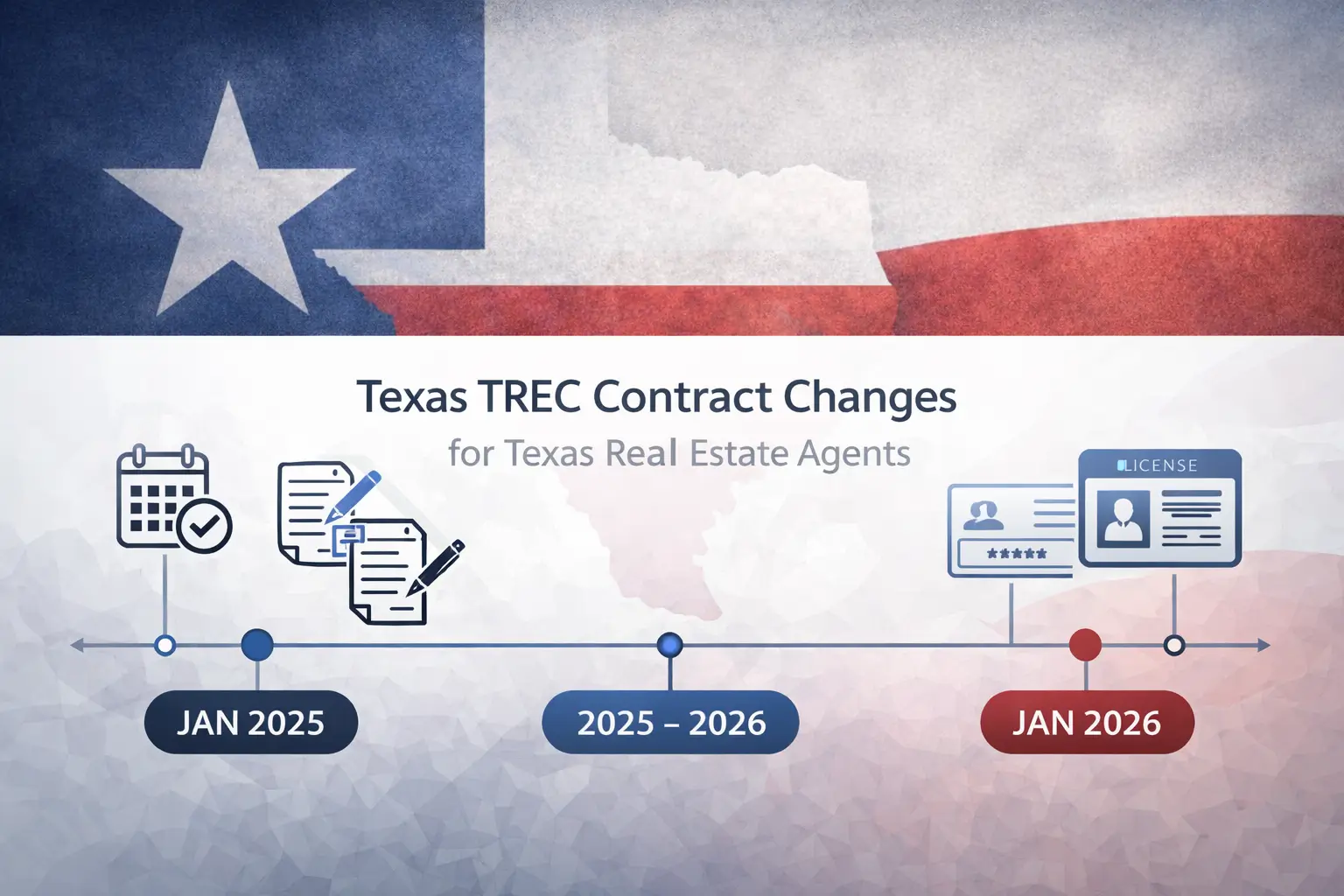
TREC Contract Changes: Complete 2025-2026 Compliance Guide for Texas Real Estate Agents
Last Updated: February 7, 2026
Texas real estate agents face the most significant regulatory transformation in decades. Between January 2025 and January 2026, the Texas Real Estate Commission (TREC) implemented sweeping TREC contract changes affecting every residential transaction in the state. These updates stem from three converging forces: the National Association of REALTORS® settlement pushing for commission transparency, Texas-specific legislation including Senate Bill 1968, and comprehensive TREC form revisions designed to align contracts with new buyer representation requirements.
If you’re a Texas broker or agent, you’re navigating mandatory written buyer agreements, restructured broker compensation clauses, new survey procedures, and a licensing portal that launched with significant technical challenges.
By the end of this guide, you will be able to:
- Use the correct TREC forms 100% of the time
- Structure buyer compensation legally in every offer
- Run open houses without risking your license
- Avoid REALM-related renewal mistakes
- Train your team using a simple compliance checklist
✅ TREC Contract Changes 2025–2026: TL;DR
| Date | What Changed |
|---|---|
| Jan 3, 2025 | New TREC contract forms are mandatory |
| Dec 15, 2025 | REALM portal launches with major issues |
| Jan 1, 2026 | Written buyer agreements required before showings |
Biggest risk for agents: Misaligned buyer agreements vs Paragraph 12
Biggest opportunity: Better professionalism and transparency
Understanding the Timeline: When TREC Contract Changes Take Effect
| Date | What Changed | Who It Affects | What Agents Must Do |
|---|---|---|---|
| Jan 3, 2025 | New TREC forms (20-18) | All agents | Update templates immediately |
| Dec 15, 2025 | REALM launch | All licensees | Verify license status weekly |
| Jan 1, 2026 | Buyer agreements mandatory | Buyer agents | Sign agreements before showings |
January 3, 2025: Updated TREC contract forms (including TREC 20-18) became mandatory, featuring rewritten broker compensation language in Paragraph 12, new survey procedures incorporating T-47.1 declarations, expanded mold remediation disclosure requirements, and the introduction of a Section 1031 Exchange Addendum.
December 15, 2025: TREC launched the REALM licensing portal, replacing legacy systems for license renewals and continuing education tracking. The rollout experienced significant technical difficulties.
January 1, 2026: Written buyer representation agreements became legally required for all residential buyers in Texas under new Section 1101.563 of TRELA, creating strict requirements for buyer agreements before showing property.
Paragraph 12 Broker Compensation: The Heart of TREC Contract Changes
The most consequential TREC contract changes center on Paragraph 12, which governs broker compensation. TREC completely restructured this section to reflect post-NAR settlement realities and eliminate assumptions about automatic MLS-driven commission payments.
Each Party Pays Their Own Broker
Paragraph 12A(1)(a) and 12A(2) now explicitly state that each party pays the brokerage fees they have agreed to pay. This language shift supports the principle that broker compensation flows from written representation agreements with clients, not from automatic offers through the Multiple Listing Service.
Seller Contributions to Buyer’s Broker Fees
New Paragraph 12A(1)(b) creates a specific mechanism for sellers to contribute toward buyer’s brokerage fees. Any seller contribution must be explicitly negotiated and documented in Paragraph 12A(1)(b) as a specific dollar amount or percentage.
Other Buyer Expenses
Paragraph 12A(1)(c) introduces a separate line item for “other buyer expenses” not to exceed a specified dollar amount. This could include closing costs, rate buydowns, or prepaid taxes. Separating broker fees from other buyer expenses prevents confusion between commission contributions and general seller concessions.
📌 Agent Playbook for Every Offer
Before submitting any contract, confirm:
- ✓ Buyer agreement fee matches contract
- ✓ Seller contribution is written clearly in 12A(1)(b)
- ✓ Buyer responsibility is clear in 12A(1)(a)
- ✓ Any credits are separated from commission
- ✓ Your brokerage policy is followed
Real-World Example: How Paragraph 12 Works
Scenario:
- Buyer agreement fee: 3%
- Seller agrees to pay: 2%
- Buyer pays: 1%
How it should appear in Paragraph 12:
- 12A(1)(b): Seller contributes 2%
- 12A(1)(a): Buyer responsible for remaining 1%
This clear documentation prevents disputes at closing and ensures all parties understand their obligations.
Survey Requirements and T-47.1 Declaration Updates
T-47.1 Declaration Replaces T-47 Affidavit
Paragraph 6C(1) now permits sellers to provide a T-47.1 Declaration instead of the traditional T-47 Affidavit. The critical difference: T-47.1 declarations do not require notarization, making them easier and faster for sellers to execute.
“May Obtain” Survey Language
Paragraph 6C(2) changed “Buyer shall obtain a new survey” to “Buyer may obtain a new survey.” The biggest risk under the new “may obtain” language is that buyers lose leverage later in the transaction if survey issues emerge.
When Should Buyers Still Order a Survey?
- Older properties (built before 1990)
- Rural or acreage properties
- Homes near boundaries (corner lots, adjacent to commercial)
- Properties with fences, additions, or easements
Mold Remediation Disclosure and Required Notices
Five-Year Mold Remediation Certificate Requirement
New Paragraph 6E(11) requires sellers to provide any mold remediation certificate issued within the last five years.
📋 Listing Agent Mold Checklist
- Ask seller about mold remediation in last 5 years
- Collect certificates if yes
- Upload to MLS and transaction file
- Disclose proactively to avoid renegotiation
Buyer agents should make “request mold remediation certificates” a standard line item in your initial document request list.
Section 1031 Exchange Addendum: New Tool for Investors
TREC introduced the Addendum for Section 1031 Exchange (TREC 60-0) as part of the January 2025 TREC contract changes. Agents who understand 1031 addenda will win more investor business in DFW, Austin, and Houston.
The addendum protects the non-exchanging party by ensuring that participation in the exchange does not create additional costs or liabilities, and the exchange process does not delay closing. When representing sellers conducting a 1031 exchange, attach the addendum at listing. When representing buyers in an exchange, attach it with the initial offer.
Written Buyer Agreements: The January 2026 Game-Changer
The January 1, 2026 implementation of mandatory written buyer representation agreements fundamentally alters how Texas agents interact with prospective buyers. Section 1101.563 mandates that license holders must enter into a written agreement before showing any residential property or presenting an offer.
Simple Script for Buyers
“Texas law now requires a written agreement before I can show homes. This doesn’t lock you in—it simply clarifies how I work and how I’m paid.”
Minimum Required Elements
Every written buyer agreement must include:
- Services to be provided
- Termination date (14 days max for non-representation agreements)
- Exclusivity status
- Representation status
- Compensation terms
- Conspicuous negotiability language
Representation vs. Non-Representation Agreements
Representation agreements establish a formal agency relationship with full fiduciary duties. These can be exclusive or non-exclusive with terms extending months or a year.
Non-representation showing agreements allow agents to show property without creating an agency relationship. Agents can only provide factual information and cannot advise on strategy, valuation, or negotiations. These must be non-exclusive and cannot exceed 14 days.
Open House Compliance: The Most Confusing Scenario
Quick Decision Rule
| Situation | Agreement Required? |
|---|---|
| Your listing? | No buyer agreement needed |
| Another brokerage’s listing? | Buyer agreement required |
| Buyer refuses to sign? | You must refuse to show the home |
Agent Represents the Seller (Your Listing)
If you host an open house for your own listing or for another agent within your brokerage, you do not need written buyer agreements with visitors. You must disclose that you represent the owner.
Agent Does Not Represent the Seller (Different Brokerage)
If you host an open house for a property listed by another brokerage, you must:
- Provide the Information About Brokerage Services (IABS) form
- Enter into a written buyer agreement before showing them the property
- Refuse to show the home if the buyer refuses to sign
Many agents now decline to host open houses for other brokerages to avoid this compliance burden.
REALM Licensing Portal: Technical Challenges and Compliance Risks
On December 15, 2025, TREC launched the REALM Portal for license management and renewals. Despite intentions to modernize Texas real estate licensing, the REALM launch encountered significant technical problems:
- Account creation failures and invitation email mismatches
- Payment processing errors blocking submissions
- Extended processing delays with no status updates
- Unresponsive support with unanswered emails
- License status uncertainty creating anxiety about practicing on expired licenses
🛡️ REALM Survival Checklist
- ✓ Check public TREC lookup weekly
- ✓ Screenshot your active status
- ✓ Keep all CE certificates saved
- ✓ Renew 60 days early
- ✓ Never assume renewal went through
Protecting Your License During REALM Challenges
Verify license status independently using TREC’s public license lookup tool. Screenshot your status page regularly as documentation.
Document everything: Save timestamped copies of continuing education certificates, payment confirmations, and any error messages.
Renew early: Build in buffer time for technical issues and processing delays.
Cease practice if status is uncertain: If you cannot verify active status and your renewal deadline has passed, stop practicing until you have written confirmation.
Additional Critical Rule Changes
Timely Response Rule (22 TAC §535.157)
Requires all brokers and sales agents to respond to principals, other agents, and unrepresented parties within two calendar days during the offer-to-close period. Delayed responses can trigger rule violations and disciplinary action.
License Renewal After Expiration (22 TAC §535.93)
If you renew within six months after expiration, your license automatically renews on inactive status, requiring a $250 reactivation fee to return to active practice.
2026 Broker License Requirements
Effective January 1, 2026:
- Experience points doubled: Now requires 720 points instead of 360
- Education credit caps reduced
- Broker Responsibility Course mandatory for all brokers
Frequently Asked Questions
Q: Can I still get paid if the seller refuses to pay my buyer agent commission?
Yes. Your buyer representation agreement controls your fee. If the seller doesn’t contribute via Paragraph 12A(1)(b), your buyer is responsible for the full amount.
Q: Do I need a buyer agreement for rental transactions?
No. This rule applies specifically to residential purchase transactions.
Q: Can I rebate part of my commission to my buyer?
Yes, if structured properly in your buyer representation agreement as reductions in your agreed-upon fee or as credits applied at closing.
Q: What happens if REALM delays my renewal and my license expires?
Stop practicing immediately until you verify active status. Expect a $250 reactivation fee and inactive status until processed.
Q: What’s the difference between T-47 and T-47.1?
T-47.1 doesn’t require notarization, making it faster and easier for sellers.
Final Thoughts
The 2025-2026 TREC contract changes represent the most comprehensive regulatory overhaul Texas real estate has experienced in decades. Success in this new environment demands updated transaction templates that reflect current TREC forms, clear buyer representation agreements that align with Paragraph 12 contract language, training protocols for open house scenarios, and documentation systems for REALM renewal verification.
Ready to implement these changes?
Agents who master these TREC contract changes first will have a significant competitive advantage in professionalism and compliance.