Texas Real Estate Trends 2026: What Agents, Buyers & Investors Must Know
Introduction: A Market That Rewards Skill Over Speed
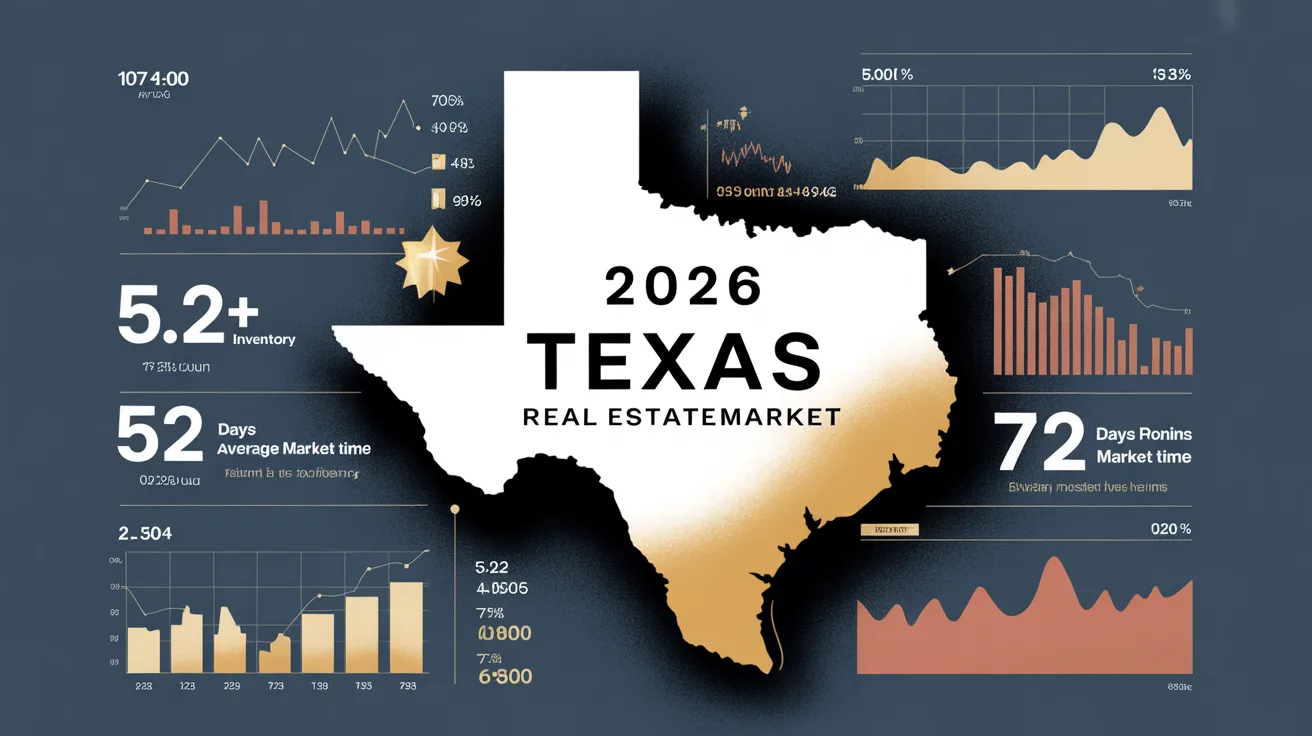
Texas real estate trends 2026 signal one thing clearly: the frenzy is over, and fundamentals are back. Statewide inventory sits at 5.2+ months. Homes that sell average 72 days on market. The median seller cuts their asking price by roughly $18,740 (about 5%). And the NAR settlement rules from August 2024 have permanently shifted how agents earn their commissions. [TRERC 2026 Forecast; National Mortgage Professional, 2026]
For prepared agents and informed buyers, this environment is full of opportunity. For those still running a 2021 playbook, the next six months will be a hard lesson.
“The 2026 Texas market is not weak — it is selective. This is the first time since 2019 that pricing skill matters more than marketing volume.”
Texas Real Estate Trends 2026 — Quick Summary
| Metric | Status |
|---|---|
| Inventory | 5.2–5.5 months (buyer leverage high) |
| Median price growth | ~1.3% statewide increase projected |
| Average DOM (sold) | 72 days |
| Average DOM (unsold) | 103 days |
| Seller concessions | Standard — ~5% median price cuts |
| Mortgage rates (base case) | 5.9%–6.3% by late 2026 |
| Insurance & taxes | Now primary affordability constraints |
| Agent landscape | 100K+ exited in 2025; more leaving through 2026 |
How 2026 Compares to the 2020–2022 Boom
Most Texas housing market analysis focuses only on today. Knowing the full cycle tells you where you actually stand.
| Year | Market Character |
|---|---|
| 2020 | Low rates ignite demand |
| 2021 | Peak frenzy — sub-10 days on market in major metros |
| 2022 | Rate shock correction begins |
| 2023 | Volume collapse — buyers and sellers both freeze |
| 2024 | NAR settlement reshapes commission rules |
| 2025 | Agent washout — 100K+ REALTORS® exit |
| 2026 | Skill-based normalization |
Understanding this cycle matters because the Texas housing forecast 2026 is not a crisis — it is a reset. Prices are not crashing. Volume is recovering slowly. The agents and investors who built systems through 2023 and 2024 are now positioned to capture disproportionate market share.
Texas Housing Market 2026 by Metro
Texas is not one market. Is Texas a buyer’s market in 2026? In most metros, yes — but the degree varies significantly.
Austin housing market 2026: Most corrected market in the state. Median price ~$415,000, down from a 2022 peak above $550,000. High inventory, frequent price cuts, negotiable environment. [TRERC, 2025]
Dallas real estate outlook 2026: Prices remain relatively stable but active listings are up 35%+ year-over-year in some counties. The $350K–$600K range faces the weakest demand. [TRERC, 2025]
Houston home price forecast: Long-term demand supported by energy, medical, and logistics jobs. Flood-risk zones and high-insurance neighborhoods face sharper price sensitivity. Insurance costs are now a closing-table conversation in many Houston zip codes.
San Antonio and secondary markets: Military presence and relative affordability keep demand steady. Secondary metros like Waco, Killeen-Temple, and Corpus Christi are absorbing buyers priced out of major metros — a trend accelerating into mid-2026.
What’s Driving Texas Real Estate Conditions Right Now
The Lock-In Effect: More than 80% of Texas homeowners hold rates below 6%. They are not moving unless forced to. This suppresses resale supply — keeping prices from falling dramatically while limiting new listings. [National Mortgage Professional, 2026]
Population Growth: Texas adds 400,000+ residents annually from corporate relocations, energy and tech job growth, and migration from high-tax states. Demand is real; it just needs affordable financing to unlock.
NAR Settlement Impact: Texas SB 1968 requires buyers to sign written representation agreements before tours. Sellers no longer automatically pay buyer agent fees through the MLS. Average national commission reached 5.44% in 2025, but buyer-side fees face growing downward pressure. [NAR commission data, 2025]
Tariff-Driven Construction Costs: Tariffs on steel, aluminum, and lumber added ~$9,200 to the average new Texas home. The Beck Group estimates total construction cost increases of 5.8%–6.8% above baseline in 2025. [Beck Group, 2025; Cushman & Wakefield, 2025]
Insurance and Tax Pressure: Texas homeowners insurance averaged $6,522 annually in 2025 — a 19% year-over-year spike. Property taxes run 1.6%–2.2% of home value. Nearly 79% of Texas voters name rising insurance costs as a top concern. [Texas insurance industry reports, 2025]
The Real Cost of Buying in Texas: A Sample Calculation
Most buyers focus on the mortgage. The full picture looks different.
Scenario: $340,000 home, 10% down, 6.25% rate
| Cost Component | Monthly Estimate |
|---|---|
| Principal & interest (6.25%, $306K loan) | ~$1,883 |
| Property tax (2% annual) | ~$567 |
| Homeowners insurance ($6,500/yr) | ~$542 |
| PMI (approx., until 20% equity) | ~$130 |
| Total monthly payment | ~$3,122 |
A buyer needs roughly $85,000–$95,000 household income to qualify comfortably at this payment level. That number surprises many first-time buyers who only see the home price. Agents who present this upfront build trust. Those who don’t risk a deal falling apart at underwriting.
What Texas Real Estate Trends 2026 Mean for Investors
Competitors cover agents and buyers. Almost none address investors — and investors are actively searching for answers right now.
Rent growth is flat: Statewide single-family rents sit at approximately $2,100–$2,300/month with little growth expected through mid-2026. Investors underwriting deals on 5%–8% rent growth assumptions need to recalibrate. [TRERC, 2025]
Insurance is compressing ROI: A $6,500+ annual insurance bill on a $340K rental property represents roughly 1.9% of purchase price annually — before taxes, maintenance, or vacancy. Investors in storm-prone zones (Gulf Coast, North Texas hail corridor) should stress-test insurance assumptions in every pro forma.
Cap rates by metro: Cap rates on single-family rentals in Austin and DFW have expanded modestly from their 2021–2022 compression, but remain relatively tight compared to pre-pandemic norms. Houston and San Antonio offer slightly better entry-point yields, particularly in stabilized neighborhoods outside flood zones.
Short-term rental watch: Several Texas municipalities, including Austin and San Antonio, have moved to tighten short-term rental regulations. Investors underwriting STR income should verify current zoning and permitting requirements before purchase.
New build vs. resale for rentals: Builder incentives (rate buydowns, closing cost credits) can make new construction competitive for long-term rental hold strategies, despite higher sticker prices. The effective yield comparison often favors new builds in suburban growth corridors around DFW, San Antonio, and Houston when builder incentives are factored in.
The Texas 2026 Transaction Success Model
No competitor article has organized the agent opportunity this clearly. Five disciplines separate agents who thrive from those who exit through 2026.
1. Pricing Precision — Master zip-code-level data. Win listings by showing sellers the true cost of overpricing (carrying costs, stigma, eventual deeper cuts).
2. Cost Transparency — Use the all-in cost worksheet (mortgage + taxes + insurance + HOA + maintenance) in every buyer consultation. Clients who understand full costs close faster and with fewer surprises.
3. Commission Clarity — Practice the 60-second value pitch. Quantify outcomes: your average sale price vs. market, your average DOM vs. area average, your negotiation results. Numbers replace doubt.
4. Digital Authority — Optimize your Google Business Profile, collect reviews systematically, create neighborhood-level short-form video content, and run Google Local Services Ads. The Texas home prices prediction searches happening right now lead buyers to agents with visible digital presence.
5. Cash Reserve Discipline — Build three to six months of business expense reserves. The agents exiting the industry are largely those with no financial runway. Survivors capture their market share.
Apply all five consistently, and you are in the top tier of the Texas market regardless of what rates do next.
Mortgage Rate Scenarios: Preparing for Three Outcomes
| Scenario | Rate Range | Texas Market Impact |
|---|---|---|
| Optimistic (aggressive Fed cuts) | 5.5%–5.75% by mid-2026 | Demand rebounds, inventory tightens, sellers regain leverage |
| Base case (gradual easing) | 5.9%–6.3% by late 2026 | Modest sales increase, continued buyer-friendly conditions |
| Pessimistic (inflation resurgence) | 6.5%+ | Market stalls further, deeper price cuts, extended DOM |
Sources: Fannie Mae Housing Forecast; Mortgage Bankers Association rate projections, 2025
Build your systems for the base case. Maintain reserves for the pessimistic scenario. Stay ready to pivot if the optimistic case arrives.
Red Flags to Watch: Signs the Market Is Shifting
These thresholds signal a meaningful change in Texas housing market conditions:
- Statewide inventory rises above 7 months (from current 5.2–5.5)
- Sale-to-list ratio drops below 0.92 (currently at 0.95)
- Homeowners insurance increases exceed 25% year-over-year
- 30-year mortgage rates re-cross 7.0%
- Annual home sales fall below 320,000 statewide (from projected 349,000)
If two or more of these trigger simultaneously, expect a meaningful pullback in buyer activity and a faster agent attrition cycle.
Frequently Asked Questions
Q: Will Texas home prices drop in 2026?
A significant drop is not projected. TRERC forecasts a modest ~1.3% statewide price increase to approximately $334,000–$350,000 median. Austin has already absorbed most of its correction from 2022 peaks. Individual sellers who overprice face deep cuts, but the broader market is not in freefall.
Q: Is Texas a buyer’s market in 2026?
Yes, in most metros. With 5.2+ months of inventory, 72+ average days on market, and a 0.95 sale-to-list ratio, buyers hold more negotiating leverage than at any point since 2019. Sellers who price accurately still sell; those who don’t sit for 100+ days.
Q: Do Texas buyers have to sign a written agreement before touring homes?
Yes. Texas SB 1968, aligned with NAR settlement rules effective August 17, 2024, requires buyers to sign a written representation agreement specifying services and compensation before property tours.
Q: How much should I budget for property taxes and insurance in Texas?
Property taxes run 1.6%–2.2% of home value annually. Homeowners insurance averaged $6,522/year statewide in 2025. On a $340,000 home, those two costs alone add roughly $1,100+ per month beyond the mortgage — a figure that derails many first-time buyer qualifications.
Q: Are Texas builders offering incentives in 2026?
Yes. Rate buydowns (some below 5%), closing cost credits, and design package upgrades are standard tools builders use to reduce standing inventory. These incentives can represent $10,000–$30,000 in effective value compared to a comparable resale. [Builder industry reports, 2025]
Q: What is the best lead generation strategy for Texas agents right now?
A layered approach: Google Business Profile optimization + systematic review collection (free, high-intent), Google Local Services Ads (top-of-search, pay-per-lead), consistent short-form video content on Instagram Reels or YouTube Shorts, and CRM-driven follow-up for past clients. Agents visible in AI search and local pack results are capturing disproportionate inbound traffic.
Q: What should investors watch in the Texas rental market in 2026?
Flat rent growth, rising insurance costs compressing NOI, and tightening short-term rental regulations in major metros are the three primary variables. Underwrite conservatively: assume 2%–3% rent growth, stress-test insurance at $7,500–$8,000/year on properties in high-risk zones, and verify STR permitting before purchase.
Q: How many agents are leaving the industry?
Approximately 100,000 REALTORS® left in 2025. Up to 300,000 more are expected to exit by end of 2026. In 2024, US existing home sales fell to roughly 3.9 million — the lowest in approximately 30 years. For agents who build durable systems and stay, the reduced competition is a significant long-term advantage. [NAR, 2025]
Data Methodology
Projections and data points in this article are compiled from multiple sources: TRERC forecast models, MLS data releases, NAR membership and commission reports, Texas insurance industry filings, and builder cost indices (Beck Group, Cushman & Wakefield). Markets update monthly. Projections may shift based on rate changes, legislative developments, or macroeconomic events. All data cited reflects the most recent available figures as of the publication date.
6-Month Agent Action Checklist
- [ ] Update listing presentations with current zip-code-level data (inventory, DOM, price trends)
- [ ] Write and practice your 60-second commission value pitch
- [ ] Audit and optimize Google Business Profile; implement systematic review collection
- [ ] Build an all-in cost worksheet for every buyer consultation
- [ ] Research local down payment assistance programs (TDHCA, city-level grants)
- [ ] Establish relationships with two to three lenders offering rate buydown programs
- [ ] Create a short-form video content calendar (two to three posts per week)
- [ ] Set up or audit CRM for automated lead nurture and past-client follow-up
- [ ] Develop tiered service packages with clear deliverables and pricing
- [ ] Set up Google Local Services Ads for high-intent lead capture
- [ ] Track active builder incentive programs in your service area monthly
- [ ] Build a cash reserve covering three to six months of business expenses
Conclusion: Adapt Now or Exit Later
Texas real estate trends 2026 reward one thing above all else: preparation. Pricing expertise, cost transparency, commission clarity, digital authority, and financial discipline — the Texas 2026 Transaction Success Model — separate the agents and investors building long-term businesses from those heading for the exit.
The 300,000 REALTORS® expected to leave through 2026 are not your competition anymore. They are your market share opportunity. The buyers sitting on the sidelines are not gone — they are waiting for the right guide. Be that guide.
Pick three items from the checklist above and complete them this week. The agents who act now will be the ones closing deals in August.
Want a custom Texas market strategy for your metro or brokerage? Book a free 15-minute strategy call and get a breakdown specific to your area.
Sources: Texas A&M Real Estate Research Center (TRERC) 2026 Forecast; National Mortgage Professional, 2026; NAR commission and membership data, 2025; Beck Group construction cost analysis, 2025; Cushman & Wakefield, 2025; Fannie Mae Housing Forecast; Mortgage Bankers Association, 2025; Texas insurance industry reports, 2025; Builder industry reports, 2025.