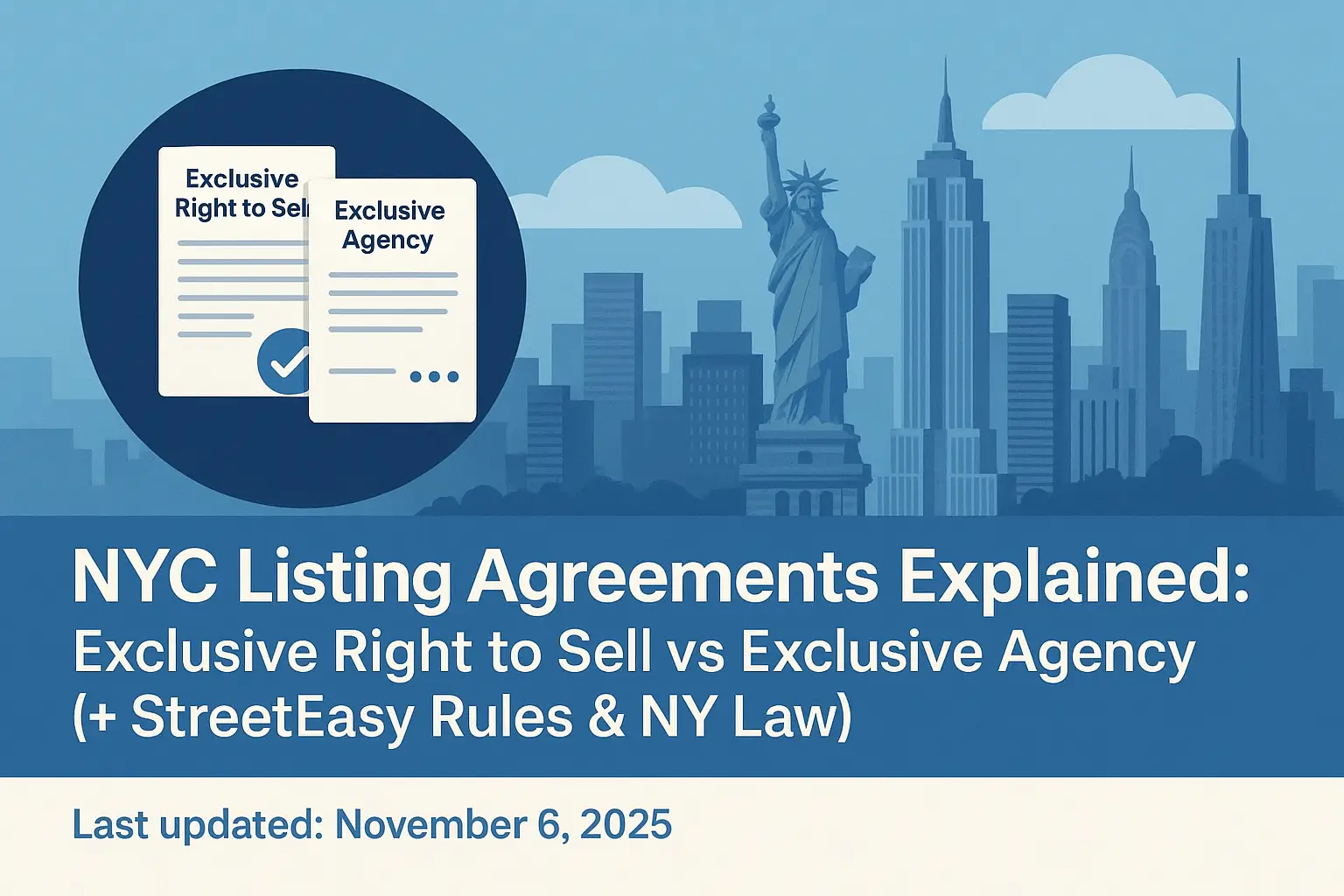
NYC Listing Agreements Explained: Exclusive Right to Sell vs Exclusive Agency (+ StreetEasy Rules & NY Law)
Last updated: November 6, 2025
When you’re ready to sell your New York City property, the listing agreement you sign determines whether you pay commission even if you find the buyer yourself. Most NYC sellers sign exclusive right to sell agreements without understanding they’re promising payment regardless of who procures the buyer—a decision that can cost tens of thousands of dollars.
This guide explains the two main NYC listing agreements with real New York legal requirements, StreetEasy platform rules, and contract clauses that protect or trap you. You’ll learn which agreement fits your situation and how to negotiate terms that work in your favor.
In this article, we delve into NYC Listing Agreements Explained (Exclusive Right to Sell vs Exclusive Agency, helping you understand the nuances involved.
What Is a Listing Agreement in NYC?
Watch this quick 7‑minute video for a clear overview of how Exclusive Right to Sell and Exclusive Agency listing agreements work — especially helpful if you’re selling in NYC and need to understand your commission and contract options
A listing agreement is a legally binding contract between you and a real estate broker that authorizes the broker to represent you in selling your property. While New York’s Statute of Frauds (General Obligations Law § 5-701[a][10]) exempts licensed brokers from the writing requirement for commission agreements, New York Department of State regulations (19 NYCRR §§ 175.10, 175.25) require written authorization to advertise a listing. Always insist on a written contract—it controls when commission is earned and payable, protecting you from disputes.
The agreement you sign determines whether your broker has exclusive rights to commission regardless of who finds the buyer, or whether you retain the right to sell independently without paying commission. This single choice affects your bottom line significantly.
Exclusive Right to Sell: The Industry Standard
What It Means in Practice
An exclusive right to sell listing gives your broker the right to earn commission no matter who procures the buyer during the listing period. Even if you find a buyer through your personal network, you still owe full commission to your listing broker.
Under this agreement type, commission entitlement flows from the contract terms themselves, not from proving procuring cause. The New York Court of Appeals confirmed in Blooming Home Realty, Inc. v. Infinity Holdings N.E. LLC (2d Dep’t 2024) that exclusive right to sell brokers are entitled to commission “by virtue of the exclusive listing agreement terms,” regardless of who actually finds the buyer.
Typical NYC Terms
Duration: 90 to 180 days is standard. According to the National Association of Realtors (2024), the median listing agreement term in competitive markets is 120 days.
Commission structure: Post-NAR settlement (effective August 2024, final court approval November 26, 2024), commissions are fully negotiable. According to Redfin’s Q1 2025 data, buyer agent commissions averaged 2.40% (slightly up from Q4 2024), with total commissions typically 4.5-5.5%.
Protection period: Also called a “tail provision,” this extends commission obligations for 30-90 days after agreement expiration if you sell to anyone introduced by the broker during the listing period. Common language in New York forms includes 90-day protection periods, though you can negotiate shorter terms.
MLS and StreetEasy inclusion: Your property gets marketed on the Regional Multiple Listing Service. StreetEasy requires exclusive or co-exclusive listings to appear in their database (open listings are not accepted per their Listings Quality Policy). StreetEasy is a dominant search portal for NYC buyers, making this inclusion critical for exposure.
Why Brokers Prefer This Agreement
Exclusive right to sell agreements guarantee commission compensation, which motivates brokers to invest maximum resources in marketing your property. Research from Colibri Real Estate (2023) indicates that exclusive right to sell listings represent over 90% of professionally marketed properties because most experienced brokers refuse exclusive agency arrangements.
Exclusive Agency: When You Keep the Right to Self-Sell
Watch why most brokers push for Exclusive Right to Sell agreements — and what you should know if you’re considering an Exclusive Agency listing.
Definition and Key Difference
An exclusive agency listing authorizes one broker to represent you, but you retain the right to find a buyer independently and avoid paying commission. If the broker brings the buyer, you pay commission. If you find the buyer through your own efforts without broker involvement, you owe nothing.
The New York Department of State Legal Memorandum LI10 (1998, updated through 2024) clarifies that under exclusive agency agreements, commission is only earned when the broker is the “procuring cause”—meaning the broker initiated the uninterrupted chain of events that led to the transaction. The recent case Angelic Real Estate LLC v. Aurora Props. XI, LLC (2d Dep’t 2025) reinforced that “mere creation of an occasion for the transaction” is insufficient to establish procuring cause.
Why Exclusive Agency Is Rare
Exclusive agency agreements represent less than 5% of professional listings in competitive markets. Here’s why:
Reduced broker motivation: Brokers have less incentive to invest time and money marketing your property if there’s a meaningful chance you’ll find the buyer yourself and eliminate their commission.
StreetEasy eligibility concerns: StreetEasy requires exclusive or co-exclusive listings and rejects open listings. Exclusive agency is technically a type of exclusive listing, but eligibility depends on meeting the platform’s exclusive-listing definition and feed rules through REBNY Regional Listing Service (RLS). Confirm with your broker that your exclusive agency agreement qualifies for StreetEasy submission.
Higher dispute potential: Exclusive agency agreements generate more procuring cause disputes. If the broker introduced a buyer who later contacts you directly, determining commission obligation requires proving the broker’s role in the transaction chain—these gray areas lead to costly litigation.
When It Makes Sense
Exclusive agency works in specific scenarios: you already have a probable buyer (family member, colleague, tenant) but want broker backup; you’re selling unique commercial property where you have industry connections that outperform traditional channels; you’re testing the market before committing to full marketing; or estate/divorce situations where one party has direct buyer contacts.
New York Law in Plain English: When Commission Is Earned
New York real estate commission law is contract-based, meaning your specific agreement language determines when commission is earned. The New York Department of State Legal Memorandum LI10 provides the interpretive framework.
Default rule: Unless your contract states otherwise, a broker earns commission by producing a buyer who is “ready, willing, and able” to purchase on terms acceptable to you—even if the deal later falls through for reasons unrelated to the broker’s performance.
Contract override: Your agreement can specify different terms. Common variations include “commission payable at closing” or “commission earned upon contract signing but payable at closing, or if closing doesn’t occur due to seller default, when closing would have occurred.” This language (from NYSAR 2024 standard forms) protects you if the buyer backs out or fails to secure financing.
Exclusive right to sell vs. procuring cause: With exclusive right to sell, commission entitlement flows from the contract itself. With exclusive agency, the broker must prove they were the procuring cause—the initiator of the uninterrupted chain of events leading to the sale.
Co-op board considerations: For co-op sales, specify that commission is “payable only at closing, or if closing doesn’t occur due to seller default after board approval, when closing would have occurred.” This protects you from paying commission if the co-op board rejects the buyer.
Critical Contract Clauses NYC Sellers Must Understand
1. Tail/Extension Clause (Protection Period)
This clause extends your commission obligation for 30-180 days after the agreement expires. Standard language: “If within 90 days after expiration of this agreement, the property is sold or contracted for sale to any person to whom the property was shown or with whom the broker negotiated during the agreement term, the seller agrees to pay the broker the full commission stated herein.”
Negotiation tips:
- Limit the tail period to 30-60 days maximum
- Require the broker to provide a written list of protected buyer names within 5 business days of expiration
- Specify that only buyers who physically toured the property or submitted written offers are protected, not everyone who received an email blast
2. Named Exclusions (Carve-Outs)
You can negotiate to exclude specific buyers from commission obligations. Sample language: “The following individuals are excluded from this agreement, and no commission is owed if the property is sold to: [Full Name 1, relationship], [Full Name 2, relationship]. Seller must provide written notice to broker within 24 hours if negotiating with excluded parties.”
Best practices: Be specific with full legal names and relationships. Most brokers accept 2-5 reasonable exclusions. Add a sunset provision: “If excluded party later re-engages through broker introduction, exclusion is void.”
3. Marketing Obligations
Your agreement should specify the broker’s duties to hold them accountable:
- Professional photography within 7 days of signing
- MLS entry within 3 business days
- StreetEasy submission (if exclusive or co-exclusive)
- Floor plan creation
- Minimum 3 email marketing blasts to broker’s database
- Weekly written status reports including showing count, feedback summary, and competitive market analysis
- Weekend and evening showing availability
Without specified obligations, you can’t hold the broker accountable for poor performance.
4. What Counts as a “Sale”
Your agreement should clearly define what triggers commission: sale, exchange of the property, assignment of contract for sale, transfer by option exercise, or lease with option to purchase exceeding one year in term. If you decide to lease your property instead of selling, your broker might claim commission under broad “transfer” language—clarify this upfront.
5. Buyer Agent Compensation Grid (Post-NAR Settlement)
Since MLS no longer displays offers of buyer-broker compensation (effective August 2024), specify your buyer agent compensation offer in the listing agreement:
| Offer Level | Compensation | Expected Impact |
|---|---|---|
| Full | 2.5-3% | Maximum showing activity; 30% more showings (NAR 2024) |
| Partial | 1-1.5% | Moderate activity; buyers negotiate remainder with agents |
| Zero | 0% | Reduced buyer pool; buyers pay own agents; 18 days longer to sell (NAR 2024) |
6. Early Termination Rights
Most NYC listing agreements don’t include easy termination clauses. Negotiate performance-based termination language: “If the property receives fewer than [X] showings in the first 30 days, or if broker fails to provide agreed marketing deliverables, seller may terminate this agreement with 7 days written notice. Upon termination, seller reimburses broker for pre-authorized, itemized out-of-pocket expenses up to $[amount], and broker retains no further commission rights.”
Agency Disclosure & Dual Agency in NYC
New York Real Property Law § 443 requires brokers to provide written agency disclosure explaining whom they represent. You must also give advance informed written consent if your broker will act as a dual agent (representing both buyer and seller) or use designated sales agents (different agents in the same brokerage represent each party).
Your choice: You can decline dual agency entirely in your listing agreement by adding: “Seller does not consent to dual agency. Broker may not represent the buyer in any transaction involving this property.” This eliminates potential conflicts but may reduce the pool of buyers your broker brings directly.
StreetEasy Reality: Platform Rules That Affect Your Exposure
StreetEasy dominates NYC property search. Their Listings Quality Policy requires sale listings to be exclusive or co-exclusive—open listings are not accepted.
Additional requirements (as of August 2024): StreetEasy requires buyers to sign a “Private Touring Agreement” before scheduling tours, aligning with post-NAR settlement buyer representation rules. This protects both buyers and sellers by clarifying agency relationships upfront.
What this means: If you insist on an open listing (no exclusivity), your property won’t appear on StreetEasy. Exclusive agency listings are technically exclusive and may qualify, but confirm with your broker that they can submit under RLS rules.
NYC Listing Agreement Comparison
| Feature | Exclusive Right to Sell | Exclusive Agency | Co-Exclusive |
|---|---|---|---|
| Commission if you find buyer | Yes, full commission | No commission | Yes, to participating brokers |
| Commission if broker finds buyer | Yes, full commission | Yes, full commission | Yes, split among brokers |
| StreetEasy eligibility | Yes | Depends on RLS submission rules | Yes |
| Broker motivation | Highest (guaranteed) | Low (uncertain) | High (shared risk) |
| Typical duration | 90-180 days | 90-180 days | 90-180 days |
| Best for | Standard residential sales | Self-sale scenarios with backup | Luxury/new development |
Decision Tree: Which Agreement Fits Your Situation?
You already have a likely buyer (family, tenant, colleague)?
→ Exclusive Agency with tight named exclusions + accept no StreetEasy listing
→ OR Exclusive Right to Sell with named exclusions for known parties (preserves StreetEasy)
Need maximum exposure for typical condo/co-op sale?
→ Exclusive Right to Sell + specify buyer-agent compensation (2.5-3% for max showings)
Luxury property ($3M+) or new development with multiple broker relationships?
→ Co-Exclusive with clear territory/buyer-pool division and split documentation
Testing market before full commitment?
→ Short-term Exclusive Right to Sell (60-90 days) with performance termination clause
Avoiding Procuring Cause Disputes
Procuring cause disputes arise when multiple parties claim responsibility for bringing the buyer. Here’s how the transaction chain typically unfolds:
- Initial inquiry – Buyer contacts broker or sees listing
- First showing – Broker tours buyer through property
- Negotiations – Broker facilitates offer/counteroffer
- Contract signing – Deal memorialized in writing
- Closing – Title transfers
Under Angelic Real Estate LLC v. Aurora Props. XI, LLC (2d Dep’t 2025), “mere creation of an occasion for the transaction” (like sending a listing link) doesn’t establish procuring cause. The broker must initiate an uninterrupted chain of events leading to the sale.
Dispute prevention:
- Keep a Buyer Contact Log documenting every inquiry: name, date, contact method, who initiated, showing dates, offer status
- Forward all direct buyer inquiries to your broker immediately—even “just looking” emails
- Never negotiate directly with buyers your broker introduced
- If a buyer contacts you months after seeing the property with your broker, notify your broker in writing before engaging
NYC-Specific Prohibited Practices
Net listings are illegal in New York under 19 NYCRR § 175.19(b). A net listing lets the broker keep everything above a minimum price you set (e.g., “I want $500K net; broker keeps anything above that”). This creates conflicts of interest—the broker benefits from you receiving less. If a broker proposes this structure, refuse and report them to the New York Department of State.
Advertising without authorization is prohibited under 19 NYCRR §§ 175.10 and 175.25. Brokers cannot advertise your property without your written authorization and must comply with advertising identification rules. Your listing agreement serves as this authorization.
Post-NAR Settlement Changes (Effective August 2024)
The National Association of Realtors settlement (effective late July/August 2024, final court approval November 26, 2024) fundamentally changed buyer agent compensation:
What changed:
- MLS platforms no longer display offers of buyer-broker compensation
- MLS participants working with buyers must use written buyer representation agreements before touring properties
- Buyer agent compensation is negotiated off-MLS and fully negotiable
- No default assumptions about sellers paying buyer agents
Real market impact: Despite predictions of steep declines, Redfin data shows buyer agent commissions averaged 2.40% in Q1 2025, slightly up from Q4 2024 and Q3 2024 (though down from Q1 2024). The settlement created transparency but didn’t eliminate compensation expectations.
For NYC sellers: You now explicitly choose buyer agent compensation levels. Properties offering full compensation (2.5-3%) receive approximately 30% more showings and sell 18 days faster on average compared to properties offering zero compensation, according to NAR research (2024).
Risks and Dispute Prevention
Before You Sign
Verify the broker’s license: Check the New York Department of State Division of Licensing Services database to confirm active licensure and disciplinary history.
Negotiate these terms:
- Initial term: 90 days maximum with 30-day renewal option
- Tail period: 30-60 days with required written protected-buyer list
- Named exclusions: Specific individuals with full names and relationships
- Marketing obligations: Photography, MLS/StreetEasy, floor plans, email blasts, weekly reports
- Commission payable: “At closing” not “upon finding buyer”
- Co-op board contingency: For co-ops, “payable only at closing or if seller defaults after board approval”
- Early termination: Performance triggers with expense cap
Get everything in writing: Verbal promises are unenforceable. Insist on written contracts that control when commission is earned and payable.
During the Listing Period
Document all buyer contacts: Keep detailed records in your Buyer Contact Log—name, date, contact method, who initiated, showing dates, offer details. This documentation proves procuring cause if disputes arise.
Forward all inquiries to your broker: Even if someone contacts you directly, refer them to your broker immediately in writing to maintain the paper trail.
Review weekly marketing reports: Hold your broker accountable for agreed marketing activities. Document any failures before requesting termination or reduced commission.
If You Want to Cancel Early
Request written release: Many brokers will agree if they’re not seeing buyer interest. Offer to reimburse documented marketing expenses (photography, staging, advertising receipts) in exchange for full release.
Negotiate reduced term: Instead of full cancellation, negotiate to reduce remaining term to 30 days, giving the broker one final window to produce results.
Understand legal consequences: New York Judiciary Law Section 487 makes listing agreements legally binding contracts. You cannot unilaterally cancel without broker consent. If you refuse to cooperate (deny showings, reject reasonable offers), you might breach the agreement and owe damages.
Never sign dual agreements: If you’re still bound by an exclusive right to sell agreement and sign with a second broker, you could owe double commission if both claim procuring cause.
Frequently Asked Questions
What’s the difference between exclusive right to sell and exclusive agency in NYC?
Exclusive right to sell means you pay commission no matter who finds the buyer—even yourself. Exclusive agency means you only pay commission if the broker is the procuring cause of the sale. Under exclusive right to sell, commission entitlement flows from the contract terms themselves; under exclusive agency, the broker must prove they initiated the uninterrupted chain of events leading to the transaction.
Does an NYC listing agreement have to be in writing?
New York Department of State regulations (19 NYCRR §§ 175.10, 175.25) require written authorization for brokers to advertise your property. Commission agreements with licensed brokers can technically be oral under General Obligations Law § 5-701(a)(10), but always insist on a written contract to control when commission is earned and payable, protecting you from disputes.
Can I negotiate the commission rate in my listing agreement?
Yes. Commission rates are fully negotiable and never set by law. The August 2024 NAR settlement reinforced that all commission terms must be individually negotiated. According to Redfin (2025), buyer agent commissions averaged 2.40% in Q1 2025, with listing agent commissions typically 2-3%, for total commissions of 4.5-5.5%.
What happens if I find the buyer myself under an exclusive right to sell agreement?
You still owe full commission to your listing broker. The agreement guarantees commission regardless of who procures the buyer. If you know someone who might buy your property, negotiate a named exclusion before signing to exempt that specific person from commission obligations.
How long do NYC listing agreements typically last?
Most NYC exclusive right to sell agreements run 90-180 days, with 120 days being most common according to NAR (2024). You can negotiate shorter initial terms (60-90 days) with renewal options if both parties agree. Avoid agreements longer than 180 days.
What is a protection period (tail clause) and how long should it be?
A protection period extends your commission obligation for 30-180 days after the agreement expires. If you sell to anyone the broker introduced, showed the property to, or negotiated with during the listing period, you still owe commission. Common New York forms include 90-day protection periods. Negotiate for 30-60 days maximum and require the broker to provide a written list of protected buyer names within 5 business days of expiration.
Can I cancel my listing agreement early in New York?
Only if your agreement includes a cancellation clause or the broker agrees to release you in writing. New York Judiciary Law Section 487 makes listing agreements legally binding contracts. You cannot unilaterally cancel without broker consent. However, you can negotiate early termination by offering reimbursement for documented marketing expenses or requesting mutual release if the broker isn’t performing.
Can an exclusive agency listing appear on StreetEasy?
StreetEasy requires exclusive or co-exclusive sale listings and rejects open listings per their Listings Quality Policy. Exclusive agency is technically a type of exclusive listing, so eligibility depends on meeting the platform’s exclusive-listing definition and REBNY Regional Listing Service feed rules. Confirm with your broker that they can submit your exclusive agency agreement to StreetEasy.
Who pays the buyer’s agent commission after the 2024 NAR settlement?
It’s fully negotiable. The NAR settlement (effective August 2024) eliminated automatic buyer agent compensation offers posted in MLS. Sellers now explicitly choose whether to offer buyer agent compensation. You can offer full compensation (2.5-3%) for maximum showing activity, partial compensation (1-1.5%), or zero compensation requiring buyers to pay their own agents. NAR research (2024) shows properties offering buyer agent compensation receive 30% more showings and sell 18 days faster on average.
What are named exclusions and should I negotiate them?
Named exclusions are specific people exempt from your commission obligation. If you have family members, business partners, current tenants, or colleagues who might buy your property, list them by full legal name and relationship in your agreement to avoid paying commission if they purchase. Most brokers accept 2-5 reasonable exclusions. Add sunset language: “If excluded party later re-engages through broker introduction, exclusion is void.”
What happens if a deal falls through—do I still owe commission?
It depends on your agreement language. Some contracts state commission is earned when the broker finds a “ready, willing, and able buyer,” meaning you owe commission even if the deal collapses due to buyer financing failure or inspection issues. Better language states commission is “payable at closing” or “payable at closing, or if closing doesn’t occur due to seller default, when closing would have occurred,” protecting you if the transaction doesn’t complete through no fault of yours.
When is commission actually “earned” in NYC?
By default (under common law), when the broker produces a ready, willing, and able buyer on terms acceptable to you. However, your contract can alter this—most modern agreements state commission is payable at closing. For exclusive agency agreements, the broker must also prove they were the procuring cause (initiated the uninterrupted chain of events leading to the sale). For co-op sales, specify that commission is payable only after board approval or at closing.
Is dual agency allowed in New York?
Yes, with advance informed written consent under Real Property Law § 443. You can decline dual agency entirely or allow “dual agency with designated sales agents” (different agents in the same brokerage represent each party). Add language to your listing agreement: “Seller does not consent to dual agency. Broker may not represent the buyer in any transaction involving this property” if you want to prohibit it.
Are net listings legal in New York?
No. Net listings are prohibited under 19 NYCRR § 175.19(b) because they create conflicts of interest. A net listing allows the broker to keep everything above a minimum price you set (e.g., “I want $500K net; broker keeps anything above that”), incentivizing the broker to minimize your proceeds. If a broker proposes this structure, refuse and report them to the New York Department of State.
What’s a normal tail period in NYC?
Commonly 30-90 days in New York listing agreement forms, with 90 days being most standard. However, you can and should negotiate for 30-60 days maximum. Require your broker to provide a written list of protected buyer names (anyone shown the property or who submitted an offer) within 5 business days after the agreement expires. Without this list, brokers can claim protection for anyone they vaguely “contacted.”
Key Takeaways
Exclusive right to sell is the industry standard because it motivates brokers through guaranteed commission, provides StreetEasy eligibility, and generates maximum MLS exposure. Unless you have specific buyer connections, this agreement type serves most NYC sellers best.
Exclusive agency preserves your self-sale rights but may limit StreetEasy visibility and reduces broker motivation. Confirm platform eligibility with your broker if you choose this route.
Negotiate before you sign. Shorten the initial term to 90 days, limit tail provisions to 30-60 days, add named exclusions, specify marketing obligations in writing, clarify co-op board contingencies, and ensure commission is payable at closing—not just upon finding a buyer.
The post-NAR settlement gives you power. Commission rates and buyer agent compensation are fully negotiable. Properties offering buyer agent compensation receive 30% more showings and sell 18 days faster, but you can choose partial or zero compensation depending on your priorities.
Document everything to avoid disputes. Keep a Buyer Contact Log, forward all inquiries to your broker in writing, and never negotiate directly with buyers your broker introduced. These practices prevent costly procuring cause litigation.
Read your agreement carefully. The specific language determines when you owe commission, whether you can cancel early, and what happens if deals fall through. New York courts enforce listing agreements as written.
Next Steps
Before you meet with brokers, prepare your negotiation points using this guide. Interview multiple brokers and compare agreement terms—not just commission rates. Request sample agreements before listing appointments to review actual contract language for tail provisions, marketing obligations, and commission payment triggers.
Consult a real estate attorney if you’re uncertain about any terms. A one-hour consultation ($300-500) can save you tens of thousands in avoided commission disputes or unfavorable contract terms.