New York Property Condition Disclosure Law 2025: Complete Guide for Buyers and Sellers
Last updated: November 27, 2025
If you’re buying or selling a home in New York State, the New York property condition disclosure law 2025 has transformed how residential real estate transactions work. Gone are the days when sellers could simply pay $500 to skip detailed disclosures. The state has fundamentally shifted from “buyer beware” to mandatory transparency, with major updates in March 2024 and July 2025 creating new obligations and risks.
At a Glance – New York Property Condition Disclosure Law (2025)
Applies to: 1–4 family residential property (not condos/co-ops)
Effective dates: Major changes on March 20, 2024 + septic update July 1, 2025
Key change: No more $500 opt-out; PCDS is mandatory
PCDS length: 56 questions, including 7 flood questions and detailed septic disclosures
Penalty: Seller can be liable for actual damages for willful non-compliance
Quick Answer: What New York’s Property Condition Disclosure Law Requires in 2025
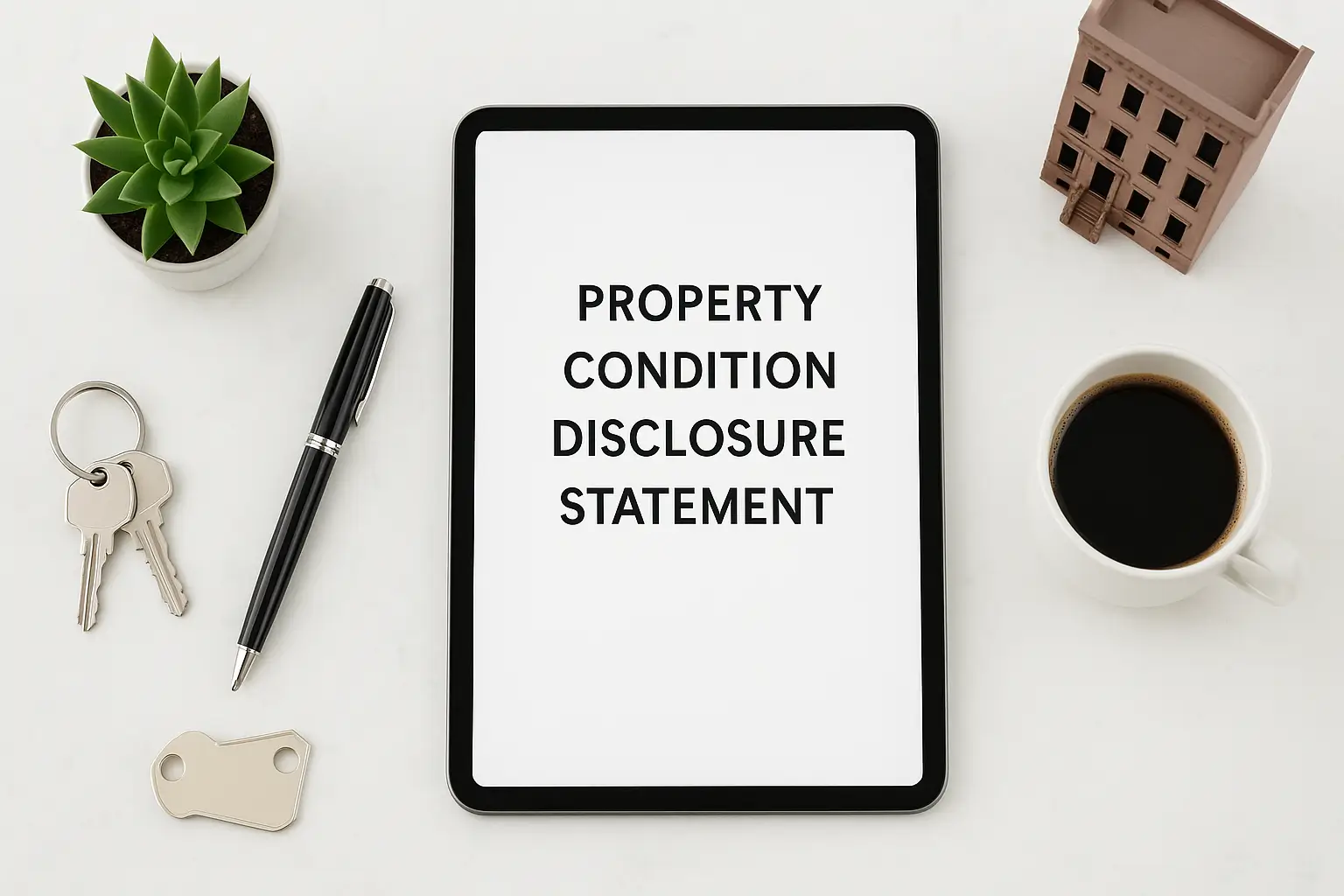
In 2025, New York’s property condition disclosure law requires most sellers of 1–4 family homes to complete a 56-question Property Condition Disclosure Statement (PCDS) and deliver it to the buyer before the buyer signs a binding contract. The old option to skip the form by giving a $500 credit was eliminated on March 20, 2024, and a July 1, 2025 update added more detailed septic-system disclosures. Sellers who willfully provide false or incomplete information can be liable for the buyer’s actual damages.
Key points:
• Mandatory disclosure: No more $500 credit opt-out (eliminated March 20, 2024) • Expanded flood questions: Seven new questions address FEMA floodplains, insurance, and prior claims • July 1, 2025 septic update: Enhanced guidance on septic maintenance via NYS Department of Health resources • Increased liability: Sellers providing false information can face actual damages and, in some cases, court-awarded attorney’s fees • Not a warranty: The PCDS doesn’t replace professional inspections • Major exemptions: Condos, co-ops, estate sales, foreclosures, and intra-family transfers are exempt
Timeline: How the Law Evolved
2002-2024: The $500 Credit Era
For two decades, New York sellers could choose: complete a detailed PCDS or pay buyers a $500 credit at closing. According to the New York State Bar Association, most sellers routinely chose the credit route.
March 20, 2024: The Disclosure Revolution
Governor Kathy Hochul signed legislation (A.1967/S.5400) on September 22, 2023, eliminating the $500 credit option entirely. The form expanded from 48 to 56 questions, with seven new flood-related questions addressing climate resilience after devastating New York floods.
July 1, 2025: Septic System Enhancement
The most recent amendment updated Question 36 to address septic system operation and maintenance. The revised form (DOS Rev. 02/25) now directs parties to NYS Department of Health resources for septic care standards.
Who Must Provide a PCDS Under New York Property Condition Disclosure Law 2025?
Properties Requiring Disclosure
You must provide a PCDS if you’re selling 1–4 family residential property (including mixed-use properties with a 1–4 family dwelling) used or intended to be used as a home. The New York property condition disclosure law doesn’t apply to unimproved land, condos, co-ops, or HOA property not owned in fee simple.
Major Exemptions: 14 Statutory Categories
New York Real Property Law §463 lists 14 exemptions. According to Stewart Title, common examples include:
| Situation | PCDS Required? | Notes |
|---|---|---|
| Sale of 1–4 family home | Yes | Standard residential sale |
| Mixed-use with 1–4 family dwelling | Yes | Residential part triggers PCDS |
| Condo / co-op sale | No | Exempt under RPL §461(5) |
| Estate sale by executor | No | Fiduciary exemption |
| Transfer between spouses | No | Intra-family exemption |
| Foreclosure/bankruptcy sale | No | Court-ordered exemption |
In Manhattan, the majority of apartment sales involve condos or co-ops, so most NYC buyers never see a PCDS at all.
What’s Inside the 2025 PCDS: 56 Questions Explained
The 56 questions on the 2025 PCDS cover:
General property information: Basic details about ownership and occupancy
Environmental and flood risk: According to JDSupra, seven new flood questions address FEMA floodplains (100-year and 500-year), prior flood insurance claims, federal disaster assistance, FEMA elevation certificates, plus radon, lead paint, asbestos, and underground storage tanks
Structural issues: Water intrusion, roof leaks, foundation cracks, pest damage, and drainage problems
Mechanical systems and utilities: Heating, cooling, plumbing, electrical, water supply, sewage, and appliances
Septic systems (enhanced July 1, 2025): According to NYS Department of State, sellers must now disclose system age, last pumping date, pumping frequency, and known defects. For Long Island, Westchester, and other suburban areas, improper maintenance can cost $10,000 to $30,000 or more.
Buyer’s Playbook: How to Use the PCDS
Does the New York Property Condition Disclosure Law Replace Home Inspections?
No. The form explicitly states: “This is not a warranty of any kind by the seller or seller’s agent and is not a substitute for any inspections or tests.” Sellers only disclose what they actually know.
Invest in Professional Inspections
Essential services include:
• General home inspection: $400-600 • Septic system inspection: $300-500 • Mold testing: $500-1,000 • Radon testing: $150-300
According to Gotham City Home Inspections, findings often lead to price reductions exceeding the inspection cost.
Sample PCDS Red Flags
Multiple “Unknown” answers: Signals neglect or evasion—push for seller-paid inspections
Flood questions answered “Yes”: Trigger independent FEMA map research and flood insurance verification
Water intrusion history: A seemingly minor leak can snowball into tens of thousands in remediation costs
Septic 20+ years old without pumping records: System may be nearing failure under the July 1, 2025 requirements
“Yes” on floodplain with no active insurance: Suggests prior claims or affordability issues
Decision Framework: Walk, Negotiate, or Proceed?
| Issue Severity | PCDS Answer | Action |
|---|---|---|
| Minor non-structural | Fully disclosed | Proceed with minor negotiation |
| Major water intrusion | Vague/”Unknown” | Negotiate hard or walk + attorney review |
| Septic 25+ years | No pumping records | Require inspection or escrow holdback |
What Happens If a Seller Lies on the Property Condition Disclosure Statement?
To pursue a claim after closing, you must prove the seller made a false statement knowing it was false or negligently failed to investigate. One national survey cited by Houzeo suggests roughly 77% of real estate lawsuits are tied to disclosure disputes.
Seller’s Playbook: Reducing Your Risk
Can I Sell a House “As Is” in New York After 2024?
Yes, but you still must provide the PCDS. According to Stewart Title, “as is” clauses remain valid but don’t eliminate your duty to disclose known material defects under the New York property condition disclosure law 2025.
Consult a Real Estate Attorney First
According to Drake Loeb PLLC, attorney consultation typically costs $300-500 and can prevent significant liability exposure. Your attorney helps you understand defensible answers, phrase responses carefully, and gather supporting documentation.
The “Unknown” vs. “No” Dilemma
Marking “Unknown” protects you from misrepresentation claims but may signal evasion to buyers. Answer honestly based on actual knowledge. Mark “Unknown” only when genuinely uncertain, not as a blanket liability shield.
Gather Documentation
Compile receipts for repairs, HVAC and plumbing service records, septic pumping logs (critical for July 2025 compliance), roof documentation, and prior inspection reports. This proves you exercised reasonable care.
What Septic Disclosures Are Required Under the July 1, 2025 Update?
For properties with septic systems, provide maintenance records showing regular pumping (typically every 3-5 years), consider a pre-sale inspection ($300-500), and share NYS Department of Health resources. The amendment reflects New York’s recognition that septic failures are a major dispute source.
The Liability Landscape
How Long Can a Buyer Sue Me After Closing?
According to The Donaldson Law Firm, claims can potentially be brought up to six years after closing under certain legal theories, though typical fraud statutes of limitations run 2-3 years from discovery. This shift from the old $500 credit system, where liability essentially ended at closing, makes accurate disclosure critical.
Real-World Example: How the Law Plays Out
Example: Flood History Discovered Late (Fictional but realistic)
Brooklyn 2-family home, seller answers “No” to all flood questions. Buyer’s attorney spot-checks FEMA maps and insurance history, discovers a prior NFIP claim three years ago that seller never disclosed.
Buyer’s response: Negotiates aggressively—seller pays for additional environmental inspection and agrees to $15,000 credit.
Outcome: Deal closes with adjusted price instead of litigation. Seller avoids fraud claim but takes financial hit for incomplete disclosure.
Lesson: Accurate disclosure upfront prevents worse outcomes later.
How This Plays Out: NYC vs. Upstate
New York City (Manhattan, Brooklyn, Queens)
Most apartment sales involve condos or co-ops—exempt from PCDS requirements under the New York property condition disclosure law 2025.
NYC buyers should focus on: Building financial statements, board meeting minutes, engineering reports, and offering plan terms.
Suburbs and Upstate (Long Island, Westchester, Hudson Valley)
More transactions involve 1–4 family homes with septic systems, wells, and flood exposure. The PCDS is critical, and Question 36 (septic) under the July 1, 2025 amendment is especially important.
Suburban/upstate buyers should focus on: Complete PCDS review, independent septic and well testing, FEMA flood verification, and environmental assessments.
Frequently Asked Questions
Does New York Still Allow the $500 Credit Instead of the Disclosure Form?
No. The $500 credit option was eliminated entirely on March 20, 2024. Sellers must now complete the full 56-question PCDS.
Does the New York Property Condition Disclosure Law 2025 Apply to Condos and Co-ops?
No. Condominiums and cooperative apartments are explicitly exempt under RPL §461(5).
Do I Need a Home Inspection If the Seller Provides a Complete PCDS?
Absolutely yes. One national survey cited by Houzeo suggests about 28% of buyers discover hidden issues after closing. Your inspection identifies problems the PCDS will never reveal.
What If the Seller Marks “Unknown” for Everything?
This raises serious red flags. Push for seller-paid inspections, negotiate price reductions, and consult your attorney about whether the disclosure satisfies legal requirements under the New York property condition disclosure law 2025.
Can My Real Estate Agent Fill Out the PCDS for Me?
No. According to the New York State Association of Realtors, agents should never complete the PCDS on behalf of sellers. The disclosure must be based on the seller’s actual knowledge.
If I Discover New Problems After Providing the PCDS But Before Closing, What Must I Do?
New York law requires you to provide a revised PCDS “as soon as practicable” after acquiring new knowledge. This obligation ends at transfer of title or buyer’s occupancy. Consult your attorney immediately if major issues arise.
Your Next Steps
✓ For Sellers
- Hire a real estate attorney before completing your PCDS (budget $300-500)
- Gather documentation for all major systems and repairs
- Answer honestly based on actual knowledge
- Deliver the disclosure early to build buyer confidence
- For septic systems, compile pumping records (critical for July 2025 compliance)
✓ For Buyers
- Review the PCDS carefully before signing the contract
- Invest in professional inspections regardless of disclosure completeness
- Research flood risks independently using FEMA’s Flood Map Service Center
- Negotiate based on findings—request repairs or credits for disclosed defects
- Don’t skip attorney review of the PCDS and contract
✓ For Real Estate Professionals
- Update client education materials to reflect 2024 and 2025 changes
- Maintain comprehensive documentation of all disclosure discussions
- Never complete the PCDS on behalf of clients
- Stay current on New York property condition disclosure law updates
The Bottom Line
The New York property condition disclosure law 2025 represents a fundamental rebalancing of risk from buyers to sellers. The state has moved definitively away from “buyer beware” toward mandatory transparency.
For sellers, disclosure is mandatory, liability exposure is significant, and attorney consultation is essential. The days of $500 credits are definitively over.
For buyers, you have more information than before, but must still conduct independent inspections. The PCDS is a floor, not a ceiling.
For agents, your role includes client education, documentation maintenance, and professional referrals. Understanding these requirements protects both your clients and your license.
The March 2024 and July 2025 amendments reflect New York’s ongoing commitment to targeted disclosure requirements. Whether buying your first home, selling after decades, or facilitating transactions as a professional, understanding the New York property condition disclosure law 2025 is critical for every residential real estate transaction in the state.
Need help navigating disclosure requirements? Consult a licensed New York real estate attorney before completing your PCDS or committing to a purchase.