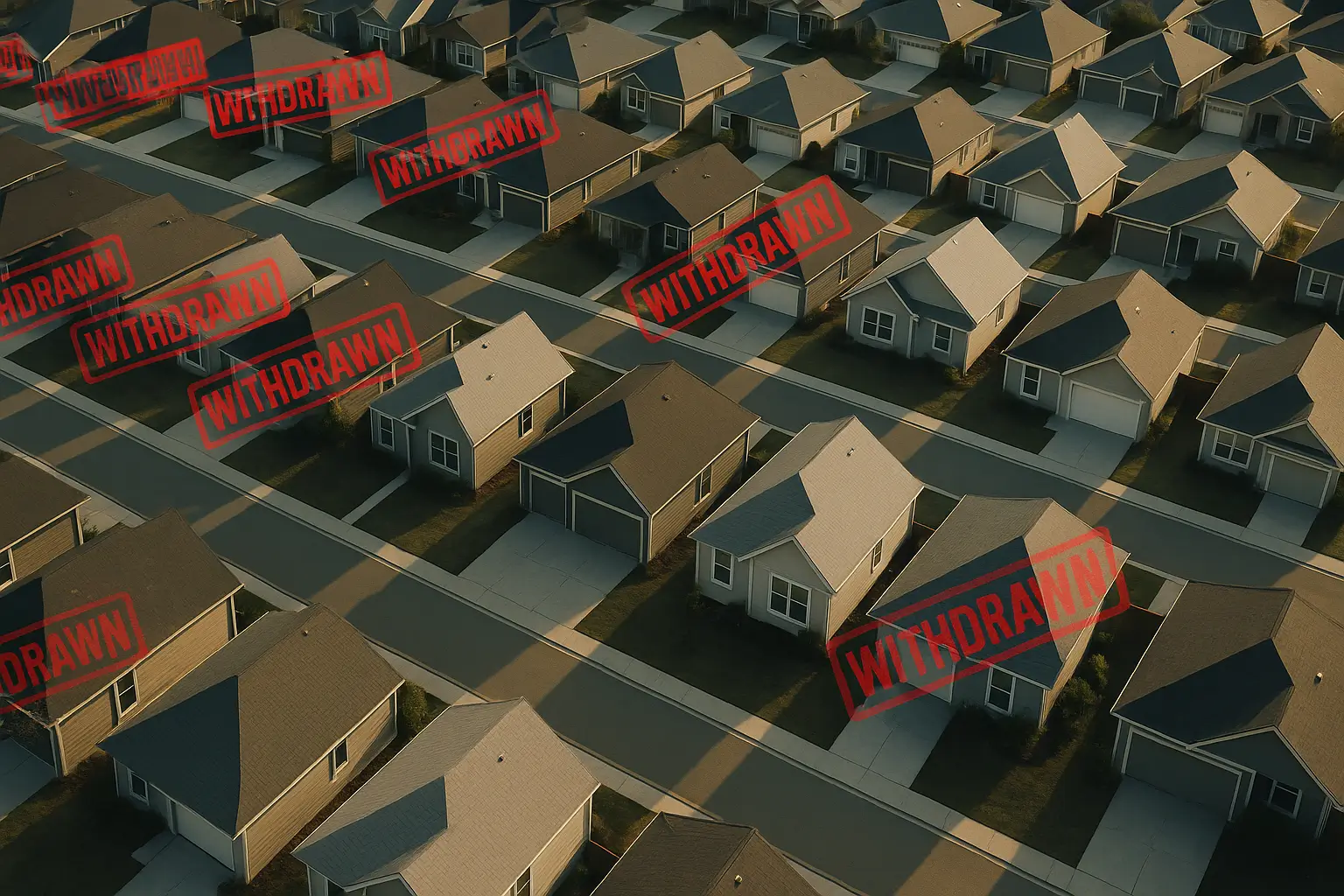
Home Delistings 2025: Why U.S. Sellers Are Pulling Properties and What Buyers Need to Know
Last updated: December 10, 2025
TL;DR: Home Delistings 2025
• U.S. delistings hit 84,900 in September 2025 — highest monthly total in 8+ years
• Sellers removed 27 homes for every 100 new listings by October (Realtor.com)
• Pandemic boomtowns like Phoenix (+47%), Miami (+45%), Austin (+36%) show massive YoY spikes
• Loss aversion + mortgage rate lock-in (85% of homeowners below 6%) drive withdrawals
• Shadow inventory creates hidden opportunities for strategic buyers who track off-market properties
• Major relisting wave expected February–May 2026 as 90-day MLS resets trigger returns• NYC buyers: September-December 2025 offers peak negotiation leverage (30% less competition)
In September 2025, nearly 85,000 U.S. homes vanished from the market—not because they sold, but because frustrated sellers pulled their listings entirely. This unprecedented surge in withdrawn listings has created a shadow inventory crisis reshaping real estate nationwide, with delistings jumping 28% year-over-year to reach the highest monthly total in eight years, according to Redfin’s September 2025 market analysis.
By October 2025, the ratio of canceled listings to new listings climbed to 27 per 100—meaning sellers are removing homes nearly three times faster than new inventory enters the market, based on Realtor.com’s monthly housing report. For buyers, this means the “inventory recovery” narrative masks a tighter, more competitive marketplace than raw statistics suggest. Understanding these off-market inventory patterns reveals hidden opportunities for strategic buyers willing to hunt shadow properties and time their purchases carefully.
This guide explains why withdrawn listings in 2025 spiked to record levels, what it means for buyers navigating today’s market, and practical strategies for accessing delisted properties before competitors discover them.
Definition: What Is a Home Delisting?
A delisting occurs when a property is removed from the Multiple Listing Service (MLS) without selling, typically marked as Withdrawn, Canceled, or Expired. Unlike sold properties, these homes can return to market later.
Definition: Shadow Inventory
Shadow inventory refers to homes temporarily removed from public listings (Zillow, Redfin, Realtor.com) but still owned by sellers who may be open to off-market offers. These properties are invisible to standard buyer searches.
Home Delistings 2025: 5 Critical Numbers
[Insert Chart: Delisting Trend Line 2021-2025 Showing Sharp Spike]
84,900 homes delisted in September 2025
– highest monthly total in eight years (Redfin, September 2025)28% year-over-year increase
in September, following 47% spike in June (Realtor.com, October 2025)27 delistings per 100 new listings
in October—triple the historical baseline of 10 per 10070% of homes for sale
sat on market 60+ days before removal, averaging 100 days (Redfin, September 2025)20% of withdrawn listings relist within 3 months, often after minor improvements (Redfin, 2025)
Psychological Drivers Behind the 2025 Delisting Surge
Behavioral economics research from the Wharton School reveals homeowners feel financial losses approximately 2.5 times more intensely than equivalent gains. This loss aversion drives much delisting behavior in 2025.
Consider a seller who bought at $500,000 in 2021 when rates sat below 3% and bidding wars peaked. Today’s market values that home at $450,000. Accepting this offer feels like losing $50,000—psychologically devastating despite substantial equity gains compared to pre-pandemic values.
Rather than accept perceived losses, sellers with substantial equity and low mortgage rates simply wait, betting conditions will improve. Unlike 2008 distressed sellers facing foreclosure, today’s behavior reflects calculated patience backed by financial security.
Key Insight: Sellers aren’t desperate—they’re psychologically anchored to pandemic peak prices and financially capable of waiting indefinitely for market conditions to match their expectations.
Mortgage Rate Lock-In Is Freezing Seller Movement
Approximately 85% of U.S. mortgage holders secured rates below 6%, with many holding sub-4% pandemic-era mortgages, according to Redfin’s September 2025 analysis. Current rates hover between 6.4% and 6.6%—more than double what many homeowners pay.
A $400,000 mortgage at 3% costs roughly $1,686 monthly versus $2,528 at 6.5%—an extra $842 monthly or $10,104 annually. Selling means abandoning valuable below-market mortgages, making transactions financially painful even if home prices rise.
For sellers not forced to move, removing listings makes financial sense. They avoid locking in sale price losses while simultaneously avoiding refinancing costs at higher rates. This dynamic particularly affects markets with high pandemic-era purchasing activity—exactly the markets showing the highest delisting rates in 2025.
Key Insight: 85% of U.S. mortgage holders locked into sub-6% rates are unwilling to give up their financing advantage—fueling delisting surges even in strong local markets.
Pandemic Price Anchoring and Why It Still Matters in 2025
Most withdrawn listings were purchased during 2020-2022 when ultra-low mortgage rates (below 3%), remote work demand surge, and supply chain disruptions created bidding wars and rapid appreciation. Markets like Phoenix and Miami saw 50%+ price jumps, according to Zillow’s Home Value Index.
Sellers anchored to these pandemic peaks view current prices as temporary aberrations rather than realistic market corrections. This psychological anchoring—combined with financial ability to wait—fuels record canceled listings rather than price concessions.
Key Insight: Pandemic prices represented the aberration, not today’s values—but seller psychology anchored to 2021 peaks drives current withdrawal behavior regardless of economic rationality.
How Delistings Distort Price Signals and Market Data
The surge in withdrawn listings creates four critical distortions in market data that mislead buyers and mask true price discovery:
Inflated inventory numbers:
When reports announce “inventory up 15%,” they reference months-of-supply ratios (homes for sale divided by sales pace), not actual available listings. With 6% monthly delisting rates since June 2025, real-time available inventory remains constrained despite theoretical recovery.Artificial scarcity:
Properties that would be most negotiable are hidden off-market. Available inventory skews toward premium listings where owners have most equity and can wait indefinitely. Middle-market buyers face disproportionate constraints.Sticky median prices:
When overpriced homes are removed rather than reduced, median list prices remain artificially elevated. Only properties priced realistically remain visible, creating false impression market supports higher valuations.Hidden listing failures: Days-on-market resets after 90-day delistings mask true listing failures. A property that sat unsold 100+ days can relist appearing “new” to buyers, hiding market rejection signals.
Key Insight: Delistings artificially tighten effective inventory and prevent true price discovery—keeping sale prices higher than buyer activity alone would support.
Where Home Delistings 2025 Hit Hardest: Top Metro Analysis
[Insert Table: Top 10 Metros by Delisting Rate YoY Change]
Pandemic boomtowns show highest delisting rates. Based on Realtor.com and Redfin October 2025 data:
Top 10 metros: Phoenix (+47% YoY), Miami (+45%), Denver (+42%), Houston (+41%), San Diego (+39%), Los Angeles (+37%), Austin (+36%), Tampa (+35%), Atlanta (+33%), Seattle (+31%). These metros experienced 40-50%+ pandemic appreciation, creating massive expectation gaps between peak prices and current realistic values.
Phoenix — Highest Delisting Spike (+47% YoY)
Phoenix leads the nation in withdrawn listings, driven by extreme pandemic price inflation and investor activity. Home prices jumped 52% between 2020-2022 before stalling in 2023-2024. Now sellers face the reality that buyer demand cannot support pandemic-era valuations.
Why Phoenix sellers are withdrawing: Investor-heavy neighborhoods like Scottsdale and Tempe show highest rates—investors purchased at peak expecting continued appreciation. Suburban areas (Gilbert, Chandler) see more delistings than urban core, reflecting family buyer affordability constraints. Many sellers waiting for spring 2026 believing seasonal demand will justify higher prices.
Buyer opportunity: Track withdrawn listings in investor-heavy areas—these sellers may be more motivated than owner-occupants to negotiate off-market rather than wait indefinitely.
Miami — Pricing Expectations vs. Reality (+45% YoY)
Miami’s delisting surge combines pandemic price anchoring with insurance crisis pressure. The city saw massive migration influx 2020-2022 driving prices up 48%, but insurance costs have jumped 40-60% since 2023, according to state insurance commission data.
Unique Miami factors: Climate risk and insurance costs now factor into buyer valuations, but sellers anchored to pre-crisis prices resist adjustments. Migration momentum has slowed dramatically in 2024-2025, removing the buyer surge that justified previous pricing. Condo market particularly affected—new regulations post-Surfside require reserve funding, adding carrying costs sellers didn’t anticipate.
Key Insight: Miami sellers face dual pressure—pandemic price expectations meeting insurance reality—making withdrawn listings more likely to accept realistic off-market offers than in other metros.
New York City — Lower Delisting Rates, Strategic Opportunities
New York City shows lower delisting rates than national averages but still experiences elevated removals. Manhattan’s October 2025 market had 7,362 active listings (down 2% YoY). Borough performance varied: Manhattan +11.5% homes entered contract YoY, Brooklyn -2.4%, Queens +17.5% (strongest performer).
NYC’s lower rates reflect sophisticated sellers pricing realistically from start, plus stronger luxury demand where buyers remain less price-sensitive. However, micro-market variations exist—Financial District and Chelsea show increased seller willingness to negotiate, creating pockets of buyer leverage.
How to Find and Access Shadow Inventory: 3 Proven Strategies
[Insert Flowchart: Buyer Strategy for Accessing Shadow Inventory]
Strategy #1: Partner with MLS-Access Agent
Most effective approach: Real estate agents with MLS credentials view complete listing histories including withdrawn properties, previous prices, days on market, and all reductions. When interviewing agents, ask: “Can you pull reports on recently delisted properties in my target neighborhoods?” and “Do you have experience with sellers who’ve withdrawn listings and might accept off-market offers?”
Strategy #2: Build Personal Tracking System
Create proprietary intelligence: (1) Save properties to favorites on StreetEasy, Zillow, or Redfin as you browse, (2) Check saved properties weekly and note when status changes to “Off Market,” (3) Record in spreadsheet: address, last price, days on market, delisting date, (4) Follow up quarterly to see if property relisted, (5) Consider direct outreach after 90+ days.
Strategy #3: Direct Outreach with Professional Approach
Direct contact succeeds when respectful: Research ownership via public records, send professional letter (not cold-call), reference previous listing respectfully, express genuine interest and readiness, make reasonable offers based on comparable sales, and avoid pressure tactics. Expect 5-10% response rate, but responses often yield below-market deals.
Example: Successful Off-Market Negotiation
Original asking price:
$980,000Days on market before delisting:
94 daysBuyer’s off-market offer:
$915,000 with flexible 60-day closingOutcome:
Seller accepted due to transaction convenience and no showing disruptionSavings: $65,000 below original ask (6.6% discount)
Strategic Timing: When to Buy in 2025-2026
New York City’s optimal buying window occurs early-to-mid September (not October like most metros). NYC inventory runs 33% higher than January baseline in September, with prices 3.4% below seasonal peaks—potential $15,000+ savings on median homes. Buyer competition drops 30% compared to spring/summer.
Best timing windows:• November-December 2025:
Peak negotiation leverage as holiday fatigue reduces buyer pools• January 2026:
New Year seller motivations with continued low competition• February-May 2026: Major relisting wave but also competition surge—trade selection for leverage
Avoid: March-May peak spring season brings maximum competition eliminating negotiation advantages despite inventory surge.
Negotiation Strategies for the 2025 Withdrawn Listings Market
Negotiating with sellers who’ve pulled listings requires understanding psychology and using data strategically.
Lead with Comparable Sales Data
Sellers anchored to inflated expectations respond to data-driven offers. Build analysis: (1) Pull closed sales from past 3-6 months in same neighborhood, (2) Match similar properties within 10% square footage, (3) Calculate price per square foot, (4) Adjust for condition (±3-5%), (5) Present in offer: “Based on recent closed sales, market value appears to be [X].” This frames negotiation around market reality.
Master Three Essential Contingencies
Protect yourself without appearing weak:1. Home inspection (10-day window)
— 70% of listings sat 60+ days; time correlates with deferred maintenance2. Appraisal with gap clause
— “Will pay up to $15,000 above appraised value” protects while showing commitment3. Financing contingency — Standard lender requirement
Frequently Asked Questions About Home Delistings 2025
Why are so many homes being delisted in 2025?
Three forces converge: psychological loss aversion (homeowners feel losses 2.5× more intensely than gains), mortgage rate lock-in (85% of holders have sub-6% rates worth $10K+ annually), and pandemic price anchoring (sellers expect 2021 peak prices, not current realistic values). Unlike 2008, today’s sellers have equity and can afford to wait.
Will withdrawn listings come back to market?
Yes—20% relist within 3 months, another 15-20% within 6 months per Redfin 2025 analysis. Homes pulled summer/fall 2025 will surge back February-May 2026 targeting spring peak after 90-day MLS resets. However, only 31.6% of relisted homes ultimately sell—many withdraw again if pricing remains unrealistic.
How do I access shadow inventory properties?
Three methods: (1) Partner with MLS-access agent who pulls complete delisting histories (most effective), (2) Build personal tracking—save favorites on StreetEasy/Zillow, monitor weekly for removals, follow up quarterly, (3) Direct outreach via professional letter to owners using public records (5-10% success rate but often yields below-market deals).
Is this a market crash?
No—it’s recalibration, not collapse. Sellers have substantial equity and choose to wait (unlike 2008 foreclosures). Expect modest movements (0-3%) in most markets. NYC shows 1-3% annual appreciation likely. The market is transitioning from pandemic extremes toward equilibrium—slow normalization, not catastrophic failure.
What’s the best time to buy through 2026?
NYC buyers: September-December 2025 optimal (inventory peaks early-to-mid September, 33% above baseline, prices 3.4% below seasonal high, competition drops 30%). November-December particularly strong for negotiation. Avoid March-May 2026 despite inventory surge—competition returns eliminating negotiation advantages.
Which contingencies should buyers include?
Three essentials: inspection (10-day window since 70% of listings sat 60+ days), appraisal with gap clause (“Will pay up to $15K above appraised value” protects while showing commitment), and financing contingency (lender requirement). These balance protection with seller confidence.
How do I identify motivated sellers?
Signals: multiple price reductions before delisting (2-3 cuts show reality acceptance), extended time on market (100+ days suggests significant overpricing), property requiring work, life event indicators (divorce, relocation, estate), and delisting during strong season (spring/summer removal indicates frustration). Request listing history showing all changes.
Are NYC prices falling?
Mixed by segment: Manhattan overall +1.5% YoY with luxury up 31.5% in contracts (October 2025). Brooklyn -2.4% YoY, Queens +17.5%. Financial District and Chelsea show increased negotiation room. Better described as “stalling” than “crashing”—expect 0-3% movements. Market transitioning from frenzy toward equilibrium, not collapse.
Sources and Data References
• Redfin Market Report (September 2025) — National delisting data and metro breakdowns
• Realtor.com Monthly Housing Report (October 2025) — Delisting ratios and inventory metrics
• Zillow Home Value Index (2020-2025) — Pandemic price appreciation data
• Wharton School of Business — Behavioral economics research on loss aversion
• U.S. Census Bureau (2023) — Cost-burdened household statistics• Manhattan market data courtesy of Douglas Elliman and StreetEasy (Q3-Q4 2025)
The unprecedented surge in withdrawn listings—84,900 homes removed in September with ratios hitting 27 per 100 new listings by October—creates both challenges and opportunities. Understanding seller psychology, timing searches to seasonal patterns, and accessing shadow inventory through deliberate tracking transforms apparent scarcity into competitive advantage.
Four essential actions:1. Work with MLS-access agents
who track delisting histories and identify off-market opportunities2. Time searches strategically
—September through December 2025 offers peak inventory, lowest prices, 30% less competition3. Build comparable sales analysis
for every offer—data-driven negotiations overcome seller anchoring4. Master three contingencies—inspection, appraisal with gap clause, financing protection
This market favors prepared, patient buyers. Shadow inventory exists; accessing it requires intentional strategy. Spring 2026 will bring major relisting wave—position yourself now, but don’t wait passively when opportunities exist today. Take action: schedule consultations with experienced agents, create your personal tracker, pull comparable data, and get pre-approved. The window exists now through early 2026 before spring competition returns. Navigate strategically, and you’ll turn apparent scarcity into competitive advantage.