The Texas Real Estate Local SEO Playbook: Rank Higher, Build Authority, and Convert More Leads
Why Most Texas Agents Are Invisible Online
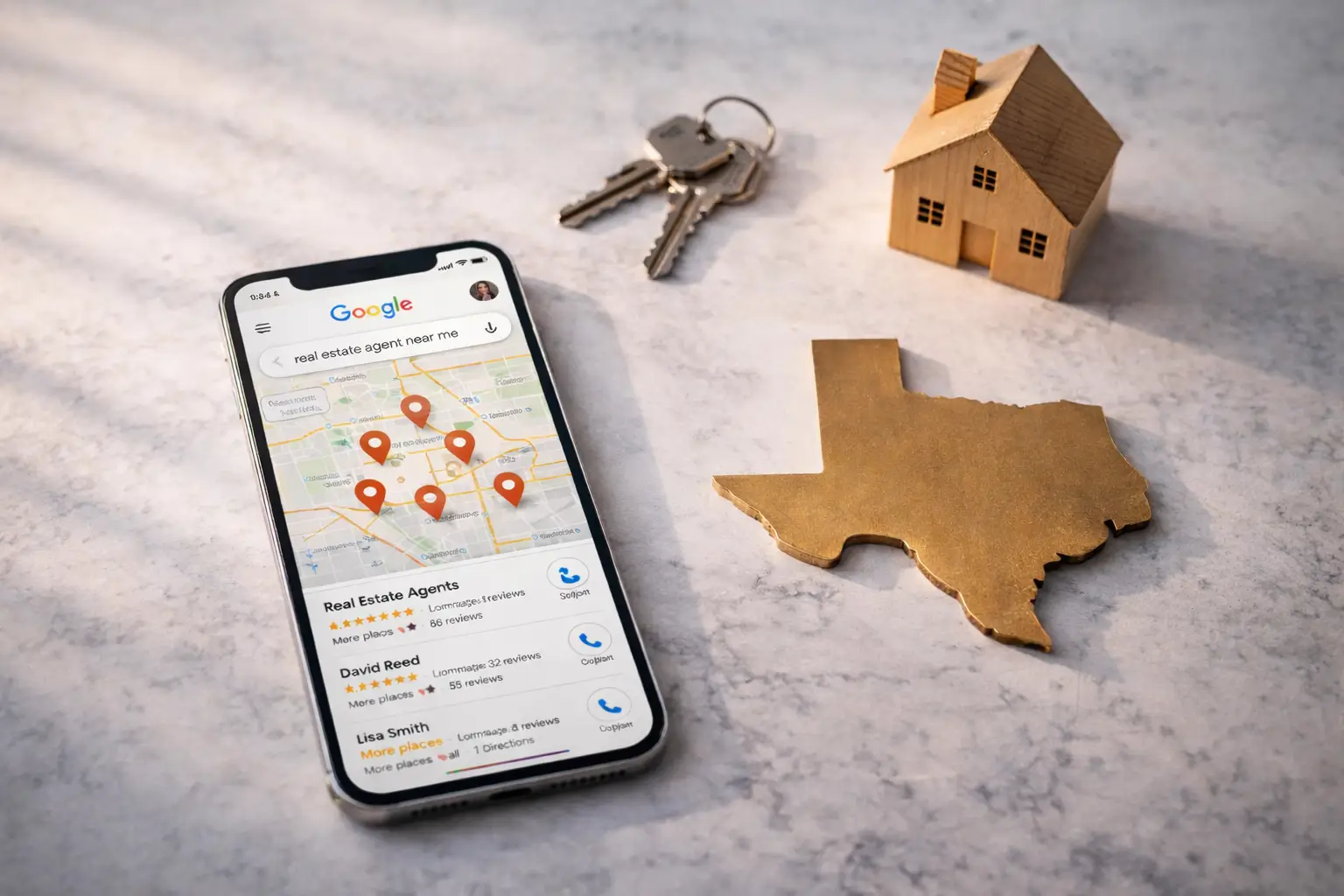
Google local SEO for Texas real estate is the highest-ROI lead generation channel most agents completely ignore. Over 97% of homebuyers start their search online, according to the National Association of Realtors, yet most Texas agents pay $181–$223 per Zillow connection in major metros while overlooking the one channel that compounds over time. Rank in the Google Local Pack for searches like “real estate agent in Austin” or “sell my house fast Plano,” and you capture high-intent leads without paying per click. This playbook gives you the strategy to get there.
60-Second Summary
What is Google local SEO for Texas real estate?
It is the process of optimizing your Google Business Profile, reviews, website authority, and local signals so your business appears in the Google Map Pack and AI results when buyers or sellers search in your city.How long does it take?
Small Texas markets: 2–3 months | Mid-size markets: 3–6 months | Major metros: 6–12+ monthsWhat matters most?
Review velocity, local authority signals, neighborhood content depth, and consistent entity mentions.
Understanding Texas Market Tiers Before You Spend Anything
Texas is not one market. Your entire SEO strategy changes based on where you operate.
| Tier | Markets | Competition |
|---|---|---|
| 1 | Houston, DFW, Austin, San Antonio | Extreme — 20,000+ active agents per metro |
| 2 | Round Rock, Plano, El Paso suburbs | High — 3,000–8,000 agents |
| 3 | Lubbock, Waco, Beaumont, Amarillo | Moderate — 500–2,500 agents |
| 4 | Midland, Tyler, smaller markets | Low — under 500 agents |
A Waco agent can realistically rank in the Local Pack within 60–90 days. That same effort in central Austin may take 6–12 months. Knowing your tier tells you how much to invest and how long to be patient.
Key Takeaways: Tier 1 cities require a full authority-building strategy. Tier 3–4 cities can rank with a well-optimized GBP and consistent reviews alone.
How Many Leads Each Ranking Position Actually Gets You
Before building your strategy, understand the economics of where you rank.
| Position | Avg. Click Share | Business Impact |
|---|---|---|
| #1 | 38–45% | Primary pipeline driver |
| #2 | 20–28% | Consistent deal flow |
| #3 | 12–18% | Supplemental leads |
| Outside Pack | Under 5% | Nearly invisible |
The insight most agents miss: moving from position #5 to #3 produces more business impact than moving from #3 to #1. Getting into the Pack at all is the biggest jump. If you are currently outside the Local Pack for your target Texas city, that is your entire focus until you break through.
How Google Actually Ranks Real Estate Agents
Google ranks real estate differently than service businesses like plumbers. Buyers and sellers research for weeks before contacting anyone. Google rewards agents who demonstrate topical authority across a neighborhood, not just agents with a complete GBP.
Three core ranking signals apply:
Relevance — how well your profile and website content match the searcher’s query. An agent who has published “Mueller neighborhood home values” and “Austin condo market trends” signals topical authority, not just location.
Distance — how close your verified address is to the searcher. It matters, but it is not decisive.
Prominence — the most weighted signal in competitive markets. Built through reviews, local backlinks, media mentions, and your overall digital footprint.
Google Doesn’t Rank Websites. It Ranks Entities.
Before Google ranks you confidently, it verifies four things: you exist, you operate in that city, people search for you by name, and others reference you. When all four are confirmed, Google treats your business as a trusted local entity.
Signals that build entity trust:
- Consistent NAP (name, address, phone) across every platform
- Branded search volume (people Googling your business name directly)
- Unlinked press mentions in local Texas media
- Directory listings with identical formatting
- Local backlinks from Texas-based websites
Key Takeaways: Prominence and entity trust drive rankings in competitive Texas markets. Review velocity, local links, and content depth build both.
The Self-Audit: Why Some Texas Agents Never Rank
Before spending another dollar, check this list. Three or more applies means Google likely distrusts your business entity, and no content strategy will overcome that.
Google Trust Diagnostic
- [ ] Different phone numbers across platforms (GBP vs. Zillow vs. website)
- [ ] Personal Gmail instead of domain email
- [ ] Office address shared by 50+ agents with no unique identifier
- [ ] No branded searches for your business name
- [ ] No neighborhood-specific content on your website
- [ ] Reviews say “great agent” but never mention a city or neighborhood
0–2: Solid foundation. 3–4: Fix these before anything else. 5–6: Start with a full entity cleanup.
That last item surprises most agents. When reviews never mention Dallas, Uptown, or condos, Google cannot extract location relevance from them. Naturally coach clients to include context: “Helped us close our first home in Plano” outperforms “amazing agent, highly recommend.”
Not All Real Estate Searches Are Equal
Competitors treat all searchers as one audience. They are not. Seller and buyer searches have completely different conversion values.
| Intent | Example Query | Commission Value | Priority |
|---|---|---|---|
| Seller | “sell my house fast Plano TX” | Very high | First priority |
| Buyer | “homes for sale Frisco TX” | Medium | Strong secondary |
| Research | “moving to Austin pros and cons” | Future pipeline | Long-term play |
| Investor | “rental property Houston ROI” | Niche, high value | Targeted opportunity |
Ranking for fewer seller keywords often generates more commissions than ranking for broad buyer terms. A seller lead controls a listing and typically generates both a listing commission and a buyer referral from the same transaction. Audit your current content. If it all targets buyers, you are missing the higher-value side of your pipeline.
Your Google Business Profile and Review Strategy
Your GBP is the foundation of local SEO for real estate in Texas. Optimize these elements first:
- Primary category: “Real Estate Agent” for individuals, “Real Estate Agency” for brokerages
- Business description: Name your target city and 3–4 specific neighborhoods
- Service areas: List every city and zip code you actively serve
- Weekly posts: Market updates, neighborhood spotlights, new listings
- Geo-tagged photos: Property images, neighborhood shots, team headshots with location metadata
Review velocity beats review volume. An agent with 30 reviews collected over the past 12 months outranks an agent with 80 reviews collected over 5 years. Google weights recency. Target 2–4 new reviews per month with a simple system: thank-you text within 48 hours of closing, Google review link follow-up on day 3, and a public reply to every review within 24 hours.
In Tier 1 Texas markets, agents in the top three Local Pack positions typically show 50+ reviews at 4.8+ stars with consistent recent activity.
Case Study: Why the Agent With More Reviews Lost
Two agents competing in Dallas for the same Uptown zip code. This scenario reflects ranking patterns commonly observed in competitive Texas markets.
Agent A: 120 reviews (4.9 stars), no neighborhood pages, no backlinks, fewer than 5 reviews in the past 12 months. Result: ranks #7, outside the Local Pack.
Agent B: 38 reviews (4.8 stars), 6 Uptown Dallas content pages, 3 local backlinks from a mortgage broker, title company, and community blog, 2–3 new reviews monthly. Result: ranks #2 in the Local Pack.
Agent B won because Google evaluates entities holistically. Agent A’s stale review velocity, zero content authority, and no local links tell Google this business is coasting. Agent B’s smaller but fresher review count, neighborhood content depth, and local link signals create a stronger authority signal across all three ranking factors.
Building Neighborhood Topical Authority (The Biggest Gap in Texas SEO)
Topical authority means Google recognizes your site as the most knowledgeable source for a specific neighborhood. You build it with a content cluster: 5–8 interconnected pages all focused on one geographic area.
Example cluster for a Dallas agent targeting Uptown:
- Core page: “Living in Uptown Dallas: Neighborhood Guide”
- Supporting: “Uptown Dallas Condo Market Report 2026,” “Best Streets to Buy in Uptown,” “Uptown vs. Oak Lawn: Which Neighborhood Is Right for You?”
- All pages link to each other and back to the core page.
No competitor in the current Texas real estate SEO search results builds this properly. It is the clearest path to Local Pack rankings for neighborhood-specific searches in competitive Texas markets.
Why People Call One Agent and Ignore the Others
Ranking gets you seen. Your profile gets you called — or skipped. People choose which agent to click on in 8 seconds based on four signals:
- Review wording: Specific beats generic. “Helped us close on a historic home in Southlake after three failed offers” beats “great agent, highly recommend.”
- Photos: Professional headshot and active property images signal competence.
- Specialization: Vague loses to specific.
- Bad: “Helping clients achieve their real estate dreams”
- Good: “Dallas relocation specialist for out-of-state buyers — 50+ relocations closed”
- Neighborhood mentions: Seeing “Frisco” and “Prosper” in your description makes local buyers feel you know their area.
FAQs: Google Local SEO for Texas Real Estate
How long does it take to rank in the Google Local Pack in Texas?
Tier 3–4 markets: 60–90 days with a complete GBP and consistent reviews. Tier 1 cities like Houston, Dallas, and Austin: 6–12 months of effort across GBP, content, reviews, and backlinks.
What is the most important ranking factor in competitive Texas markets?
Prominence — built through review velocity, local backlinks, citation consistency, and content depth. Relevance and distance matter but are less actionable.
Does HAR.com help with local SEO for Houston agents?
Yes. HAR.com is a high-authority Texas real estate domain. A fully optimized HAR agent profile with consistent NAP is a strong citation and trust signal for Google in Houston-area searches.
Should I create separate pages for each Texas city I serve?
Yes, if you can produce meaningful, unique content for each. Thin city pages with no original content do not rank and can dilute your site authority. Build 2–3 deep clusters before expanding.
How does local SEO compare to Zillow in cost?
Zillow Premier Agent leads average $181–$223 per connection in major Texas metros. A well-executed local SEO strategy requires upfront time but produces leads at a fraction of that cost over time, with compounding returns.
What keywords should Texas agents target first?
Start with high-intent, lower-competition variations: “[Your suburb] real estate agent,” “[Neighborhood] homes for sale,” and “[City] market report [year].” These convert better and are more achievable before you have built significant domain authority.
How do I appear in Google AI Overviews as a Texas agent?
Structure content with direct definitions at the start of each section, answer questions in 2–4 sentences before expanding, and include FAQ blocks with conversational questions. Mention specific Texas cities, neighborhoods, and landmarks throughout.
What is a neighborhood topical authority cluster?
A group of 5–8 interconnected pages all focused on one Texas neighborhood or city, each covering a different angle (market data, lifestyle, buying guide, investment) and linking back to a core neighborhood page.
Your Texas Local SEO Timeline
MONTH 1 — TRUST
Fix NAP inconsistencies. Complete your GBP with service areas and description.
Launch your post-closing review request system.

MONTH 2 — AUTHORITY
Build your first neighborhood content cluster (5–6 pages).
Secure 3–5 local backlinks. Post to GBP weekly.

MONTH 3 — VISIBILITY
Add FAQ schema to website pages. Target seller-intent keywords.
Check Map Pack position for your top 5 target keywords.

MONTHS 4–6 — OPTIMIZATION
Expand to a second neighborhood cluster.
Pitch local Texas media for expert commentary.

MONTH 6+ — MARKET DOMINANCE
Branded search volume grows. Referral traffic becomes measurable.
Organic leads arrive without paid advertising dependency.
Conclusion
Google local SEO for Texas real estate compounds while your competitors keep paying per click. The agents dominating the Local Pack in Houston, Dallas, and Austin built consistent review velocity, neighborhood content clusters, and local authority signals over time. Start this week: run the self-audit checklist, optimize your GBP description with specific neighborhood language, and set up your post-closing review request system. Those three moves, done consistently, put you in the Map Pack without paying $181–$223 per Zillow connection.
This framework is based on analysis of ranking patterns across Texas markets including Austin, Houston, and Dallas-Fort Worth (2025–2026). Sources: National Association of Realtors (2024), BrightLocal Local Consumer Review Survey (2024), industry lead cost benchmarks (2024–2025).