NYC Buyer-Agent Commissions After the NAR Settlement (2025): Exactly Who Pays, How Much, and What Changed
Last updated: November 5, 2025 • Reviewed with REBNY & NAR source documents and Q2 2025 Redfin data.
The real estate industry experienced sweeping changes in August 2024 when new rules from the National Association of Realtors (NAR) settlement took effect. For NYC homebuyers and sellers navigating buyer agent commission NYC 2025 requirements, understanding these changes is essential. Despite dramatic headlines predicting the “end of the 6% commission,” the reality in New York City has been far more nuanced. This guide explains exactly what changed, who actually pays buyer-agent fees in NYC today, and how to navigate the new landscape.
Key Sources Referenced
This article draws on: REBNY buyer-broker agreement FAQs, Redfin Q2 2025 commission data, HomeLight nationwide agent survey, and Federal Reserve steering analysis.
Quick Answer: Who Pays a Buyer’s Agent in NYC in 2025?
The short version: Buyers are now technically responsible for paying their agent’s commission, but in practice, most NYC sellers still cover these fees through seller concessions—especially in Manhattan’s slower market where sellers need to remain competitive.
Here’s how it typically works:
| Scenario | Who Pays? | Typical Amount |
|---|---|---|
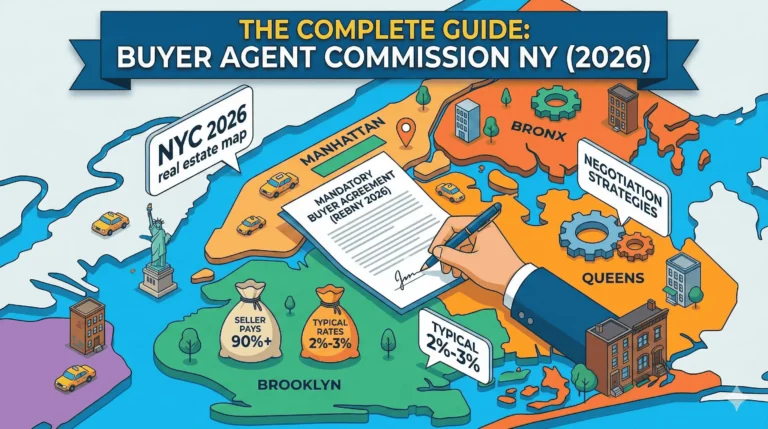
| Manhattan co-op / condo | Seller (via concession) | 2.5%–3%* |
| Brooklyn / Queens | Seller (via concession) | 2.5%–2.7%* |
| New development (sponsor sale) | Often the buyer directly | 1.5%–3% |
| FSBO or seller refuses to pay | Buyer out-of-pocket | Negotiated per agreement |
In NYC, “seller-paid” compensation is commonly structured as a closing credit (seller concession) rather than a visible commission line item.
*Based on broker interviews and market practice; national data shows similar ranges.
According to a HomeLight nationwide survey of top agents (July 2025), 92% of sellers continue paying buyer-agent fees post-settlement. NYC practice appears consistent with this national trend based on broker interviews across Manhattan, Brooklyn, and Queens.
What the NAR Settlement Changed (and What It Didn’t)
The Settlement Background
In March 2024, NAR agreed to a $418 million settlement resolving class-action lawsuits. The plaintiffs argued that requiring sellers to pay both agent commissions artificially inflated costs and violated antitrust laws. The settlement became effective August 17, 2024 nationally, with REBNY requiring full compliance by January 13, 2025.
Three Core Changes That Actually Matter
Two core shifts: (1) No advertising of buyer-agent compensation on MLS/RLS; (2) Written buyer-broker agreements before showings with a stated, not-to-exceed compensation amount.
1. No More Commission Advertising on MLS
Buyer-agent compensation can no longer be advertised on Multiple Listing Services. In NYC, the Real Estate Board of New York’s (REBNY) Residential Listing Service (RLS) made compensation fields optional in August 2024, with formal removal and practice changes implemented by May 2025.
However, sellers can still offer to pay buyer agent commission NYC amounts—they just can’t advertise it on the RLS. According to NAR’s settlement FAQ, these offers now happen verbally, via email, or on individual brokerage websites.
2. Mandatory Written Buyer-Broker Agreements
Before touring any property, buyers must sign a written agreement specifying:
- Exact compensation amount (flat fee, percentage, or hourly rate)
- That compensation is negotiable
- That the agent cannot receive more than the agreed amount
- Services the agent will provide
- Agreement duration and termination terms
According to REBNY’s Buyer’s Broker Representation Agreement FAQs, as of January 13, 2025, an agreement is required even for existing clients before showing properties.
3. Formal Responsibility Shift
Buyers are now formally responsible for compensating their agent under the written agreement structure. However, as NAR clarifies in its settlement documentation, sellers can still pay this fee through seller concessions—and in NYC’s current market, most do to remain competitive.
NYC vs. National: How Practice Differs
Most NYC agents aren’t NAR members—they’re affiliated with REBNY, which separated from NAR in 1994. However, REBNY voluntarily adopted the settlement terms to align with industry standards.
In Manhattan’s sluggish market where inventory remains tight, sellers recognize that refusing to pay buyer-agent fees can make listings unappealing. Manhattan agent Muk Lalchani notes, “sellers continue to pay the buyer’s agent fee, usually around 2.5% to 3%, because they recognize that transferring this cost to buyers can render their listing unappealing.”
This reflects common NYC market practice, though individual transactions vary by property type, neighborhood, and market conditions.
What the Numbers Actually Show
Commission Rates Haven’t Dropped—They’ve Risen
Contrary to predictions, buyer agent commission NYC rates have remained stable or increased since the settlement. Redfin’s Q2 2025 analysis shows the national average buyer-agent commission rose from 2.38% in Q2 2024 to 2.43% in Q2 2025.
National variation by price tier according to Redfin:
- Properties under $500K: ~2.5% average
- Properties $500K–$999K: ~2.4% average
- Properties $1M+: ~2.3% average
Yahoo Finance reporting on industry surveys indicates combined total commissions (both sides) averaging around 5.44% in 2025, up slightly from 2024 levels.
NYC appears to follow similar patterns based on broker interviews, with Manhattan properties typically seeing 2.5–3% buyer-agent commissions, and Brooklyn/Queens ranging 2.5–2.7%, though these represent market practice rather than published NYC-specific data.
Real NYC Examples: Co-op, Condo, and New Development
Manhattan Co-op Purchase ($750,000)
How It Works:
- Buyer signs agreement: 2.5% commission ($18,750)
- Seller agrees to pay as seller concession
- Closing statement shows seller credit to buyer for $18,750
- Buyer brings down payment + closing costs (no out-of-pocket agent fee)
Brooklyn Condo in Competitive Market ($900,000)
How It Works:
- Buyer signs agreement: 2.67% commission ($24,030)
- Seller communicated (off-MLS) willingness to offer 2.5% buyer-agent comp
- Buyer negotiates 2.67% from seller or covers 0.17% difference
- Final contract includes seller concession for buyer agent commission NYC payment
New Development Sponsor Sale ($1.2M)
How It Works:
- Sponsor excludes buyer-agent commissions from pricing
- Buyer signs agreement: 2% commission ($24,000)
- Sponsor declines to pay buyer agent
- Buyer pays $24,000 directly at closing
Financing Your Buyer-Agent Commission
Can Buyer-Agent Fees Be Seller-Paid Concessions?
Yes. When structured as seller concessions, buyer agent commission NYC payments typically don’t count against standard financing concession limits, according to NAR guidance. However, treatment of concessions toward agent fees can vary by lender and loan program—confirm specific handling with your loan officer.
Conventional Loans (Fannie Mae/Freddie Mac): Seller concessions typically allowed up to 3–9% of purchase price depending on down payment percentage. Buyer-agent commissions paid by seller generally don’t reduce these limits, but lender policies vary.
FHA Loans: Seller concessions capped at 6% of purchase price. Buyer-agent fees may count toward this total depending on how they’re structured.
VA Loans: No cap on seller concessions. Buyer-agent commissions can be fully seller-paid, making this particularly advantageous for military buyers.
Important: Always verify with your specific lender how they handle buyer-agent commission concessions, as interpretations of guidelines vary.
What If the Seller Won’t Pay?
You have several options:
- Negotiate it into your offer as a seller concession
- Adjust your offer price upward with seller paying your agent
- Pay it yourself from your own funds at closing
- Explore whether your lender allows rolling it into the mortgage (limited availability; verify eligibility)
Protecting Yourself: What to Check in Your Agreement
Must-Have Elements
According to REBNY’s buyer-broker agreement requirements, ensure your agreement clearly states:
- Specific Compensation: Exact dollar amount or percentage, never open-ended language
- Duration: Request shorter periods (30–60 days) initially if you’re uncertain
- Termination Clause: How you can exit if the relationship isn’t working
- Services Included: Specific deliverables the agent provides
- Maximum Cap: Explicit statement that agent cannot receive more than agreed amount
Red Flags to Avoid
Professor Tanya Monestier’s August 2024 analysis of buyer representation agreements identified problematic language to watch for:
- Compensation details buried in fine print or unclear terms
- Provisions allowing agents to collect bonuses from sellers without disclosure
- Clauses making you liable for full commission if the deal falls through before closing
- Language stating commission is “earned” when you sign the purchase agreement (rather than at closing)
- Payment-trigger language that creates ambiguity about when fees are owed
The Consumer Federation of America echoes these concerns, noting buyers should carefully review all terms before signing.
Negotiating Your Buyer-Agent Commission in NYC
Is Negotiation Actually Possible?
Yes. Despite consumer reports noting negotiation challenges in practice, you have stronger positioning when you’re:
- A repeat client or referral with established relationship
- Pre-approved with strong financials and clear timeline
- A low-maintenance buyer with specific budget and criteria
- Willing to handle some tasks yourself (property research, open house attendance)
What to Negotiate
- Flat fees: $15,000 flat regardless of final purchase price
- Tiered percentages: 3% under $500K, 2.5% for $500K–$1M, 2% over $1M
- Reduced rates for specific services: 1.5% if you source the property yourself
- Performance incentives: Base 2% with 0.5% bonus for closing within specific timeframe
Anti-Steering Reality Check
The Federal Reserve’s May 12, 2025 analysis highlights a critical concern about the settlement’s anti-steering goals:
“Taking offers of compensation off the MLS may reduce steering—but information can migrate to off-MLS channels,” the Fed note observes, suggesting that while the settlement aimed to eliminate steering behavior, practical workarounds through broker-to-broker communication may persist.
How to Protect Yourself
- Require written disclosure of all compensation offers the seller has made for properties you’re considering
- Ask direct questions: “Is the seller offering to pay buyer agent commission NYC for this property? How much?”
- Watch warning signs: Agent consistently pushing properties in narrow price ranges or dismissing properties you’ve found yourself
Borough-by-Borough Realities
Based on market practice and broker interviews across NYC:
Manhattan: 2.5–3% typical based on common market practice. Sellers in slower market conditions almost universally offer buyer agent commission NYC payments to attract offers. Luxury segment ($4M+) maintains traditional structures.
Brooklyn: 2.5–2.7% range typical in competitive neighborhoods. Seller-paid commissions remain standard practice, particularly in Park Slope, Brooklyn Heights, and Williamsburg.
Queens: 2.5–2.6% range common. More affordable entry point for first-time buyers. Commission practices generally mirror Brooklyn patterns.
The Bronx: 2.5–2.6% range typical. Higher likelihood of encountering sellers who don’t automatically offer compensation, particularly in FSBO situations.
Note: These ranges reflect market practice based on broker interviews rather than published NYC-specific data. Individual transactions vary by property type, neighborhood, and market conditions.
FAQ: Your Questions Answered
Do I have to sign an agreement to attend open houses?
Generally no—you can attend open houses without signing a buyer-broker agreement. The mandatory written agreement applies when you want an agent to show you specific properties or provide formal representation. However, check specific brokerage policies, as some may have different requirements. Private showings require an agreement per REBNY’s January 13, 2025 rule.
Can my agent receive more than we agreed to?
No. The NAR settlement explicitly prohibits agents from receiving more than the amount specified in your buyer-broker agreement. If a seller offers a higher commission than you agreed to pay your agent, any excess must revert to you as a credit, reduce the purchase price, or return to the seller. Your agent cannot keep the difference.
How does this affect first-time homebuyers in NYC?
First-time buyers face the biggest challenges with potential out-of-pocket costs. On a $650,000 NYC home with a 2.5% buyer agent commission NYC fee, that’s $16,250 additional cash at closing—representing a significant increase in required funds beyond down payment and closing costs. However, based on the HomeLight survey showing 92% of sellers still paying buyer-agent fees, most first-time buyers in NYC will likely see sellers cover this through concessions.
Should I use a discount brokerage?
Discount brokerages offer reduced buyer agent commission NYC rates (typically 1–1.5%) for streamlined services. Trade-offs include fewer services, less hands-on support, and potentially limited availability. In NYC’s complex market with co-op board requirements, contract negotiations, and attorney coordination, many buyers find full-service representation provides value justifying traditional rates—particularly for first-time purchasers navigating co-op boards and building requirements.
Can I roll buyer-agent commission into my mortgage?
In limited situations, some lenders allow buyer agent commission NYC fees to be financed as part of the loan, but availability varies significantly by lender, loan type, and property type. Fannie Mae and Freddie Mac guidelines provide some flexibility for this, but individual lender interpretation varies. Consult your loan officer early in the process to understand your specific options and any restrictions that apply.
What happens if I find a property myself?
This depends entirely on your buyer-broker agreement terms. Most exclusive agreements entitle your agent to the full agreed commission for any property you purchase during the agreement term, regardless of who initially found it. If you want flexibility for self-sourced properties, negotiate reduced rates for this scenario upfront before signing—for example, “1.5% commission for buyer-sourced properties, 2.5% for agent-sourced properties.”
Are commission rebates legal in New York?
Yes. Unlike some states that prohibit rebates, New York allows buyer agents to rebate part of their commission to buyers. Some brokerages build this into their business model, returning a portion (typically 0.5–1%) to buyers at closing. Ensure any rebate arrangement is properly documented and verify it doesn’t violate your lender’s policies or co-op board rules.
What if I’m not satisfied with my agent after signing?
Review your agreement’s termination clause carefully. Many allow termination with written notice, though terms vary by brokerage. Best practice: communicate concerns directly with your agent first, as many issues can be resolved through discussion. If the relationship isn’t salvageable, request a mutual release in writing and document any service failures or concerns. Some brokerages offer more flexible cancellation policies than others.
What You Should Do Right Now
For NYC Homebuyers
Before searching:
- Get pre-approved knowing your full budget including potential agent fees
- Interview 3–4 agents before signing any agreements
- Negotiate buyer agent commission NYC terms upfront—once you sign, negotiation becomes significantly harder
- Read agreements carefully; consider consulting a real estate attorney
- Budget for worst-case: plan as if you’ll pay your agent directly, even if you expect the seller to cover it
When making offers:
- Ask explicitly about seller willingness to pay buyer agent commission NYC through concessions
- Work with your agent to structure competitive offers that include commission coverage
- Document all commission arrangements in writing as part of your offer
- Verify with your lender how the commission structure affects your financing and closing costs
For NYC Home Sellers
- Discuss strategy with your listing agent about whether to offer buyer-agent compensation
- Research what other sellers in your building or neighborhood are offering by asking agents directly (since it’s not on RLS)
- Budget for both sides’ commissions when calculating your net proceeds
- Remember your listing agent’s rate is also fully negotiable
- Consider current market conditions—in Manhattan’s slower market, offering buyer agent commission NYC payments remains necessary to attract competitive offers
The Bottom Line
One year after the NAR settlement took effect, the buyer agent commission NYC 2025 landscape looks remarkably similar to 2024 in day-to-day practice, despite significant structural changes in how commissions are disclosed and negotiated.
What actually changed:
- No advertising of buyer-agent compensation on REBNY RLS (effective August 2024)
- Mandatory written buyer-broker agreements before property showings (REBNY compliance: January 13, 2025)
- Formal responsibility for payment shifted from sellers to buyers in agreement structure
What hasn’t changed:
- According to HomeLight data, 92% of sellers nationwide still pay buyer-agent commissions
- Commission rates remain stable at 2.5–3% for buyer agents based on NYC market practice
- Redfin data shows national rates actually increased from 2.38% to 2.43% (Q2 2024 to Q2 2025)
- NYC sellers recognize that refusing to pay buyer-agent fees makes their listings less competitive
The real impact: More paperwork through required written agreements, increased need for upfront commission negotiations before touring properties, and potential (though uncommon in NYC) for buyers to pay agents directly if sellers refuse concessions.
The full transformation will likely unfold over years. As buyers become more cost-conscious and alternative brokerage models gain traction, we may see the commission compression many predicted. For now, in NYC’s complex market with unique co-op structures, board requirements, and attorney-driven transactions, the traditional full-service model and its associated buyer agent commission NYC costs remain the market standard.
Understanding how buyer agent commission NYC 2025 rules work in practice—not just in theory—gives you the knowledge to navigate this transition successfully. Whether you’re buying your first apartment or selling in a competitive neighborhood, the key is transparency, upfront negotiation, and written documentation of all commission arrangements before beginning the process.
Sources Cited: