Texas Housing Demand in 2025: Why Stable Mortgage Rates Haven’t Revived Buyers—and What Agents Should Do
Last updated: February 10, 2026
Texas housing demand has stalled despite mortgage rates stabilizing around 6.5-7% throughout 2024-2025. Rates stopped their volatile climb, yet buyers remain cautious, inventory keeps rising, and days on market stretch longer each month.
The core issue isn’t rate movement—it’s affordability. Rates at 6.5-7% still represent double the pandemic-era 3% norm. Combined with elevated prices, surging property taxes, skyrocketing insurance, and slowing migration, total homeownership costs have become prohibitive. According to the Texas Real Estate Research Center (TRERC, 2025), “sluggish home sales remain a persistent reminder of ongoing affordability challenges.”
This guide explains why Texas housing demand remains weak, which buyer segments are active, and what strategies work in today’s market—backed by data from TRERC, Redfin, Bankrate, and local reports.
Texas Housing Demand at a Glance: 2025 Market Snapshot
| Metric | Texas (2025) | Trend | What It Means |
|---|---|---|---|
| Mortgage rates | 6.5–7% | Stable/flat | Buyers remain payment-constrained |
| Median home price | ~$340,000 | Down 2.7% YoY | Modest correction, not affordable reset |
| Active listings | ~123,000 | Up 53% vs. normal | Strong buyer leverage |
| Days on market | ~90 days average | Rising sharply | Market velocity slowing |
| Net migration | 85,000 (2024) | Down 62% from 2022 | Fewer new buyers entering |
| Builder incentives | Widespread | Increasing | Pulling demand from resale |
| Sub-$400K sales | Down 3.8–6% | Declining | Mass-market buyers priced out |
Key insight: Texas housing demand reflects an affordability crisis, not just a rate issue.
Why Stable Mortgage Rates Haven’t Fixed Demand
The Total Cost Crisis
From a buyer’s perspective, the critical variable is total monthly payment—not whether rates moved 0.1% weekly. TRERC (2025) notes that with rates hovering 6.5-7%, affordability pressures keep sales subdued despite expanding inventory.
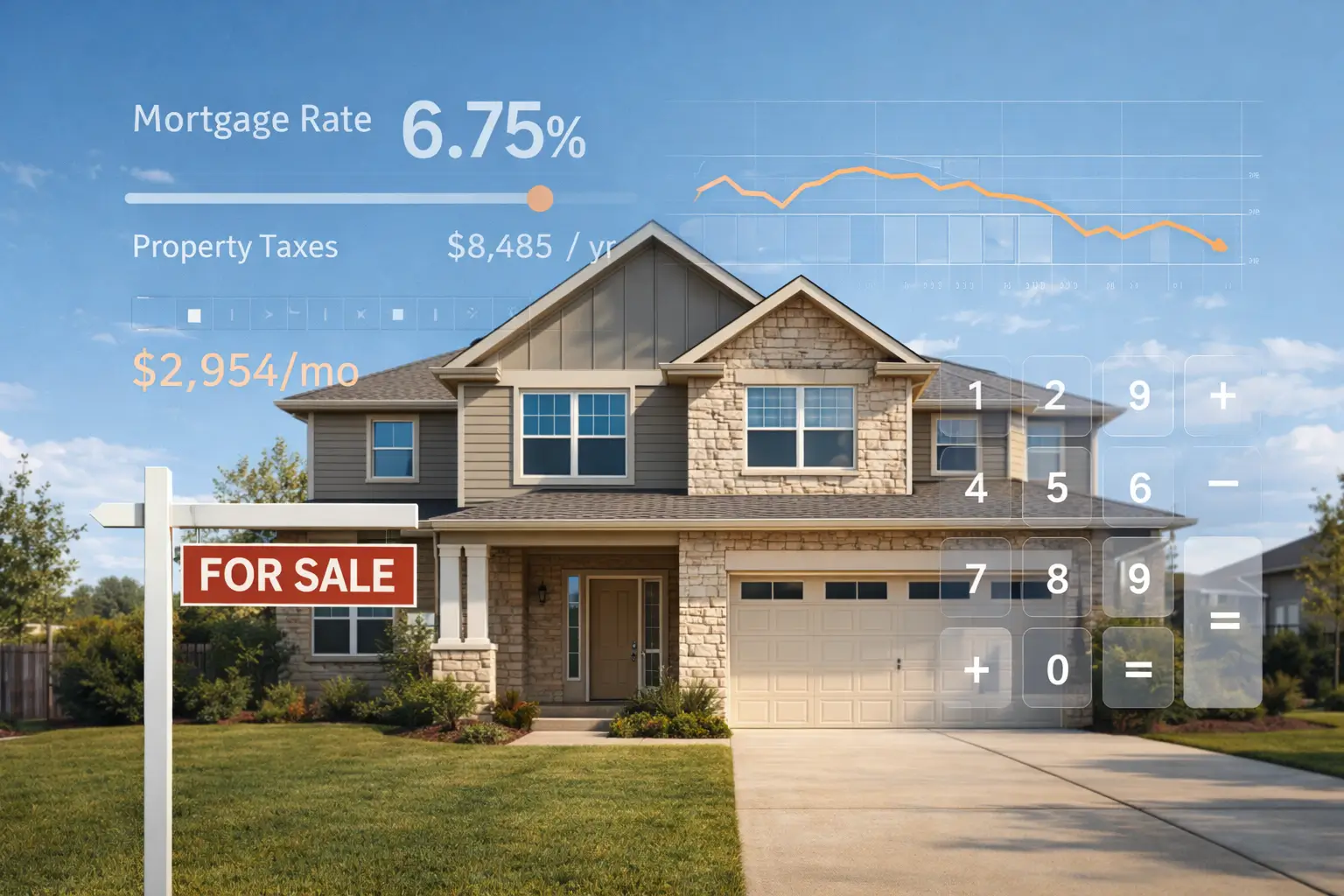
Real-World Example: The $340,000 Texas Home
Here’s what a typical financed buyer faces:
- Principal & Interest (6.75% rate): ~$1,985/month
- Property taxes (1.6% effective): ~$453/month
- Homeowner insurance: ~$250/month
- HOA + utilities: ~$300/month
👉 Total monthly cost: ~$2,988/month
To comfortably afford this (28% debt-to-income), households need ~$128,000 annual income—well above Texas’s median of ~$73,000 (U.S. Census Bureau, 2024).
The pandemic comparison: In 2020, a $300,000 home at 3% might have cost ~$2,200/month all-in. The same purchasing power now requires 36% more income, though wages haven’t increased proportionally.
Non-Mortgage Costs Have Exploded
Census data (Texas Tribune, 2025) shows median monthly homeowner costs (excluding mortgage P&I) rose to $1,452—7% higher than 2019. The Texas Comptroller reports Texas had the largest percentage-point increase in homeowner insurance premiums over five years among U.S. states, with major insurers scaling back policies after storm losses.
The Lock-In Effect Suppresses Turnover
About 70% of U.S. homeowners have mortgage rates below 5% (Redfin/Houston Chronicle, 2025). Many cannot justify abandoning these payments for 6-7% mortgages. Bankrate’s survey (2025) confirms over half of homeowners say no rate would make them comfortable selling this year.
Result: Home turnover has dropped to decades-low levels. Texas metros show even bigger sales declines. The market is dominated by “need to sell” owners (divorce, relocation) rather than discretionary moves.
Market Segmentation: Who’s Actually Buying?
Understanding Texas housing demand requires recognizing it’s highly segmented by price and buyer type.
TRERC’s data (2025) reveals stark differences:
- Sub-$300K homes: Sales fell ~3.8% year-over-year
- $300K-$400K homes: Dropped nearly 6%
- Million-dollar-plus properties: Increased ~11%, with 44% all-cash purchases
The typical financed, first-time or move-up buyer is squeezed by high rates and total ownership costs. Luxury and cash buyers remain less rate-sensitive but represent a smaller demand slice.
New Construction Pulls Demand From Resales
Texas led the nation issuing ~15% of U.S. new-home permits with only 9% of population. Builders use aggressive incentives: temporary rate buydowns (often 4.99%), closing-cost credits, and upgrade packages. Austin-area buyers report new homes sometimes costing $10K-$20K less monthly than older resales despite similar prices—pulling Texas housing demand from resale inventory.
How Texas Housing Demand Differs by Major Metro
Austin: Sharpest Correction
- Prices: Down 14-15% from 2022 peaks, ~$510K median (Realtor.com, 2025)
- Challenge: Heavy builder activity created oversupply, especially suburbs
- Strategy: Inner neighborhoods more resilient; sellers must price to current comps
Dallas-Fort Worth: High Inventory
- Status: Significant oversupply, 60-90+ days on market vs. weekend sales during boom
- Challenge: Suburban sprawl created deep oversupply pockets
- Strategy: Target stale listings (75+ days); advertise concessions upfront
San Antonio: Steepest Activity Decline
- Turnover: Down ~27% year-over-year
- Challenge: Middle-income affordability squeeze
- Strategy: Set realistic 90-120 day marketing expectations
Houston
Similar oversupply patterns as DFW, plus energy-sector volatility. HAR (2025) data shows consistently rising inventory and extending days on market.
Who Wins and Who Loses in Today’s Market
🏆 Winners
- Cash buyers: Avoid rate problem, massive leverage
- Luxury buyers: Sales up ~11% (TRERC, 2025)
- Builders with rate buydowns: Moving inventory, capturing market share
- Well-qualified move-up buyers: Less competition, strong negotiating power
- Long-term investors: Acquiring at discounts in oversupplied markets
📉 Losers
- First-time buyers: Completely priced out by rate-price-tax squeeze
- Middle-income families: ($60K-$100K) worst affordability hit
- Locked-in homeowners: 3-4% mortgages too good to abandon
- Inflexible resale sellers: Listings sit while buyers choose new construction
- Small builders: Can’t compete with large builders’ incentives
Actionable Strategies for Real Estate Professionals
For Buyer’s Agents
Leverage the buyer’s market:
- Target properties listed 60+ days where sellers are motivated
- Negotiate seller-paid rate buydowns, repair credits, closing-cost contributions
- Shop multiple builders for best rate-upgrade-price packages
- Educate clients on total costs including taxes, insurance, HOA—many are shocked by escrow estimates
For Listing Agents
Price competitively and offer value:
- Price to current 60-90 day comps, not 2021 peaks
- Advertise rate buydowns or closing-cost credits in listings to generate showings
- Set realistic 60-90 day marketing expectations
- Invest in professional photography, minor repairs, staging—properties must stand out with high inventory
Frequently Asked Questions About Texas Housing Demand
Is Texas a buyer’s market in 2025?
Yes, predominantly a buyer’s market—especially in oversupplied suburbs. Active listings are 53% above normal (Newsweek, 2025). Buyers have negotiating leverage absent since before the pandemic. Well-located infill properties remain competitive, but the market is highly segmented.
Why is demand weak if rates are stable?
Stable doesn’t equal affordable. Rates at 6.5-7% are roughly double pandemic-era norms. Combined with elevated prices, property taxes up 7% since 2019 (Texas Tribune, 2025), and insurance premiums rising fastest in the U.S. (Texas Comptroller), total monthly costs are prohibitive. Plus 70% of homeowners have sub-5% rates they won’t abandon.
Will Texas prices keep falling into 2026?
Most forecasts expect continued softness or mild declines, not freefall. TRERC expects additional pressure as inventory remains at 14-year highs. Biggest risk: oversupplied suburbs and insurance-exposed markets. Infill neighborhoods likely stay flat or decline modestly.
Which cities have the slowest demand?
Austin (down 14-15% from peaks), San Antonio (turnover down ~27%), Dallas-Fort Worth and Houston (both showing double-digit sales declines with rising inventory). Oversupplied suburban submarkets face weakest conditions across all major metros.
How are property taxes and insurance killing demand?
They inflate escrow and debt-to-income ratios beyond lender limits. Median monthly costs (excluding P&I) hit $1,452—7% higher than 2019 (Texas Tribune). For marginal buyers, learning escrow adds $500-$800/month above P&I often forces delays or lower price tiers.
Why do new builds sometimes have lower payments than resales?
Builders use rate buydowns (often to 4.99%), closing-cost credits, and upgrades to move inventory without slashing prices. Some Austin cases show new homes costing $10K-$20K less monthly than older resales despite similar list prices—pulling Texas housing demand from resale market.
What rates should buyers expect in 2026?
Drops to 3-4% unlikely absent recession. Forecasts cluster around high-5s to low-6s if inflation cools. Planning for 5.5-6.5% is realistic. A future refinance into the 5s is reasonable, but betting on 3% again is speculative.
How can buyers negotiate effectively now?
Target listings sitting 60+ days. Request seller-paid rate buydowns, repair credits, or closing contributions. Shop multiple builders. Well-qualified buyers have leverage they lacked in 2020-2021—use it strategically.
What should sellers do if homes aren’t moving?
Price to last 60-90 days of closed comps. Invest in presentation. Offer and advertise concessions prominently. Prepare for 60-90+ day cycles—now standard across most Texas metros.
Is 2026 a good time to buy in Texas?
Depends on circumstances. If payment-constrained and rate-sensitive, waiting for rates in the 5s could make sense. If you have strong income, substantial down payment, and 7-10+ year horizon, current conditions (high inventory, concessions, builder incentives) present opportunities—especially if you can refinance later. Key difference from 2021: buyers now have negotiating leverage.
The Bottom Line
Texas housing demand has slowed despite rate stability because fundamental affordability remains broken. Rates plateaued at structurally high levels, prices haven’t reset enough, and non-mortgage costs (taxes, insurance, utilities) have surged. The lock-in effect traps potential move-up buyers, while oversupply from aggressive building and 62% migration decline have shifted power to buyers.
For brokers and agents, success requires realistic pricing and expectations for sellers, total-cost education for buyers, strategic use of concessions, and recognition that financed mass-market buyers have largely tapped out while luxury and cash segments remain active.
The 2020-2021 frenzy is over. Properties that received multiple offers in 48 hours now sit 60-90 days. For professionals who adapt—emphasizing value, transparency, and practical guidance—there’s significant opportunity to build trust and capture market share.
Next step: Review current listings and buyer consultations through this total-cost lens. Are you communicating monthly payment realities including taxes and insurance? Are sellers priced against recent closes, not peak comps? Small messaging and pricing adjustments make the difference between properties that move and those that languish.