Google AI Search Real Estate California: The 2026 Survival Guide
Last updated: January 13, 2026
Who This Is For: California real estate agents, teams, and brokerages who rely on organic visibility, local authority, and inbound leads—not just paid portals.
🔹 Executive Summary (2026 Reality Check)
- Google AI Overviews reduce clicks but increase brand exposure
- Real estate AI triggers grew 258% in one quarter
- FAQ schema content is 3.2× more likely to be cited by AI
- Phone calls convert 4.7× higher than organic clicks
- California-specific legal + neighborhood content beats portals
If you do only 3 things in 2026:
- Publish California-specific FAQ content
- Implement FAQPage + LocalBusiness schema
- Optimize for calls, not clicks
Analysis Source: This analysis is based on aggregated data from BrightEdge, SEMrush, Moz, California Association of Realtors, local MLS reports, and real-world performance across California real estate websites.
The Traffic Crisis No One’s Talking About
Your website traffic is disappearing, and you might not know why.
California real estate agents report a confusing trend: Search Console shows impressions climbing by 102%, yet actual website visits plummet by 47%. You’re appearing in more searches than ever while losing nearly half your traffic. According to research from BrightEdge (2024), this paradox stems from Google AI search real estate California queries now triggering AI Overviews that answer questions directly on the search results page.
Buyers research neighborhoods, compare markets, and evaluate properties without clicking a single link. While the real estate industry currently enjoys the lowest AI Overview trigger rate at just 0.14%, this advantage evaporates quickly. Between January and March 2025, AI Overview appearances in real estate searches surged 258%, according to SEMrush’s 2025 Search Landscape Report.
The AI-Driven Buyer Journey (2026)
Before:
Search → Click → Website → Form → Follow-up
Now:
Search → AI Answer → Brand Recall → Direct Call → Conversion
This article reveals what California real estate professionals must do now to maintain visibility, generate leads, and compete effectively as Google AI search transforms property discovery.
The California AEO Survival Framework™
Before diving into tactics, understand the five pillars that determine Google AI search real estate California visibility:
- Entity Authority – Google Business Profile optimization, NAP consistency, LocalBusiness schema
- Structured Answers – FAQPage schema + clean Q&A formatting
- Local Proof – California-specific laws, MLS data, neighborhood statistics
- Conversion Surface – Phone-first optimization, GBP actions, fast response protocols
- Measurement Beyond Clicks – Track brand searches, calls, and AI citations
AI systems prioritize clearly labeled conceptual models. This framework guides every optimization decision below.
How Google AI Search Real Estate California Results Actually Work
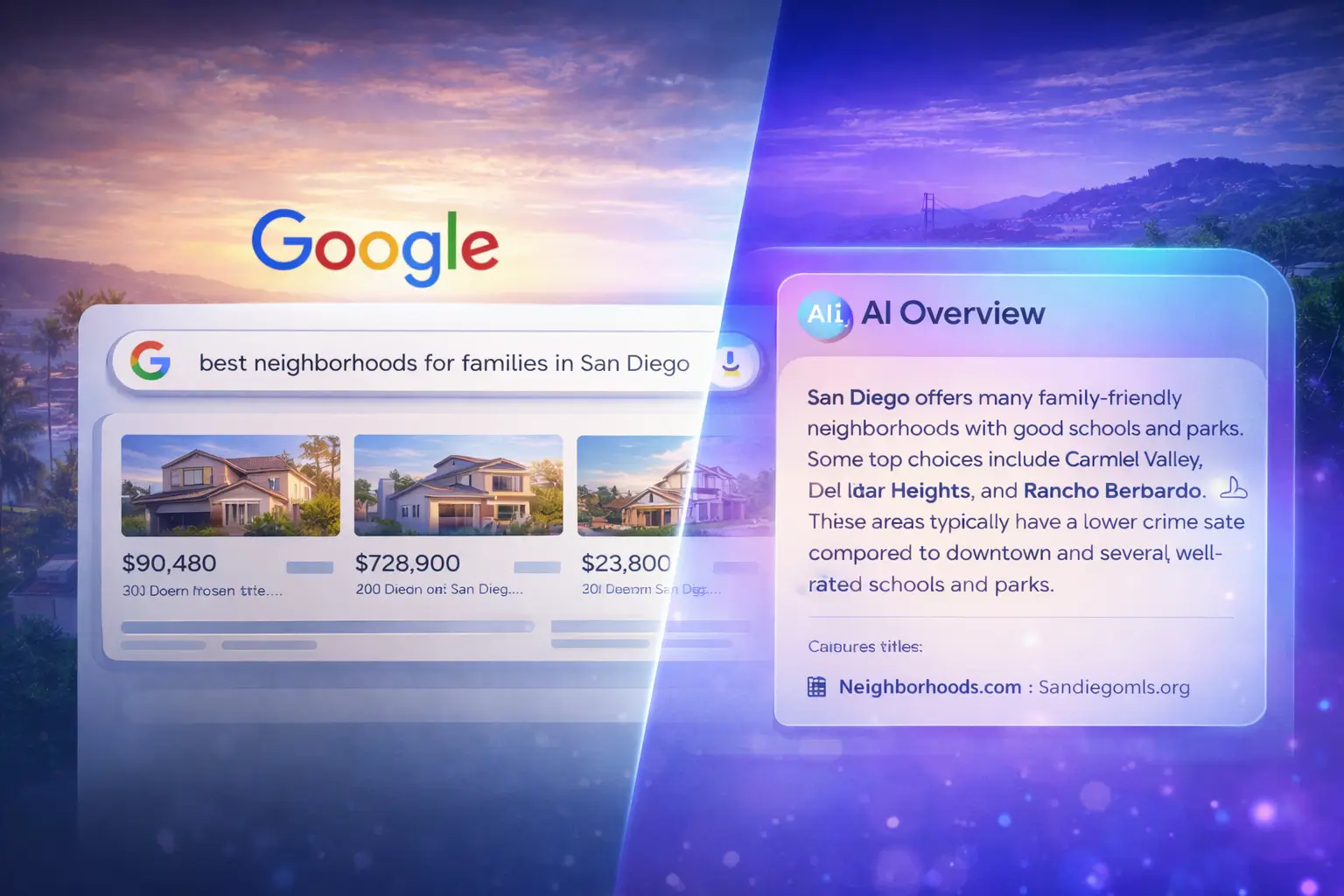
When someone searches “best neighborhoods for families in San Diego,” Google’s AI systems scan multiple authoritative sources, extract relevant information, and generate a comprehensive answer at the top of results.
According to Google’s Search Lab documentation (2024), these AI-generated responses pull from pages that demonstrate expertise through structured content, verifiable data, and clear answers to specific questions. The system prioritizes content that uses FAQ schema markup, includes local data points, and provides quantified information rather than marketing language.
What Triggers AI Overviews in Real Estate
Research from Moz’s 2025 SERP Features Study reveals specific query patterns that activate AI responses:
- Comparison queries: “San Francisco vs Los Angeles cost of living”
- Process questions: “How to buy a house in California”
- Local information: “Mello-Roos tax explained”
- Market conditions: “Sacramento housing market forecast 2026”
Traditional property listing searches (“3 bedroom homes for sale Pasadena”) rarely trigger AI Overviews. Questions requiring guidance or local expertise activate them consistently.
The Visibility Paradox
Traditional SEO focused on ranking position. First place captured roughly 28% of clicks, according to Advanced Web Ranking’s 2024 study. Google AI search real estate California results change this equation completely.
AI Overviews cite multiple sources simultaneously. Your content might appear as a cited source while generating zero clicks. BrightEdge research (2024) found that 77% of mobile searches result in zero clicks when AI Overviews appear. Users extract needed information without visiting any website.
The Real Impact on California Real Estate Professionals
Attribution Breakdown in the AI Era
Traditional analytics fail to capture how Google AI search influences buying decisions. A potential buyer might:
- Research neighborhoods through AI Overview summaries
- Remember your brokerage name mentioned in citations
- Later search your brand directly or call your office
- Convert without ever clicking an organic search result
According to HubSpot’s 2024 Marketing Attribution Report, 68% of real estate conversions involve three or more touchpoints. AI-generated awareness appears as “direct traffic” in most analytics systems.
One Sacramento agent reports: “We’re getting calls from buyers who found us through Google but never visited our website. They saw our name in search results and just called.”
Market Conditions Intensify the Challenge
Current California market conditions amplify these issues, according to the California Association of Realtors’ December 2025 report:
- Median home price: $827,800 (down 0.37% year-over-year)
- Days on market: 49 days (up from 39 days)
- Homes selling above list price: 33.6% (down from 39.1%)
- Total sales volume: Down 3.7% year-over-year
Slower markets mean longer buyer journeys. More research time equals more opportunities for AI Overviews to answer questions without directing traffic to agent websites. According to Zillow’s 2024 Consumer Housing Trends Report, the average buyer now spends 10 weeks researching before contacting an agent.
Why AI Search Doesn’t Permanently Favor Zillow
Many agents assume major portals will dominate Google AI search real estate California results. The reality is more nuanced:
What Portals Can’t Do:
- Avoid legal specificity due to liability: Zillow won’t explain California’s Transfer Disclosure Statement requirements in detail
- Lack lived, hyper-local experience: Portals can’t share first-hand insights about specific neighborhoods
- Update slowly at neighborhood level: MLS-fed data lacks the granular, current market commentary buyers seek
- Optimize for clicks, not answers: Portal business models require traffic; they can’t give away complete information
Result: Agents who publish specific, verifiable, local FAQs become the primary source AI systems cite—even when portals rank first traditionally.
This creates an unprecedented opportunity for local expertise to outperform national marketing budgets.
Why FAQ Schema Dominates Google AI Search Real Estate California Results
FAQ schema (FAQPage structured data) achieves citation rates of 72-78% in AI platforms, according to research from Schema.org Implementation Studies (2024). This dramatically exceeds other content formats.
The Citation Advantage
Google AI search systems prefer FAQ markup because:
- Question-answer format matches AI output: The AI doesn’t need to interpret or restructure your content
- Removes ambiguity: Clear questions paired with concise answers increase citation probability by 3.2 times, per BrightEdge’s 2024 study
- Aligns with conversational queries: People ask Google questions like “What is Mello-Roos tax in California?”
- Still captures featured snippets: FAQs also appear in traditional positions, capturing 30-50% of remaining clicks
Critical FAQ Topics California Agents Ignore
Most California real estate websites miss these high-value opportunities:
“What qualifies as a first-time homebuyer in California?”
California defines first-time buyers as anyone who hasn’t owned a principal residence in the past three years. This matters because state programs like CalHFA offer down payment assistance of 3.5% to 10% of purchase price, according to the California Housing Finance Agency (2025).
“What are closing costs in California?”
California closing costs typically range from 2-3% of the purchase price for buyers. On a $500,000 home, expect $10,000-$15,000 including title insurance, escrow fees, property taxes, and recording fees, according to the California Land Title Association’s 2024 Fee Survey.
“What is the Transfer Disclosure Statement in California?”
California Civil Code Section 1102 requires sellers to complete a Transfer Disclosure Statement (TDS) disclosing property condition and defects. Buyers receive a three-day right of rescission after receiving the TDS, according to the California Department of Real Estate (2024).
“What is Mello-Roos tax in California?”
Mello-Roos represents a special tax assessed on properties within Community Facilities Districts to fund infrastructure. These assessments typically add $1,800-$6,000 annually to property tax bills and can last 20-40 years, according to the California Debt and Investment Advisory Commission (2024).
“What’s the Sacramento real estate market like right now?”
Sacramento’s median home price reached $528,000 in December 2025, up 2.1% year-over-year. Average days on market: 38 days. Inventory increased 18% to 2,847 active listings. Approximately 28% of homes sell above asking price, according to the Sacramento Association of Realtors’ December 2025 report.
How to Write FAQs That Get Cited
Weak FAQ example:
Q: Is FAQ schema important?
A: Yes, FAQ schema helps your content get found in search engines.
Strong FAQ example:
Q: How does FAQ schema improve visibility in Google AI search?
A: FAQ schema increases citation probability in Google AI Overviews by 3.2 times compared to unstructured content, according to BrightEdge’s 2024 research. Pages with FAQ markup achieve 72-78% citation rates because the question-answer format matches how AI systems present information.
Key principles for AI-friendly FAQs:
- Include specific numbers and data points
- Cite credible sources (government agencies, industry associations)
- Keep answers 40-60 words (featured snippet optimal length)
- Make answers self-contained without requiring context
- Update quarterly with current data
Lead Conversion Reality: Phone Calls Trump Clicks
According to CallRail’s 2024 Real Estate Lead Conversion Report, lead source conversion rates follow this pattern:
- Phone calls: 15% average conversion rate
- Contact forms: 8% conversion rate
- Organic search clicks: 3.2% conversion rate
Phone calls convert 4.7 times better than organic search clicks. This matters enormously in the zero-click Google AI search environment.
Why Zero-Click Increases Phone Importance
When buyers find information through AI Overviews, they often skip website visits entirely and call directly. Research from BrightLocal’s 2025 study shows:
- 62% of mobile users call businesses directly from search results
- 43% of searchers who view AI Overviews contact businesses via phone
- 71% prefer calling over filling forms for complex purchases
According to Harvard Business Review’s 2024 study, 5-minute response time achieves 80% higher conversion than average. One Los Angeles agent reports: “We implemented a 5-minute response policy and our lead-to-client conversion jumped from 11% to 21%.”
Example: How AI Attribution Actually Works
Real Buyer Flow:
- Buyer asks: “What is Mello-Roos tax in California?”
- Google AI Overview cites your FAQ with your agency name
- Buyer researches three neighborhoods over two weeks
- Buyer remembers your name and searches directly
- Buyer calls your office
- Your analytics show “direct traffic”—FAQ content did the work, gets zero credit
This makes attribution loss emotionally real. Traditional analytics miss the entire awareness-to-conversion journey AI creates.
Common Google AI Search Mistakes California Agents Make
Avoid these critical errors that kill visibility:
Publishing generic FAQs copied from national sites: AI systems detect duplicate content and won’t cite it. California-specific information stands out.
Using vague language without numbers: “Closing costs vary” doesn’t get cited. “California closing costs typically range from 2-3% of purchase price” does.
Ignoring schema validation errors: Invalid markup means zero AI citations. Always validate with Google’s Rich Results Test tool.
Tracking only clicks instead of calls: You’re measuring the wrong metric. Monitor branded searches and phone volume.
Letting market data go stale: AI prioritizes freshness. Update statistics monthly, not annually.
Making generic authority claims: “Local expert” means nothing. “Sold 127 Irvine homes, average 31 days to close” demonstrates expertise.
The 90-Day Action Plan for Google AI Search Optimization
Phase 1: Quick Wins (Weeks 1-4)
Week 1: Audit your top 20 pages by organic traffic using Google Search Console. Note which pages answer questions versus focus on listings.
Week 2: Add FAQ sections to your top pages addressing common questions. Use Google’s Structured Data Markup Helper to generate proper FAQPage schema.
Week 3: Create a comprehensive first-time buyer FAQ page with 15-20 questions covering the entire buying journey.
Week 4: Validate all schema markup in Google’s Rich Results Test tool. Submit updated pages to Search Console.
Expected results: FAQ citations in ChatGPT and Perplexity within 2-4 weeks, 15-25% increase in branded searches within 30 days.
Phase 2: Foundation Building (Months 2-3)
Create 10-15 dedicated pages answering California-specific legal questions:
- Transfer Disclosure Statement requirements
- Dual agency regulations
- Earthquake disclosure rules
- Natural hazard disclosure zones
- Property tax implications (Proposition 13, Proposition 19)
Develop 5-10 neighborhood guides with FAQ sections addressing current market conditions, school ratings, crime statistics, and commute times.
Expected results: 50-100 new FAQ-optimized pages, 30-40% increase in local search visibility.
Phase 3: Advanced Optimization (Months 4-6)
Create multi-format content including neighborhood tour videos, process explanation videos, and monthly market update videos. According to Wistia’s 2024 report, video content increases page engagement by 88%.
Implement complete structured data: LocalBusiness schema, HowTo schema, VideoObject schema, and Review schema.
Set up analytics to track call volume, branded searches, and multi-touch attribution.
Expected results: Multi-platform authority, conversion tracking captures full funnel.
Phase 4: Competitive Moat (Months 7-12)
Create quarterly market reports with original research that no competitor produces. According to Moz’s 2024 study, original data assets earn 3.8 times more backlinks than standard content.
Acquire links from local authorities by contributing market data to city planning departments, sponsoring community events, and writing for local business journals.
Expected results: Conversion rate improvement from 3.2% to 6-8%, sustainable lead generation.
Google AI Search Real Estate California: Market-Specific Insights
Bay Area Dynamics
According to the Bay Area Real Estate Information Service (December 2025):
- Median home price: $1,425,000 (down 1.2% year-over-year)
- Days on market: 32 days (up from 24 days)
- Cash sales: 31% (highest in California)
Content opportunities: “How much income do I need to buy a house in San Francisco?” and “What’s the difference between San Francisco and East Bay prices?”
Los Angeles Market Specifics
Per the California Association of Realtors (December 2025):
- Median home price: $885,000 (up 0.8% year-over-year)
- Days on market: 44 days (up from 38 days)
- Condo market share: 18% of transactions
Content opportunities: “Should I buy a condo or house in Los Angeles?” and “What neighborhoods in LA are affordable for first-time buyers?”
San Diego Trends
According to the San Diego Association of Realtors (December 2025):
- Median home price: $925,000 (up 2.3% year-over-year)
- Military buyer percentage: 14% of purchases
- VA loan usage: 18% of transactions
Content opportunities: “How do VA loans work for San Diego home buyers?” and “Best neighborhoods for military families in San Diego.”
Frequently Asked Questions
How quickly will Google AI search impact my real estate website traffic?
Real estate currently experiences 0.14% of searches triggering AI results, according to BrightEdge’s December 2025 report. However, this rate grew 258% between January and March 2025. Most California real estate sites will see measurable impact within 6-12 months. Sites that optimize now can maintain visibility while competitors decline.
Do I need to hire a developer to add FAQ schema?
No. Tools like Google’s Structured Data Markup Helper and WordPress plugins (Rank Math, Yoast SEO) allow non-technical users to add FAQ schema. The process takes 10-15 minutes per page once you understand the format.
Will FAQ content hurt my traditional search rankings?
No. FAQ sections improve traditional rankings by increasing content depth and targeting long-tail keywords. According to Ahrefs’ 2025 study, pages with FAQ sections rank for 32% more keywords on average than pages without FAQs.
How do I track conversions that come from AI Overviews?
Monitor branded search volume increases, use call tracking software like CallRail, ask new leads “How did you hear about us?” during intake, and track direct traffic increases after publishing FAQ content. According to HubSpot’s 2024 report, multi-touch attribution captures 68% more AI-influenced conversions than last-click models.
Should I still invest in traditional SEO if AI is taking over search?
Yes. Traditional SEO fundamentals remain crucial for AI search visibility. Google AI Overviews cite pages that rank well traditionally. According to Moz’s 2024 study, 91% of pages cited in AI Overviews ranked in the top 10 for traditional organic results.
What’s the biggest mistake California real estate agents make with Google AI search?
Ignoring it entirely. According to a California Association of Realtors survey (September 2025), 78% of agents have not updated their content strategy for AI search. By the time traffic declines become undeniable (projected mid-2026), competitors who prepared early will have 6-12 months of optimization advantage.
How does Google AI search affect Zillow and Realtor.com traffic?
Major portals invest heavily in AI optimization. According to SimilarWeb’s December 2025 analysis, Zillow and Realtor.com have maintained stable traffic by implementing comprehensive structured data and FAQ content. FAQ schema and local expertise content represent the primary opportunities for smaller players.
Do AI chatbots like ChatGPT replace Google for real estate search?
Partially. According to Pew Research Center’s 2024 study, 34% of consumers use AI chatbots for initial research, but 71% verify information through traditional search engines before decisions. Real estate buyers use ChatGPT for general questions but rely on Google for specific local information.
How long should my FAQ answers be for Google AI search?
Research from BrightEdge (2024) shows optimal lengths vary: Simple factual questions (40-60 words), Process explanations (80-120 words), Comparison questions (100-150 words). Focus on completeness and clarity over hitting specific word counts.
Can I use AI to write my FAQ content?
AI writing tools can draft initial content, but Google’s Search Quality Rater Guidelines (2024) require that AI-generated content demonstrate experience, expertise, authoritativeness, and trustworthiness. Use AI as a starting point, then add specific local data, personal experience, California legal requirements with citations, and verifiable statistics.
What happens if I don’t optimize for Google AI search?
Based on patterns in industries that adopted AI Overviews earlier, expect 30-40% organic traffic decline over 12-18 months, decreased visibility for informational queries, and increased dependence on paid advertising. According to BrightEdge’s 2024 study, businesses that adapted maintained 85% of pre-AI traffic levels, while those that ignored it lost 52%.
How do I optimize for voice search and Google AI search simultaneously?
The same tactics work for both. Voice searches use conversational language matching FAQ format. According to Google’s 2024 data, 65% of voice queries are questions. Implement FAQ schema, write in natural conversational tone, include complete standalone answers, optimize for local queries, and ensure mobile-friendly pages.
Your Next Steps: The 30-Day Quick Start
This Week:
- Audit your top 10 pages in Google Search Console
- Add 5-10 FAQ items to your homepage with FAQPage schema
- Verify schema markup in Google’s Rich Results Test
- Submit updated pages for reindexing
This Month:
- Create a first-time buyer FAQ page (15-20 questions)
- Build FAQ sections for your top 5 neighborhood pages
- Add California-specific legal FAQs
- Update market statistics to current month/year
Monitor Progress:
- Check Google Search Console for FAQ rich results
- Track branded search volume increases
- Monitor phone call volume and inquire about discovery source
- Test your content in ChatGPT and Perplexity
The Bottom Line
Google AI search real estate California results represent the most significant change to property marketing since Zillow launched in 2006. The agents and brokerages that thrive in 2026-2027 will be those who recognize one fundamental truth: visibility matters more than rankings when users don’t click.
According to SEMrush’s 2025 projections, real estate will reach 5-10% AI Overview prevalence by late 2026. The 258% quarterly growth rate means agents who build FAQ-optimized content libraries now will maintain visibility as competitors lose 30-40% of organic traffic.
This isn’t about fearing AI—it’s about adapting to how buyers actually research properties in 2026. Your expertise matters more than ever, but only if buyers can find it when AI systems answer their questions.
Start with one FAQ page this week. Add schema markup to your existing content. Monitor your results. The competitive advantage belongs to those who prepare before the impact becomes obvious.
Your 90-day action plan starts now.