California Real Estate Lead Cost 2025: Complete Market Analysis & Optimization Guide
Last updated: January 2025
Data reflects California market conditions from Q3 2024 through early 2025 benchmarks.
California Real Estate Lead Cost 2025 – Key Takeaways
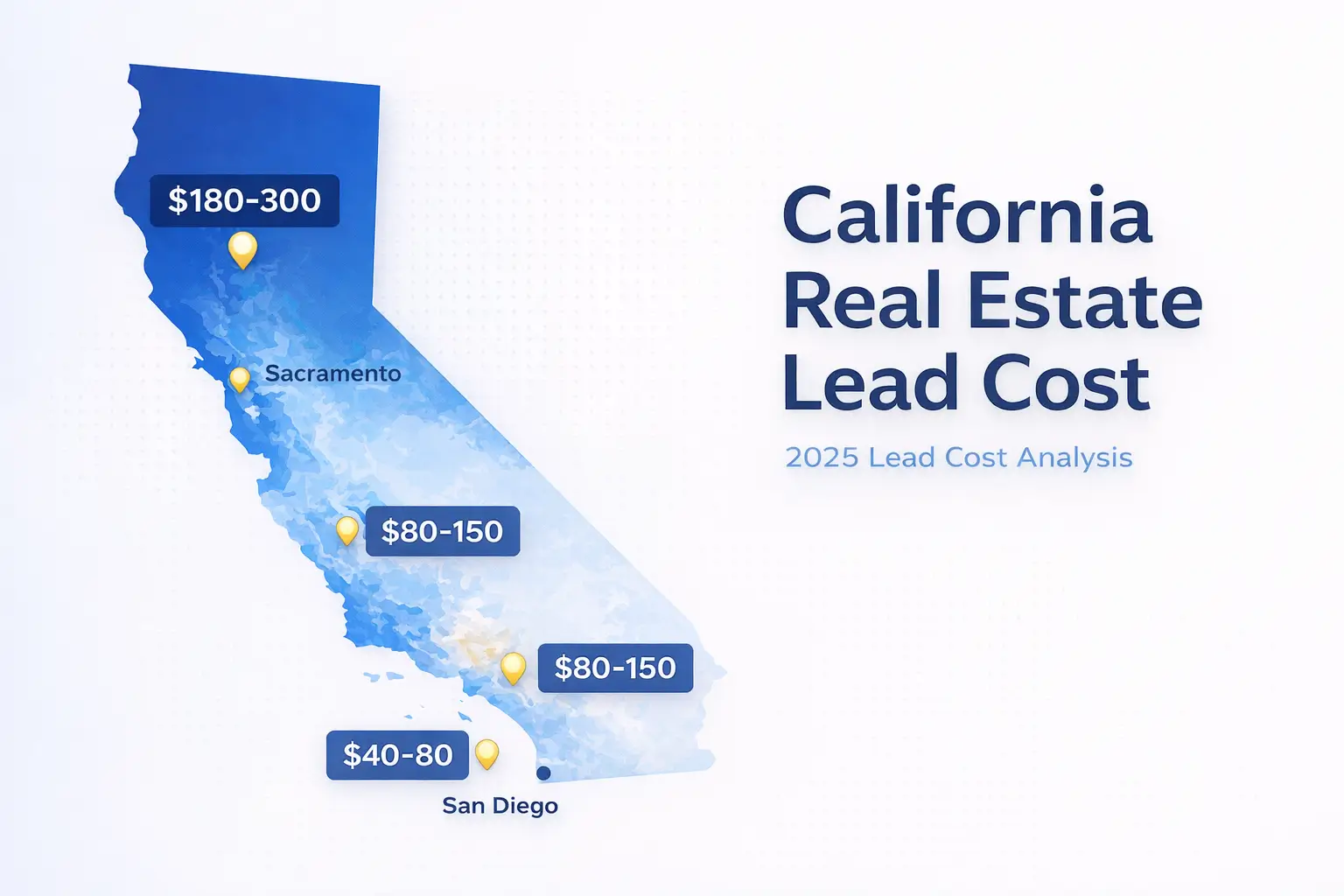
• Average CPL: $80–$150 statewide | SF & LA Google Ads: $180–$300
• Seller leads cost ~40% more than buyer leads
• Facebook delivers best short-term ROI ($5–$50 CPL)
• Referral & content channels produce 650–890% ROI long-term
• Cost per acquisition should stay under 20% of commission
Who This Guide Is For
This guide helps solo California agents, teams spending $1,000–$5,000 monthly on lead generation, agents frustrated with Zillow ROI seeking better alternatives, and new agents needing predictable pipeline strategies. Whether you’re in San Francisco paying premium rates or Stockton capitalizing on lower costs, you’ll find actionable frameworks for your market.
Executive Summary
Real estate lead cost California markets have surged 12% year-over-year, with agents paying $80–$150 per lead statewide. In San Francisco and Los Angeles, Google Ads costs hit $180–$300 per lead while the national average sits at $53.52. This guide reveals why California costs outpace the nation, which channels deliver the best ROI, and how agents cut their cost per acquisition by 70% through strategic optimization.
Understanding California Real Estate Lead Cost by Channel
What Drives Real Estate Lead Cost California Markets Higher?
California’s real estate lead costs stem from five factors. Market competition drives San
Francisco Google Ads to $180–$300 per lead while Stockton stays at $6.75–$15. The California Association of Realtors reports median home prices hit $909,400 in 2025, up 4.6% from 2024. Higher property values justify higher lead costs since commissions scale proportionally.
Inventory constraints create supply-demand imbalances. New listings declined 15–17% year-over-year in San Francisco, San Diego, and Riverside per California Regional MLS Q3 2024 data. Seller leads become premium assets worth $26–$30 versus buyer leads at $9–$20. Technology investment now requires 10% of annual income per National Association of Realtors 2024 Member Profile. Response time failures inflate costs dramatically—leads contacted within 5 minutes convert at 9x the rate of delayed responses per Harvard Business Review research, forcing agents without automation to purchase 5–10x more leads.
Real Estate Lead Cost California by Channel: 2025 Pricing
Google Ads leads cost $53.52 nationally but reach $100–$180 in LA/SD and $180–$300 in San Francisco per WordStream 2024 benchmarks, with 5–8% conversion. Facebook Ads deliver best cost efficiency at $5–$25 statewide ($25–$50 in SF/LA) with 3–7% conversion. Instagram runs $15–$40 with similar performance.
Zillow charges $2,500–$4,000 monthly but multiple 2024 agent discussions (Reddit r/RealEstate, r/Realtors, BiggerPockets) document zero conversions over 90+ days. Zillow sells each lead to multiple agents, creating speed competition. Zillow leads appear high-intent, but multi-agent distribution and delayed follow-up suppress real-world conversion below 1%. Realtor.com leads cost $25–$45 with 4–6% close rates. LinkedIn runs $30–$90 for commercial/luxury with 8–12% conversion.
The California Lead Cost Pyramid: Strategic Channel Framework
Understanding where channels sit in the cost-ROI hierarchy helps budget allocation:
Tier 1 – Volume Channels (Facebook, Instagram): $5–$50 CPL, 3–7% conversion, ideal for immediate pipeline. Tier 2 – Intent Channels (Google Ads, Realtor.com): $50–$180 CPL, 5–8% conversion, suited for qualified prospects. Tier 3 – Asset Channels (SEO, Content, Referrals): $80+ CPL initially, 8–67% conversion, best long-term ROI (650–890%), eventually producing lowest cost per acquisition ($7–$200).
Zillow sits awkwardly between tiers—charging Tier 2 prices ($2,500–$4,000 monthly) while delivering Tier 1 quality (sub-1% conversion) due to multi-agent distribution. Top California agents progressively move up the pyramid, starting with Volume channels, adding Intent channels, and building Asset channels for long-term profitability.
Real Estate Lead Cost California by Region
San Francisco/Bay Area: $180–$300 (Google), $25–$50 (Facebook), need $2,000–$3,000 monthly minimum. LA/San Diego/OC: $80–$150, support $1,000–$2,000 budgets. Inland Empire: $40–$80, succeed with $500–$1,000 budgets. Small/rural markets: $6.75–$15, need $200–$500 focusing on organic strategies.
Buyer vs Seller Lead Costs: California’s 40% Premium
Seller leads cost $26–$30+, showing 40% premium over buyer leads at $9–$20. Each listing creates 5–10 potential buyer transactions. California’s 15–17% inventory decline makes seller leads scarce assets. Smart agents allocate 60–70% of budgets to seller acquisition. Luxury leads reach $300–$500 but justify costs through commission leverage—a $3M listing generates $90,000+ commission at 3%. Commercial leads cost $150–$400 with 5–8% conversion over 6–12 months.
Case Snapshot: Los Angeles Buyer Agent
Monthly Budget: $1,500 | Channels: Facebook ($900) + Google ($600) | Leads: 42/month (36 from Facebook at $25, 6 from Google at $100) | Conversion: 6% overall | Closings: 2.5/month | Cost Per Acquisition: $600 | Average Commission: $12,000 | ROI: 5% CAC-to-commission ratio (well under 20% benchmark).
This demonstrates how blending volume channels (Facebook) with intent channels (Google) creates profitable economics with consistent 5-minute response times and proper qualification hitting 6%+ conversion.
Strategic Optimization: Cutting California Real Estate Lead Costs
Why Cost Per Lead Misleads California Agents
Agent A: 100 leads at $5 ($500 total), 1% conversion = $500 CAC. Agent B: 20 leads at $30 ($600 total), 20% conversion = $150 CAC. Agent B’s expensive leads deliver 3.3x better economics. High-intent leads convert at 8–15%, medium at 3–7%, low at 1–3% per Lead Connect 2024 study. A $50 lead at 10% conversion ($500 CAC) beats a $10 lead at 1% conversion ($1,000 CAC). Keep CAC under 20% of commission.
Real Estate Lead Cost California ROI Rankings
Referrals generate 890% ROI (Referral Rock 2024) with 45–67% conversion and $100–$200 CAC, requiring 12–24 months to build. Content delivers 650% ROI after 6–12 months, dropping from $80+ to $7–$30 per lead. Email returns $42 per $1 spent (Campaign Monitor 2024). Google Ads deliver immediate results at $50–$180 per lead, 5–8% conversion,
$1,000–$2,000 CAC. Facebook offers best short-term value at $5–$50, 3–7% conversion, $200–$800 CAC.
Why $3,000 Monthly Underperforms for Many California Agents
Zillow charges $2,500–$4,000 monthly but sells each lead to multiple agents (fastest wins). Multiple 2024 forums (Reddit r/RealEstate, r/Realtors, BiggerPockets) document $3,000+ monthly spend with zero conversions over 90+ days. One LA agent reported 128-day customer support wait. Test Facebook ($15–$50, 3–7% conversion) or Google ($50–$180, 5–8% conversion) for 60–90 days for typically superior economics.
5-Minute Response Rule: California’s Hidden Cost Multiplier
5-minute responses convert at 9x delayed responses (Harvard Business Review). Delays require 8–10x more leads for identical results. SMS automation ($50–$200/month) achieves 99% open rates. AI answering services ($300–$500/month) increase qualified conversion 40%+ per Smith.ai 2024. Virtual assistants ($8–$15/hour) reduce response time 65%, improving conversion 30–45%. Most investments pay back within 1–2 months.
Budget Allocation for California Agents
How Much Should You Budget?
Budget 10% of projected annual gross income (NAR 2024). $200K target = $1,667 monthly: 40% paid ads ($667), 30% content/SEO ($500), 20% CRM/automation ($333), 10% testing ($167). New agents (0–12 months): 60% paid, 40% organic/referral investment. Established agents (2+ years): 30% paid, 40% organic, 20% technology, 10% testing.
Seasonal California Patterns
Spring: 15–25% cost increases (CAR 2024), reduce paid 20–30%. Fall: 10–20% reductions, increase paid 20–30% for discount leads. Winter: 25–40% less competition, lowest annual costs, aggressive acquisition for agents with cash flow.
California Real Estate Lead Cost: Agent Questions
What is a good cost per lead for California real estate in 2025?
A good California real estate lead cost ranges from $20–$100 depending on market and lead type, but optimize for cost per acquisition under 20% of commission rather than CPL alone. Buyer leads: $15–$35, seller leads: $25–$60. A $50 lead at 10% conversion ($500 CAC) beats a $10 lead at 1% conversion ($1,000 CAC).
Why do California real estate lead costs exceed national averages?
California lead costs exceed national averages due to $909,400 median home prices creating commission leverage, competition intensity in SF/LA driving bidding wars, and 15–17% inventory decline making seller leads scarce (California Regional MLS Q3 2024).
How much should a new California agent budget monthly?
New California agents should budget minimum $500–$1,000 monthly in most markets, with SF/Bay Area requiring $1,500–$2,500 minimums. Allocate 60% paid ads for immediate leads, 40% long-term investments. Expect 6–12 months before organic channels contribute meaningfully.
Are Zillow leads worth $3,000 monthly?
Most California agents report poor ROI with sub-1% conversion. Zillow sells each lead to multiple agents, charges 25–35% referral fees, provides no data portability. Forums (Reddit r/RealEstate, r/Realtors) document zero conversions over 90+ days despite $3,000–$4,000 spending. Test Facebook ($15–$50, 3–7% conversion) or Google ($50–$180, 5–8% conversion) for superior economics.
Which source delivers the best ROI?
Referrals generate best long-term ROI at 890% with 45–67% conversion and $100–$200 CAC, requiring 12–24 months to build. For immediate results, Facebook delivers best value at $5–$50, 3–7% conversion. Content produces 650% ROI after 12 months, dropping from $80+ to $7–$30 per lead. Layer all three channels.
How does response time affect costs?
5-minute responses convert at 9x delayed responses, meaning delays force 8–10x more lead purchases for identical results. SMS automation ($50–$200/month) achieves 99% open rates. AI answering ($300–$500/month) increases qualified conversion 40%+. ROI within 1–2 months through reduced waste.
What’s the buyer vs seller lead cost difference?
Seller leads cost $26–$30+ (40% premium over buyer leads at $9–$20) because each listing
generates 5–10 buyer transactions. California’s 15–17% inventory shortage makes seller leads scarce. Allocate 60–70% of budgets to seller acquisition. Luxury leads reach $300–$500 but justify costs through commission leverage.
How do regional markets differ?
SF/Bay Area: $180–$300 (Google), $25–$50 (Facebook). LA/SD/OC: $80–$150. Inland Empire: $40–$80. Small/rural: $6.75–$15. Higher coastal property values justify premium pricing through larger commissions.
Paid ads or organic strategies?
Use hybrid: paid for immediate pipeline, organic for long-term profitability. New agents: 60% paid, 40% organic. Established: 30% paid, 40% organic. Content requires 6–12 months, eventually producing $7–$30 per lead. Referrals take 12–24 months but generate 45–60% of mature agent transactions.
How to measure ROI?
Calculate: (Net Profit ÷ Lead Generation Cost) × 100. Track CPL, conversion rate by source, cost per appointment, CAC, customer lifetime value, time-to-close. Benchmark: CAC under 20% of first-year commission. Example: $10K commission allows max $2K CAC.
What seasonal patterns exist?
Spring: 15–25% cost increases. Summer: stable pricing. Fall: 10–20% reductions. Winter: 25–40% less competition, lowest costs. Strategic agents increase spending when costs drop, capturing discount leads while competitors reduce budgets.
How do AI and automation impact costs?
AI delivers 40%+ qualified conversion increase, 65% response time reduction, 30% nurturing cost savings. SMS automation: $50–$200/month. AI answering: $300–$500/month. Virtual assistants: $8–$15/hour. Most investments pay back within 3–6 months through reduced waste and improved conversion.
Taking Action on California Real Estate Lead Costs
California real estate lead costs continue rising as competition intensifies and inventory constraints persist. However, profitability depends on cost per acquisition and systematic conversion optimization, not cost per lead alone.
Successful California agents segment by regional market to exploit cost advantages, optimize for conversion rate rather than volume, diversify across paid ads for immediate results plus referrals and content for long-term sustainability, implement 5-minute response automation using SMS and AI tools, and measure cost per acquisition rather than vanity metrics.
Next steps: Calculate current CAC by channel, implement SMS automation for 5-minute response, test Facebook for 60 days if using Zillow, allocate 10% of projected gross income with 60% paid and 40% organic initially, track conversion rates weekly to eliminate underperforming sources. These actions position you ahead of most California agents who continue optimizing wrong metrics while costs rise and profits shrink.