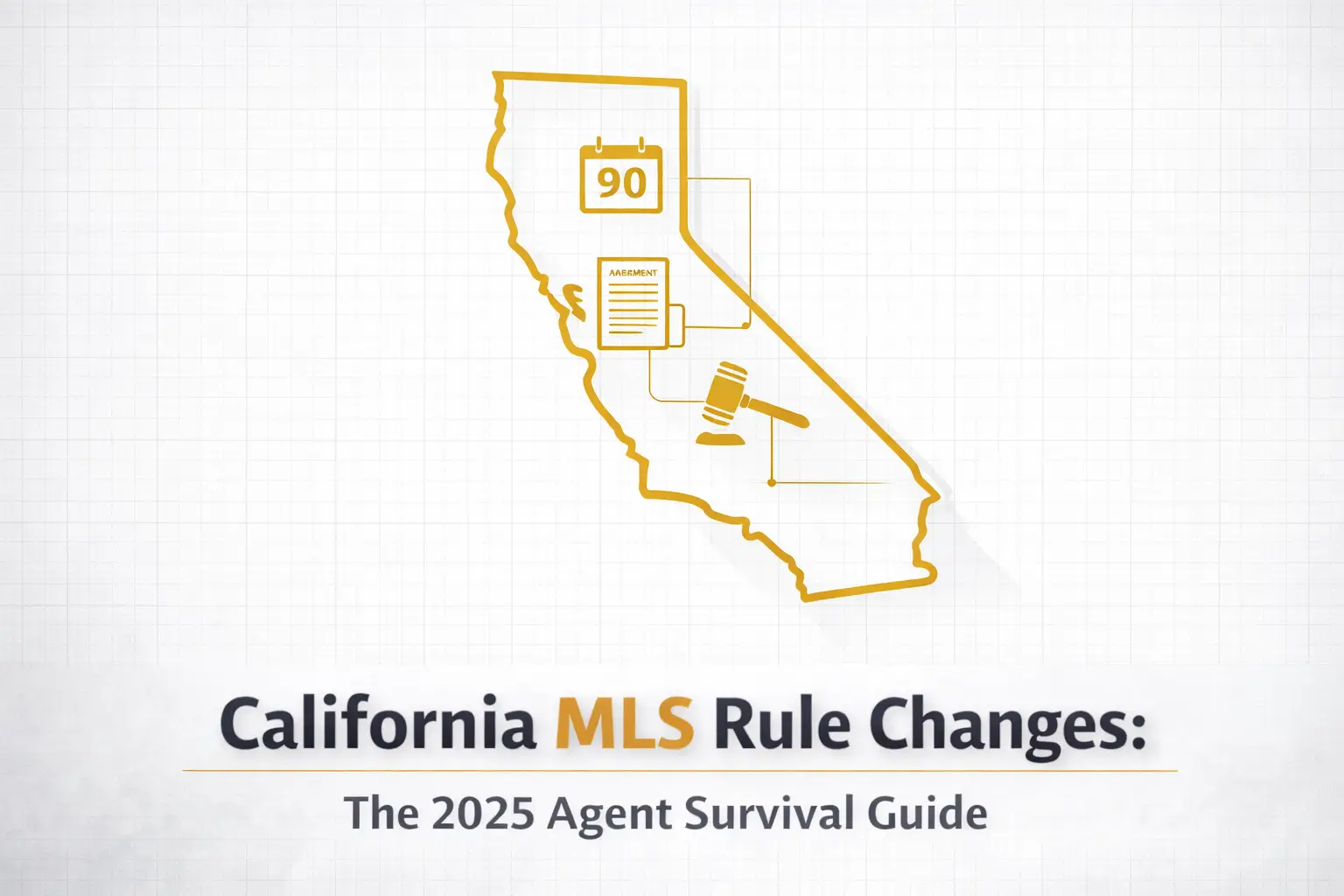
California MLS Rule Changes: The 2025 Agent Survival Guide
Last Updated: December 21, 2024
California real estate agents are navigating the most significant regulatory transformation in decades. Between August 2024 and January 2025, the National Association of REALTORS (NAR) settlement and California Assembly Bill 2992 rewrote the rules on commissions, buyer agreements, and MLS practices. If you’re still operating under pre-settlement assumptions, you’re exposing yourself to compliance violations that could cost you your license. However, agents who adapt early are already building stronger, clearer client relationships and competitive advantages in the new landscape.
This guide breaks down exactly what changed, why it matters, and how to stay compliant while building a profitable practice in 2025.
Quick Summary: California MLS Rule Changes (2025)
Key Changes Every Agent Must Know:
- Compensation cannot appear on MLS listings or remarks
- Written buyer agreements required before any property showings
- Buyer agreements capped at 90 days for individual buyers
- Agents cannot earn more than the agreement amount, even if seller offers more
- Coming Soon rules updated August 2025 with optional status and DOM reset
- Enforcement from MLS, NAR, DRE, and DOJ with overlapping penalties
- Regional MLS variations (CRMLS, Bay East, bridgeMLS) require local compliance
Before vs After: What Actually Changed
| Area | Before 2024 | After 2025 |
|---|---|---|
| Buyer Agent Pay | Displayed on MLS | Private negotiation only |
| Buyer Agreements | Optional or informal | Mandatory before showing |
| Agreement Duration | Open-ended with renewals | 90 days max (individuals) |
| MLS Remarks | Compensation allowed | Strictly prohibited |
| Coming Soon | Limited strategic use | Optional with DOM reset |
| Compensation Discovery | Instant MLS visibility | Phone/email listing agent |
| Auto-Renewal | Common practice | Prohibited by law |
Why California MLS Rule Changes Happened: The Backstory You Need
The California MLS rule changes stem from two converging forces that fundamentally restructured real estate transactions.
The Federal Lawsuit
In October 2023, a federal jury in Missouri ruled that NAR’s cooperative compensation rule violated antitrust law by artificially inflating agent commissions. The Sitzer-Burnett case awarded $1.8 billion to home sellers, arguing that requiring listing agents to post buyer-agent compensation on the MLS created systemic pressure that kept fees high. NAR settled for $418 million in March 2024 and agreed to eliminate compensation displays from MLS systems nationwide, effective August 17, 2024 (source: NAR settlement agreement, March 2024).
California’s Legislative Response
California didn’t wait for NAR. In September 2024, Governor Gavin Newsom signed Assembly Bill 2992, which mandates written buyer representation agreements before any property showing and caps individual buyer agreements at 90 days. The law took effect January 1, 2025 (source: California Legislative Information, AB 2992, September 2024).
Together, these changes eliminated the transparency that defined MLS operations for 30 years. California agents now operate in a negotiation-based compensation system where nothing is guaranteed and everything must be documented.
Who These California MLS Rule Changes Apply To
These regulations affect all California real estate professionals:
- Residential agents (single-family, condos, townhomes)
- Commercial agents (office, retail, industrial, multifamily)
- Buyer agents (representing purchasers)
- Listing agents (representing sellers)
- Team leaders and brokers (responsible for agent compliance)
- Independent contractors (working under broker licenses)
The only partial exemption: corporate buyers (LLCs, partnerships, corporations) are exempt from the 90-day agreement cap but still require written buyer representation agreements.
The Three Core California MLS Rule Changes Every Agent Must Know
1. Compensation Is No Longer Visible on MLS
Before August 2024, listing agents entered buyer-agent compensation directly into MLS fields. A typical listing showed “2.5% to buyer’s agent” or “3% co-op.” Buyer agents knew their compensation before contacting a seller.
That system is gone. California MLS platforms including CRMLS, Bay East, and bridgeMLS removed all compensation fields from listing data in August 2024. Listing agents cannot post what they’ll pay buyer agents. Buyer agents cannot see offers until they ask directly.
What This Means in Practice
Buyer agents now spend hours each week calling or emailing listing agents to ask: “Are you offering compensation?” Each conversation must be documented for compliance. One Bay Area agent reported making 40+ calls per week just to discover compensation offers, time that previously went to client service (source: agent-reported experience, anecdotal non-statistical, Reddit r/realtors discussion, November 2024).
Compliance Requirement
You cannot discuss seller-offered compensation in MLS public remarks, private remarks, or any syndicated listing description. Violations trigger enforcement from your MLS, potentially resulting in access termination. Federal regulators are monitoring MLSs for compensation disclosure violations (source: DOJ Antitrust Division compliance monitoring program, 2024).
2. Mandatory Written Buyer Representation Agreements Before Any Showing
California’s AB 2992 and the NAR settlement both require written buyer representation agreements before showing property. No exceptions, no workarounds.
Key Requirements
| Element | Requirement |
|---|---|
| Timing | Before any in-person or virtual showing, or no later than execution of purchase offer |
| Maximum Duration | 90 calendar days for individual buyers; no limit for corporations/LLCs |
| Auto-Renewal | Prohibited; all renewals must be signed and dated |
| Required Disclosures | Scope of services, compensation amount and type, circumstances requiring buyer payment |
| Standard Form | C.A.R. Form BRBC (Buyer Representation & Broker Compensation Agreement) |
| Property Types | All residential and commercial properties |
The 90-day cap fundamentally changes buyer-agent relationships. Market data shows buyers are negotiating these agreements aggressively: 61% of buyers who negotiate successfully reduce agent fees, up from 31% before the settlement (source: Consumer Federation of America survey, October 2024).
What Must Be Disclosed
Your buyer agreement must explicitly state total compensation (percentage, flat fee, or hourly rate), what happens if the seller offers different compensation, whether the buyer pays out-of-pocket if seller won’t pay, specific services included, and maximum agreement duration. Vague language like “commission to be determined” violates AB 2992.
3. Agent Compensation Cannot Exceed Agreement Amount
The most misunderstood California MLS rule change: you cannot receive more than what’s written in your buyer representation agreement, even if the seller offers more.
How This Works
| Scenario | Result |
|---|---|
| Buyer agreement: 2.5%, Seller offers: 3% | Agent receives 2.5%; excess stays with seller or listing agent |
| Buyer agreement: 2%, Seller offers: 1.5% | Buyer pays 0.5% difference or finds different property |
| Buyer agreement: $5,000 flat fee, Seller offers: 2.5% | Agent receives $5,000; seller keeps additional amount |
DOJ and California Department of Real Estate (DRE) are investigating agents who modify buyer agreements upward when sellers offer higher compensation. This practice violates both the NAR settlement and state law. Agents caught doing this face license suspension and civil penalties (source: California DRE enforcement bulletin, August 2024).
Coming Soon Listing Rule Changes: California’s August 2025 Update
California MLSs updated Coming Soon rules in August 2025 to provide flexibility while maintaining compliance with Clear Cooperation Policy.
What Changed in August 2025
Coming Soon status is now optional. Agents can choose Coming Soon or go directly to Active. Key provisions:
- Listing Agreement Required: Must have signed listing agreement before entering Coming Soon
- MLS Visibility: Visible to all MLS participants (agents), not to public consumers
- Syndication Limits: Will NOT syndicate to Zillow, Redfin, or Realtor.com unless MLS specifically approves
- Public Marketing Allowed: After MLS entry, agents can use signs, social media, and flyers
- Showing Rules: Agent showings allowed; open houses and broker tours prohibited
- Days on Market Reset: Counter resets to zero when moving from Coming Soon to Active
- Offers Permitted: Agents can accept and present offers during Coming Soon
- Photo Requirement: Minimum one exterior photo within 72 hours
Strategic Advantage
The Days on Market reset creates powerful listing strategy opportunities. An agent can list in Coming Soon for 2-3 weeks, build buyer interest through private showings, generate competitive offers, then move to Active with a reset counter. The property appears “newly listed” despite weeks of exposure.
Regional California MLS Rule Variations You Must Know
While NAR settlement requirements apply statewide, individual MLSs implement California MLS rule changes differently.
CRMLS (California Regional MLS)
Serves Southern California including Los Angeles, Orange County, and Inland Empire. Updated Rule 7.15 effective January 13, 2025, prohibiting compensation disclosure in any MLS field. Sales reporting deadline: within 48 hours of close of escrow. Coming Soon listings limited to 21 days before mandatory Active status (source: CRMLS Rules & Policy Change Summary, January 13, 2025).
Bay East Association of REALTORS
Serves Bay Area including Alameda and Contra Costa counties using Paragon MLS platform. Coming Soon rules updated August 18, 2025, aligning with CAR model policy. Photograph requirements: minimum one exterior photo within 72 hours (source: Bay East MLS Rule Changes, effective August 18, 2025).
bridgeMLS
Serves San Diego County with rule changes effective September 29, 2025. Status change requirements tied to CAR compliance standards with additional reporting requirements for concessions and seller contributions (source: bridgeMLS MLS Rule Changes, effective September 29, 2025).
Check your local MLS’s 2025 rules updates. Coming Soon duration limits, photo requirements, and syndication policies vary by MLS.
The Enforcement Trifecta: Who’s Watching California MLS Rule Changes
Agents face overlapping enforcement from three regulatory layers, each with distinct penalties.
Layer 1: National Association of REALTORS (NAR)
Monitors member compliance with settlement terms. Penalties include membership revocation and fines ranging from $500 to $15,000 per violation. Currently investigating modified buyer agreements, undisclosed compensation, and workaround strategies (source: NAR Professional Standards enforcement guidelines, 2024).
Layer 2: Multiple Listing Services
Direct contract enforcement with member agents. Penalties include MLS access suspension or termination. CRMLS received substantial compliance documentation requests from federal enforcers in 2024 (source: agent-reported experience, anecdotal non-statistical). Monitoring compensation discussions in listing remarks, touring agreement workarounds, and buyer agreement violations.
Layer 3: State and Federal Regulators
California Department of Real Estate (DRE) and U.S. Department of Justice (DOJ) Antitrust Division actively investigate secret compensation arrangements, kickbacks, and undisclosed dual agency. Penalties include license suspension, civil fines up to $100,000, and criminal charges for fraud.
A San Diego agent lost her license in September 2024 after accepting under-table payments from sellers while representing buyers (source: California DRE case documentation, September 2024).
Common Myths About California MLS Rule Changes
Myth 1: “Touring agreements are a legal workaround”
❌ False. Courts and regulators treat any agreement involving property showings as a buyer representation agreement subject to AB 2992 requirements. Using different form names to circumvent the rule is flagged as a violation by DRE investigators.
Myth 2: “We can adjust buyer agreements if the seller offers more”
❌ False. Federal regulators are actively investigating agents who modify buyer agreements upward when sellers offer higher compensation. This is a direct violation of the NAR settlement and AB 2992.
Myth 3: “Compensation can go in MLS private remarks”
❌ False. ALL MLS fields (public remarks, private remarks, agent-only notes) are prohibited from containing compensation information. Violations result in MLS access termination.
Myth 4: “These rules won’t be enforced strictly”
❌ False. The enforcement trifecta (MLS, NAR, DRE/DOJ) ensures violations are investigated and penalized. Agents have already lost licenses, and enforcement is intensifying, not relaxing.
Real-World Case Study: Mid-Size Brokerage Adaptation
Brokerage Profile: 45-agent firm, Orange County, primarily residential resale
What Changed (August-December 2024):
- Average buyer agent spent 8-12 additional hours weekly on compensation discovery
- 23% of buyer transactions required out-of-pocket buyer payments (seller offered less than agreement amount)
- Three agents received MLS warnings for compensation language in remarks
What Broke:
- Existing CRM didn’t track off-MLS compensation conversations
- E&O insurance excluded flat-fee transactions under $1,500
- Agent onboarding materials referenced pre-settlement practices
Systems Built:
- CRM tagging system for compensation discovery and documentation
- Standardized email template for listing agent outreach
- Quarterly compliance training with documented attendance
- Updated E&O policy covering alternative compensation models
- 75-day calendar reminders for buyer agreement renewals
Result After 90 Days:
- Compensation discovery time reduced to 4-6 hours weekly
- Zero compliance violations after system implementation
- 15% increase in buyer-paid transactions (agents better at justifying value)
- Stronger client relationships from transparent fee discussions
This operational transformation demonstrates that California MLS rule changes require system-level adaptation, not just policy awareness.
What California Agents Are Actually Struggling With
Commission Discovery Workload
Buyer agents working 20-30 active transactions now make 80-120 calls monthly just to discover what sellers offer. One Orange County agent documented spending 8-10 hours weekly on compensation discovery, time that previously went to client consultations (source: agent-reported experience, anecdotal non-statistical).
Buyer Expectation Management
The 61% negotiation success rate means agents must justify every service component. Smart agents itemize services in buyer agreements: property search coordination, offer preparation, inspection management, escrow coordination, and closing support.
Coming Soon Strategy Decisions
In competitive markets with low inventory, Coming Soon builds urgency. In slower markets, immediate Active status with full syndication maximizes exposure. California MLS rule changes made this a strategic decision requiring market analysis rather than automatic procedure.
Three-Month Agreement Friction
Buyers purchasing in slow markets often need longer than 90 days. Agents are developing renewal systems with calendar reminders at day 75 and pre-drafted renewal agreements to reduce administrative burden.
E&O Insurance Coverage Gaps
Policies written before August 2024 may not cover flat-fee or hourly compensation models. One Sacramento broker discovered his E&O policy excluded transactions under $1,000 total commission, leaving 15% of buyer-side deals uninsured (source: broker-reported experience, anecdotal non-statistical).
Practical Compliance Strategies for California Agents
For Buyer Agents
Commission Floor Strategy: Never show property before executing a written buyer agreement. One showing without an agreement can trigger MLS, NAR, and DRE enforcement. Agents who establish this boundary early build stronger, more professional client relationships from the start.
Systematic Discovery Process: Build a spreadsheet or CRM tag system tracking what sellers offer by property type and location. Over 2-3 months, you’ll identify patterns to inform buyer conversations about realistic compensation expectations.
Value Documentation: Create a detailed service list within your buyer agreement to protect against fee disputes after closing and demonstrate the value you provide.
For Listing Agents
Manage Seller Expectations: California MLS rule changes put compensation negotiation in your control. In competitive markets, strategic compensation offers differentiate listings and attract motivated buyer agents.
Coming Soon Mastery: Use Coming Soon for properties needing controlled exposure. Document Coming Soon limitations in your listing agreement so sellers understand syndication restrictions and strategic advantages.
Direct Buyer-Agent Relationships: Call top buyer agents before listing to discuss compensation and build relationships beyond MLS. These direct connections become competitive advantages in tight markets.
For Brokers and Team Leaders
Annual Compliance Training: Implement mandatory training covering modified buyer agreements, undisclosed compensation, and California MLS rule changes. Document training attendance for regulatory defense and demonstrate good-faith compliance efforts.
CRM Compliance Tags: Ensure all buyer agreements and off-MLS compensation conversations are tagged for audit retrieval. Systematic documentation protects both agents and brokers during investigations.
E&O Coverage Review: Ask your carrier specifically about flat-fee and hourly compensation coverage and address gaps before claims arise. Review policies annually as compensation models evolve.
Frequently Asked Questions About California MLS Rule Changes
Q1: How do I find out if a seller is offering buyer-agent compensation?
Contact the listing agent directly via phone or email. Create a template email to streamline outreach: “Hi [Agent Name], I’m representing a buyer interested in [Property Address]. Is the seller offering compensation to the buyer’s agent? If so, what percentage or amount?” Document every conversation in your CRM for compliance purposes.
Q2: Can I modify the buyer agreement if the seller offers higher compensation?
No. This violates the NAR settlement and AB 2992. Federal regulators are actively investigating agents who modify buyer agreements upward. This practice can result in license suspension. The agreement amount is your ceiling regardless of seller offers.
Q3: What if my buyer refuses to pay out-of-pocket and the seller won’t pay compensation?
Your buyer has three options: ask the seller to pay compensation as part of the purchase offer, find a different property where the seller is offering compensation, or proceed without representation. You cannot represent the buyer in that specific transaction without compensation documented in the written agreement.
Q4: How long can my buyer representation agreement last?
For individual buyers: 90 calendar days maximum with no exceptions. For corporate buyers (LLCs, partnerships, corporations): no time limit applies. Any agreement exceeding 90 days for an individual buyer violates AB 2992.
Q5: Should I use Coming Soon status or go directly to Active?
Coming Soon is optional under California MLS rule changes effective August 2025. Use it when you want controlled exposure and the Days on Market reset advantage. Key advantage: build buyer competition privately. Key limitation: no public syndication to Zillow/Redfin. Choose based on property type, market conditions, and seller goals.
Q6: What must I include in a buyer representation agreement?
AB 2992 requires scope of services, compensation amount and type, circumstances requiring buyer payment, maximum duration (90 days for individuals), renewal procedures, and disclosure that seller compensation is voluntary. Use C.A.R. Form BRBC (Buyer Representation & Broker Compensation Agreement) as your standard template to ensure compliance.
Q7: Can I use a “touring agreement” instead of a buyer representation agreement?
No. Courts and regulators treat any agreement involving property showings as a buyer representation agreement subject to AB 2992 requirements. The substance matters more than the form title. Using different names to circumvent rules is actively flagged as a violation.
Q8: What penalties do I face if I violate these rules?
Your MLS can terminate access (ending your ability to transact), NAR can revoke membership and impose fines up to $15,000 per violation, California DRE can suspend your license and impose civil fines, and federal authorities can pursue civil penalties or criminal charges if fraud is involved. The enforcement trifecta ensures violations are caught and penalized.
What Happens Next: California Real Estate in 2026 and Beyond
Increased Flat-Fee Adoption
Expect 20-30% of buyer agreements to shift toward flat-fee or hourly models by late 2026 as buyers demand transparent, itemized pricing. Agents who develop clear service menus and pricing tiers will capture this market segment.
Buyer-Paid Representation Normalization
As sellers stop offering buyer-agent compensation in competitive markets, buyer-paid representation becomes standard practice. This mirrors attorney and consultant fee structures where clients pay directly for representation.
MLS Audit Automation
MLSs are developing automated compliance monitoring systems that flag potential violations in real-time. Expect algorithm-based enforcement that reviews listing language, agreement documentation, and compensation patterns.
Increased Litigation Around Workarounds
Regulators will pursue test cases against agents attempting creative compliance workarounds (modified agreements, touring agreements, undisclosed compensation). These cases will establish enforcement precedents that shape industry practices.
Regional MLS Consolidation
Smaller California MLSs may consolidate to afford compliance infrastructure and legal defense costs, creating more standardized rule implementation across broader geographic areas.
These trends position California as the national laboratory for post-settlement real estate practices. Agents who adapt systems now gain competitive advantages as other states implement similar changes.
The California MLS Rule Changes Are Permanent
The regulatory transformation initiated by the NAR settlement and AB 2992 is not temporary market disruption. Buyer-agent compensation is now an explicit negotiation between buyer and agent, with seller contributions treated as optional rather than obligatory.
California MLS rule changes force agents to build new operational systems: systematic compensation discovery, detailed buyer agreement documentation, strategic Coming Soon decisions, and comprehensive compliance tracking. The three-way enforcement mechanism ensures violations have real consequences including license suspension.
The most successful California agents in 2025 are those who embrace transparency, document everything, understand their local MLS’s specific implementation of California MLS rule changes, and develop systematic processes for discovering and negotiating compensation off-MLS. These agents are building deeper client relationships based on clear value propositions rather than opaque commission structures.
Your Next Steps
- Review your buyer representation agreement template against AB 2092 requirements and ensure it includes all mandatory disclosures with 90-day duration cap for individuals
- Audit your E&O insurance coverage with your carrier specifically about flat-fee and hourly compensation models
- Check your local MLS’s 2025 rules documentation for Coming Soon, syndication, and reporting requirements specific to your region
- Build a compensation discovery system using your CRM or spreadsheet to track what sellers offer by property type and location
- Schedule quarterly compliance training covering California MLS rule changes, modified buyer agreements, and documentation requirements
The California real estate market hasn’t collapsed, but it has fundamentally restructured. Understanding these rules isn’t optional—it’s foundational to remaining compliant, competitive, and profitable in 2025 and beyond. Agents who view these changes as opportunities to differentiate through transparency and professionalism are already winning in the new landscape.