New York Flood Disclosure Law: 2025 Complete Guide for Buyers, Sellers & Agents
Last updated: November 28, 2025
New York’s flood disclosure law eliminated the notorious $500 waiver loophole as of March 20, 2024, fundamentally transforming real estate transactions statewide. Under Section 462 of the Real Property Law, sellers must now complete comprehensive flood risk disclosures in the Property Condition Disclosure Statement before contract signing—no more $500 opt-out and very limited statutory exemptions. This guide reveals exactly what changed, who must comply, and how to protect yourself whether buying, selling, or representing clients in New York’s evolving flood risk landscape.
Quick Answer: Does New York require flood disclosure when selling a home?
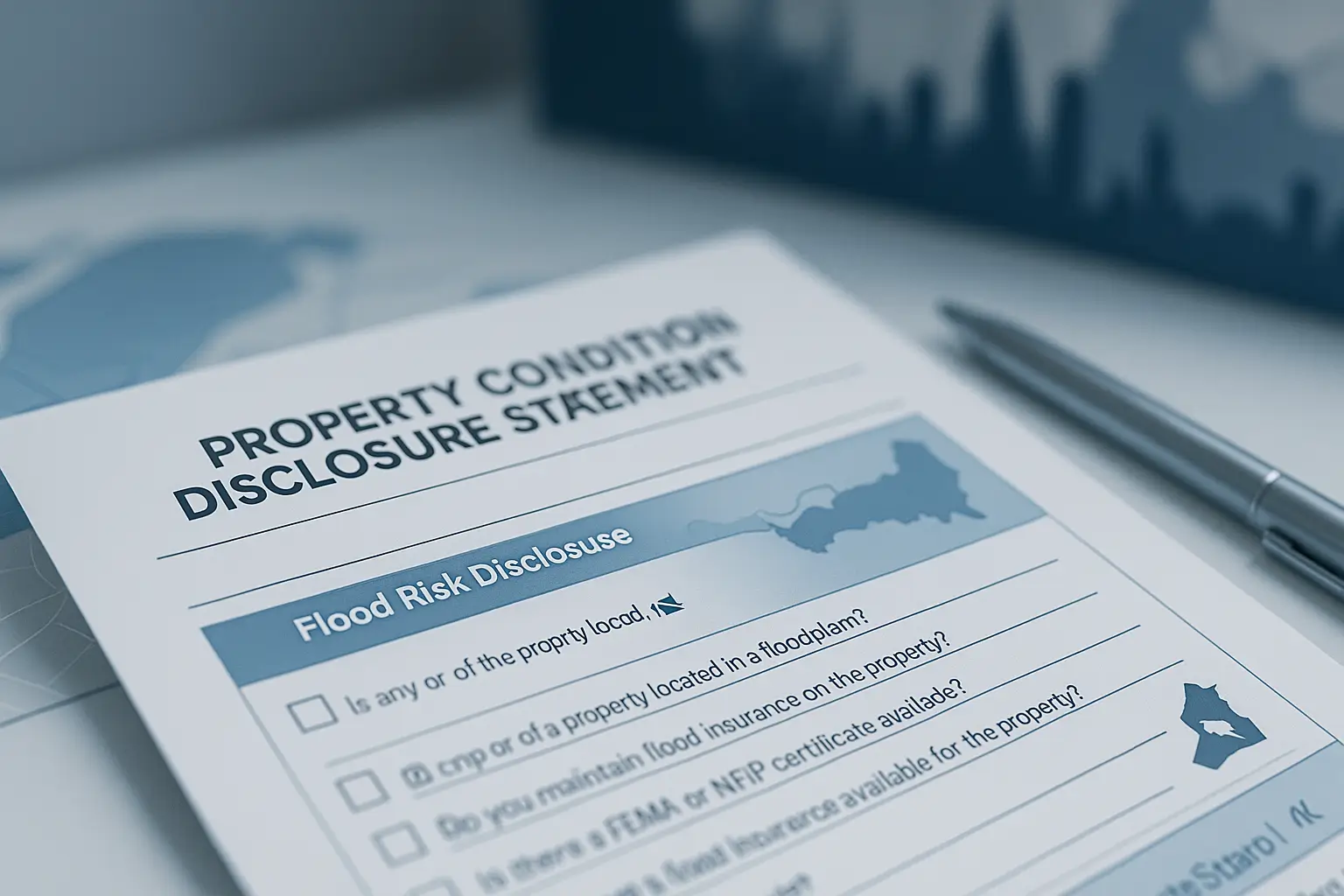
Yes. As of March 20, 2024, most sellers of one-to-four family residential properties in New York must give buyers a completed Property Condition Disclosure Statement (PCDS) before the buyer signs a binding purchase contract. The amended Property Condition Disclosure Act (A1967/S5400) eliminates the old $500 “opt-out” credit and adds seven detailed flood-risk questions about flood zones, insurance, prior flood damage, and federal disaster assistance.
What Is New York’s Flood Disclosure Law?
New York’s flood disclosure law requires residential property sellers to answer specific flood-related questions on the Property Condition Disclosure Statement (PCDS) before buyers sign a purchase contract. The law, formally designated as A1967/S5400, took effect March 20, 2024.
The New York flood disclosure law marks a dramatic shift from the previous system that allowed sellers to avoid completing the PCDS by offering buyers a $500 credit at closing. According to the Natural Resources Defense Council, eight out of ten New York sellers used this loophole to bypass disclosure requirements entirely. That option no longer exists.
Who Must Comply With New York’s Flood Disclosure Law?
The disclosure requirements apply to most sales of one-to-four family homes (including many mixed-use properties with a one-to-four family residential component), investment properties, and vacation homes.
Important statutory exemptions:
Under Real Property Law §461, “residential real property” does not include:
- Condominium units
- Cooperative apartments
- Property in homeowners’ associations not owned in fee simple by the seller
- Certain court-ordered transfers (divorce, bankruptcy, eminent domain, tax sale, sheriff’s sale)
- Transfers by fiduciaries (executors, administrators, trustees) in the course of administering an estate, guardianship, or trust
- New construction that has never been occupied
Critical note for co-op and condo sellers: While the Property Condition Disclosure Act technically doesn’t apply to condominiums and cooperatives, sellers can still face fraud or misrepresentation claims if they hide known flood issues. Many co-op and condo sellers voluntarily provide flood information to avoid potential liability under common-law fraud doctrines.
Important for all covered properties: Even properties sold “as-is” must include completed flood disclosures where the PCDS applies. The New York flood disclosure law creates a statutory obligation that cannot be waived through contract language or property condition clauses.
How the Law Changed: No More $500 Loophole
Before March 20, 2024, New York sellers could avoid the entire Property Condition Disclosure Statement by offering buyers a $500 credit at closing. The New York State Bar Association reported that many seller attorneys recommended this option to avoid potential legal exposure from vague disclosure questions.
Old Law vs. New Law: What Changed
| Feature | Before March 20, 2024 | After March 20, 2024 |
|---|---|---|
| PCDS requirement | Seller could avoid it | PCDS required in most 1-4 family sales |
| $500 credit option | Allowed in lieu of PCDS | Eliminated completely |
| Flood questions | Limited | 7 detailed flood-risk questions |
| Seller risk | More predictable ($500 + fraud) | Open-ended liability & traditional remedies |
The 2024 amendments eliminated the credit option entirely and added seven specific flood-related questions to the PCDS. Governor Kathy Hochul signed the legislation on September 22, 2023, with bipartisan support from sponsors Senator Brad Hoylman-Sigal and Assemblymember Robert Carroll.
According to the Waterfront Alliance, New York joined at least 29 other states with mandatory flood disclosure laws. The change was driven by climate impacts (the Northeast experiences sea-level rise at three times the global average), hurricane devastation (Sandy caused over $19 billion in damages; Ida killed 13 New York City residents), and consumer protection gaps. Research from Milliman examining approximately 28,826 homes sold in 2021 estimated that roughly 6.6% had experienced previous flooding, with New York accounting for approximately $23 million in annual flood costs buyers often discovered only after closing.
The Seven Required Flood Disclosure Questions
The New York flood disclosure law added seven mandatory questions to the Property Condition Disclosure Statement:
1. Is any portion of the property in a FEMA-designated floodplain? Check the FEMA Flood Map Service Center using the exact address. Properties in zones beginning with “A” or “V” are in floodplains.
2. Is the property in a Special Flood Hazard Area (100-year floodplain) or moderate-risk area (500-year floodplain)? Special Flood Hazard Areas (zones AE, AO, AH) face a 1% annual flood chance—a 26% chance over a 30-year mortgage. Moderate-risk zones account for approximately one-third of flood insurance claims according to FEMA.
3. Has flood insurance been required by a lender? This indicates high flood risk, as federally regulated lenders must require flood insurance for Special Flood Hazard Areas.
4. Has the seller received FEMA, SBA, or federal disaster assistance for flood damage? Federal assistance leaves a verifiable paper trail buyers can independently check.
5. Does the seller know of any flood insurance claims filed for the property? Captures claims that didn’t trigger federal assistance but indicate flood vulnerability.
6. Is there a FEMA elevation certificate? Certificates document structure height relative to Base Flood Elevation and significantly impact insurance premiums.
7. Has the property experienced water penetration from seepage, ponding, or natural flood events? This broad question captures flooding from spring snowmelt, heavy rain, groundwater, and poor drainage—not just major hurricanes.
Understanding “Actual Knowledge”
The New York flood disclosure law requires sellers to disclose what they have “actual knowledge” of—not what they should have discovered through investigation. However, courts typically find actual knowledge when sellers personally witnessed flooding, made insurance claims, received correspondence from FEMA or insurers, commissioned flood-related repairs, or discussed flooding with neighbors.
Sellers cannot willfully ignore obvious flood indicators and claim ignorance. The law doesn’t specify a time limit—sellers must report flood events they know about regardless of when they occurred.
For buyers: “Actual knowledge” means you’ll often need to prove the seller knew about the issue—through claims, invoices, emails, city complaints, or neighbor testimony—not just that they should have known. Collecting that evidence trail early is critical if you may need to litigate later.
What Should New York Homebuyers Do After Receiving Flood Disclosures?
Receiving a PCDS showing flood risk requires enhanced due diligence:
Step 1: Verify the Flood Zone Independently
Visit the FEMA Flood Map Service Center to confirm the current flood zone designation and map date (many New York maps date to the 1980s). Check First Street Foundation’s Flood Factor tool on Zillow or Realtor.com for climate-adjusted risk ratings through 2050.
Step 2: Order an Elevation Certificate
If the property lacks one and sits in a flood zone, commission one immediately. Licensed surveyors charge $500 to $800. Properties elevated above Base Flood Elevation qualify for substantially lower insurance rates.
Step 3: Obtain Binding Flood Insurance Quotes
Contact both National Flood Insurance Program providers and private insurers. According to FEMA, New York flood insurance averages $1,134 annually, but high-risk zones can command $2,000 to $3,200 per year. In some coastal areas of southern Queens and Staten Island, buyers report premiums reaching $3,600 annually with $10,000 deductibles.
Step 4: Request a CLUE Report
The Comprehensive Loss Underwriting Exchange report (available through LexisNexis for approximately $40) reveals all insurance claims filed in the past seven years. Discrepancies between PCDS answers and CLUE data indicate potential misrepresentation.
Step 5: Investigate Neighborhood Flood History
Walk the neighborhood during or after rain. Look for water stains, sump pumps, elevated first floors, and recent flood mitigation work. Talk to neighbors about Hurricane Sandy, Hurricane Ida, and the September 2023 storm.
Step 6: Check NYC’s Climate Resiliency Maps
New York City’s FloodHelpNY provides flood risk maps accounting for sea-level rise and storm surge through 2050—information FEMA maps ignore.
Step 7: Calculate Total Flood Costs and Negotiate Price
Compute the 10-year cost including annual premiums, likely increases (Risk Rating 2.0 can increase premiums substantially over time), deductibles, and potential mitigation investments. A $3,000 annual premium growing over time can cost $40,000+ over 10 years. In some coastal New York markets, buyers negotiate price reductions of 10% to 15% for similar homes in high-risk flood zones once long-term insurance costs are factored in.
What Happens If a New York Seller Lies or Omits Flood Damage?
The New York flood disclosure law creates potential liability for sellers who provide inaccurate or incomplete disclosures.
New York’s Statutory Liability Standard:
Under Real Property Law §465, a seller who willfully fails to meet PCDA obligations (including failing to update a materially inaccurate PCDS) can be liable for the buyer’s actual damages, plus any other equitable or statutory remedies. The law does not limit traditional claims like fraud, active concealment, or “superior knowledge” doctrines—it stacks on top of them.
When Sellers Face Lawsuit Risk
Intentional misrepresentation: Sellers who knowingly provide false answers face potential fraud claims. Buyers can seek rescission, compensatory damages, and potentially punitive damages.
Negligent misrepresentation: Sellers who carelessly complete disclosures without checking records may face negligent misrepresentation claims.
Material omissions: Leaving flood questions blank or answering “unknown” without legitimate reason creates legal exposure.
Red-Flag Behaviors That Almost Guarantee Litigation
Courts are particularly skeptical when sellers:
- Owned the property during Hurricane Sandy, Hurricane Ida, or major local floods but claim no knowledge of water issues
- Answer “unknown” despite accessible insurance records or FEMA correspondence
- Made flood-related repairs but fail to disclose the underlying water damage
- Received neighbor complaints or city violations about drainage but claim ignorance
The “Unknown” Answer
Sellers can answer “unknown,” but legitimacy depends on circumstances. It’s legitimate when sellers inherited the property and never lived there, purchased recently, or genuinely lack information despite reasonable efforts. It’s risky when sellers owned the property during major floods, neighbors confirm repeated flooding, physical evidence contradicts “unknown,” or sellers never checked accessible records.
Best Practices for Sellers
Gather documentation before completing the PCDS: request CLUE reports, review insurance declarations, check FEMA’s database, search email for flood communications, and pull current FEMA maps. Answer conservatively—if uncertain whether something constitutes flood damage, disclose it. Keep records documenting your disclosure process.
Critical: Update your PCDS if circumstances change. If you discover new flood-related information after signing the PCDS (for example, a new basement seepage event or updated FEMA zone designation), New York law requires you to deliver a revised PCDS “as soon as practicable” before closing. Failing to update can be treated similarly to giving false information in the first place.
Never rely on “as-is” clauses to avoid disclosure—the New York flood disclosure law creates a statutory duty that survives property condition clauses. Consider legal review if your property has complicated flood history.
Does New York’s Flood Disclosure Law Apply to Condos, Co-ops, and Estate Sales?
Co-ops and Condos: Exempt from PCDA, Not from Fraud Claims
Cooperative apartments and condominium units are statutorily exempt from the Property Condition Disclosure Act under Real Property Law §461. However, sellers can still face fraud claims if they actively conceal known flood issues. Smart sellers voluntarily provide flood information including building flood zone status, unit-specific flooding incidents, and special assessments for flood repairs.
What buyers should investigate: Request the building’s master flood insurance policy, review coverage limits and deductibles, and check board minutes discussing flooding. Ground-floor condo units typically pay substantially higher premiums than upper floors.
Estate Sales: Statutory Exemption with Practical Limitations
Transfers by fiduciaries (executors, administrators, trustees) are exempt from the PCDA under Real Property Law §463. However, executors can still face fraud claims if they actively conceal known flood issues. Prudent executors search the deceased’s papers, interview family members, and check public records despite the exemption.
Independent Flood Risk Verification Tools
FEMA Flood Map Service Center: Provides authoritative flood zone designations determining insurance requirements. Enter your complete address to view Flood Insurance Rate Maps and note the zone designation (AE = high risk, X shaded = moderate, X unshaded = low). Many New York maps date to the 1980s and don’t reflect current conditions.
First Street Foundation’s Flood Factor: Free climate-adjusted risk scores (1-10) through 2050 available on FloodFactor.com, Zillow, and Realtor.com. Research suggests access to enhanced flood data can increase insurance adoption by 15%+, indicating buyers find this valuable for decision-making.
NYC FloodHelpNY: City resource for five boroughs providing current flood maps, 2050 climate projections, insurance information, and mitigation guidance.
CLUE Reports: Show seven-year insurance claim history including dates, amounts, and causes. Essential for verifying seller disclosures. Order through LexisNexis for approximately $40.
Frequently Asked Questions
Does New York’s flood disclosure law apply to commercial properties?
No, the PCDA applies only to residential real property. Commercial transactions don’t require PCDS completion.
Can I negotiate price based on flood disclosures?
Yes. Properties in Special Flood Hazard Areas often sell for 10-15% less than comparable non-flood zone properties. Calculate 10-year insurance costs to support reduction requests.
What happens if I discover undisclosed flooding after closing?
Gather evidence showing the seller had actual knowledge—insurance claims, FEMA records, repair invoices, or neighbor statements. Consult a real estate attorney about potential fraud, negligent misrepresentation, or breach of contract claims.
Does buying “as-is” eliminate flood disclosure requirements?
No. Where the PCDS applies, sellers must complete it accurately regardless of “as-is” language. You accept the property’s physical condition, not concealed defects.
How does the law affect landlords?
Section 231-B (effective June 2023) requires landlords to disclose flood risk to tenants in residential leases, including whether the property sits in a flood zone and whether flood insurance exists.
What if FEMA maps change between contract and closing?
Review your financing contingency. If new designations make the property uninsurable at budgeted costs, you may have termination grounds. Consider adding specific flood insurance contingencies capping premium costs.
Do I need flood insurance if paying cash?
Legally no, but cash buyers who skip insurance self-insure all damage. FEMA reports one inch of water can cause $25,000 in damage. Most advisors recommend coverage even for cash purchases in flood-prone areas.
What is a Letter of Map Amendment (LOMA)?
A LOMA officially removes a property from a FEMA flood zone if a survey proves it sits above Base Flood Elevation. Successful applications eliminate mandatory insurance requirements and save thousands annually.
Does the law require sellers to fix flood problems?
No. The law requires disclosure, not remediation. Buyers can negotiate repairs or price reductions, but sellers can refuse.
What if a seller marks “unknown” for all questions?
Determine whether “unknown” is legitimate given ownership length and property history. If the seller owned during major flood events but claims ignorance, conduct enhanced due diligence: obtain CLUE reports, interview neighbors, and inspect for physical water damage evidence.
Should You Buy in a New York Flood Zone?
Consider buying if:
- You can afford substantial annual premium increases over the next decade
- The property is elevated above Base Flood Elevation with current certification
- You have substantial cash reserves for self-insurance or high deductibles
- The discount exceeds 15% compared to non-flood zone comparables
- You plan long-term ownership (20+ years)
Walk away if:
- The seller provides incomplete or vague flood disclosures
- The property sits below Base Flood Elevation without elevation plans
- Annual flood insurance exceeds 2% of purchase price
- The neighborhood lacks climate resiliency infrastructure
- You’re using a low down payment loan with minimal equity cushion
Summary: What This Means for You
New York’s flood disclosure law represents a fundamental shift toward transparency. The $500 opt-out elimination forces sellers to confront flood risk while buyers gain previously hidden information.
For buyers: Treat disclosures as your starting point. Verify independently using FEMA maps, elevation certificates, CLUE reports, and climate tools. Build flood costs into your offer and maintain contingencies.
For sellers: Complete the PCDS carefully after gathering documentation. When uncertain, disclose. Remember that “as-is” clauses don’t eliminate statutory obligations, and update your PCDS if circumstances change before closing.
For agents: Educate clients about requirements and implications. Help sellers gather documentation and guide buyers through verification.
The new disclosure laws provide information but not protection. In New York’s flood zones, the burden of risk assessment falls entirely on buyers. Use mandatory disclosures as a compass, but verify every detail independently—or prepare for financial exposure exceeding your down payment and closing costs combined.
Disclaimer: This guide is for educational purposes only and does not constitute legal advice or create an attorney-client relationship. Always consult a licensed New York real estate attorney about your specific transaction and circumstances.
Take Action: Start by obtaining current flood zone information from FEMA’s Flood Map Service Center. Sellers should request CLUE reports to review disclosure obligations. Buyers should never sign a purchase contract without confirming flood risk independently and obtaining binding insurance quotes. The New York flood disclosure law gives you rights—exercise them.